
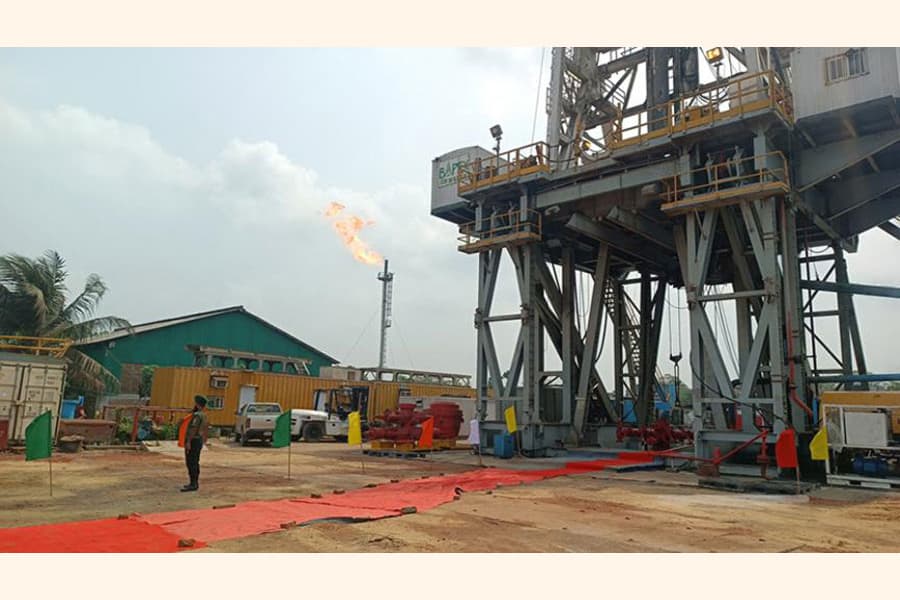
As the country is facing an acute crisis of natural gas that fires mainly power plants, industries and residential plus commercial gas ovens, the state minister for power, energy and mineral resources, Anindya Islam Amit, recently said that the government hoped to meet a significant portion of the country's gas demand from domestic sources. He expressed such optimism while speaking at an event marking gas supply to the national grid from a newly drilled well at the Srikail gas field at Muradnagar upazila in Cumilla. The gas discovered in Bangladesh Petroleum Exploration and Production Company Limited (BAPEX)'s Srikail-5 appraisal and development well is expected to add 8.0 to 10 million cubic feet per day (mmcfd) of gas to the national grid for the next 10 years.
Considering the country's demand for natural gas at around 3,800 mmcfd, the total domestic production of about 1,740 mmcfd so far meets less than 50 per cent of the demand. Even after importing LNG, the total national supply of natural gas stands at around 2,550 mmcfd. So, there is still a shortfall of over 1,000 mmcfd. Under the circumstances, such reassuring words from the minister could not come at a more critical time. In fact, energy, or for that matter gas, crisis is nothing new in Bangladesh. But at the present moment the entire world is facing a grave energy crisis, thanks to the ongoing Middle East war when Iran is subjected to carpet bombing on its civilian as well as military and energy infrastructures by Israel and the USA. In retaliation, Iran, too, has launched its energy war by effectively closing the Straight of Hormuz between Iran and Oman's Musandam Peninsula choking over 20 per cent of world's fossil energy flow. Though Iran appears positive about the passage of Bangladesh-owned fossil-fuel-carrying vessels through the Strait of Hormuz, there is no reason to be complacent about that.
For the energy facilities of Gulf countries like Qatar and Oman where Bangladesh imports its liquefied natural gas (LNG) from have been battered by Iran's retaliatory attacks. Qatar has reportedly halted its LNG production. As there is still no sign that the war is going to end any time soon, the uncertainty about the supply of LNG and oil from the Gulf nations remains. So, supply crunch on such a scale is highly concerning. As a fallout from the closure of Strait of Homuz, global energy market has turned volatile with the Bent crude, the global benchmark, settling at US$103.14 a barrel on March 13 up by 2.7 per cent on the day and 69.5 per cent since December 31, 2025. Retail gasoline prices in the USA has meanwhile gone up by 30 per cent since the beginning of 2026, according to the digital financial media house, TheStreet, in its March 14 issue.
The bad news is that the danger to the global supply is not remaining limited to the closure of the Strait of Hormuz. The way Iran's and the Gulf nations' energy infrastructures are being attacked and destroyed, the world is going to see a severe shortage of fossil fuels soon. It all reminds one of the global oil shock of 1973 triggered by the oil embargo imposed by the Organization of Petroleum Exporting Countries (OPEC) in protest against the US's support to Israel during the so-called Yom Kippur war between Israel and the Arab countries. But the present situation is worse than that. In 1973, the situation was at least under OPEC's control.
But now, there is no control over the war as the global superpower, the US, which is directly involved in the conflict, appears to be relentless. So, is Iran. Now, it is not simply energy, but the entire world is virtually on the brink. Even so, let us concentrate on our own energy issue. The impact of the global energy crunch on Bangladesh which is basically an energy-starved nation cannot be overstated. For Bangladesh roughly meets 70 per cent of its natural gas demand through imported LNG. Similarly, 90 per cent of its fuel oils need is also met through import. Though so far, discovery of some 29 to 30 gas fields has been reported and some 20 to 22 of those gas fields are producing gas, still 70 per cent of our domestic natural gas comes from only two gas fields--Bibiyana in Habiganj and Titas in Brahmanbaria. So, despite the optimism expressed by the state minister for energy that Bangldesh would be able to achieve significant self-reliance in energy within the next five years, there is still a serious need to check hard facts on the ground. Energy is not just one of the so many issues that are talked about. It should now be the central issue. Because, after food, energy is the second most critical issue in life. That is true of any nation, let alone Bangladesh. But the country is still overwhelmingly dependent on imported fossil enegy. Lacking any long-term energy policy, the past governments left the country to a reactive, adhocist approach to the all-important subject of energy.
But with few exportable natural resources or manufactured goods except readymade garments (RMG), the country's potential for earning hard currency is very limited. But without giving any thought to where the hard currency to buy energy from abroad would come from, the successive governments have only made matters worse by increasing the country's dependence on imported energy. But even if we had a strong industrial base with enough manufactured goods to export with substantial foreign currency reserves that would still not guarantee any security on energy. Consider the case of Japan or South Korea whose entire energy source is practically dependent on import. Small wonder that despite their industrial might, they are highly vulnerable to the fluctuations in the global energy market as well as geopolitical instability. In that case, the level of energy insecurity the country is in does not need further explaining. Now, with only two gas fields meeting the lion's share of the nation's demand for natural gas, the addition of the newly discovered gas field of Srikail in Cumilla is no doubt a positive development. But efforts should be on to discover more gas fields to generate substantial amount of natural gas to make the country energy-secure.
sfalim.ds@gmail.com