


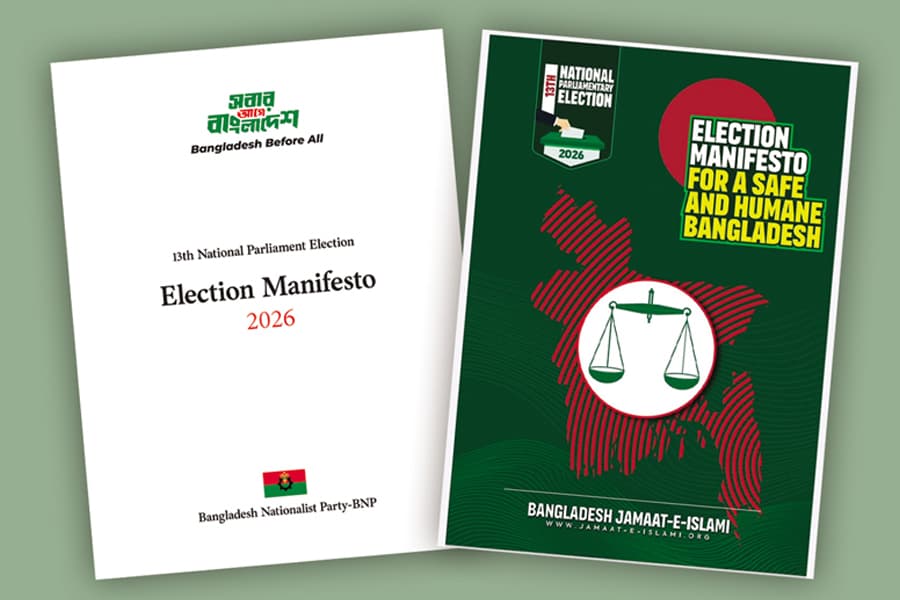
As Bangladesh heads toward the February 12 parliamentary elections, foreign policy has emerged -- at least on paper -- as an important area to focus on by the two main power contenders, the Bangladesh Nationalist Party (BNP) and Jamaat-e-Islami. Both parties have devoted space in their election manifestos to outlining how they once in power would maintain relations with other countries. Yet a closer reading of these documents would reveal what has been skipped, deliberately or otherwise, may be as significant as what is articulated.
At a time of sharpening global rivalries, shifting alliances, and intense regional pressures, both BNP and Jamaat appear careful -- perhaps overly so -- to avoid taking positions that could perturb key global or regional players. The result is a set of foreign policy pledges that are broad, cautious, and in several areas conspicuously vague.
The most striking similarity between the two manifestos is their shared reluctance to adopt any foreign policy stance that might antagonize major powers. Neither party explicitly addresses contentious global fault lines or takes positions that would clearly place Bangladesh within -- or outside -- competing geopolitical camps. This strategic ambiguity may be politically expedient, but it also raises questions about how either party would navigate a world increasingly defined by polarization rather than neutrality.
In this sense, both BNP and Jamaat project a foreign policy of reassurance: reassurance to global powers that if voted to power, they will not rock the boat, and reassurance to domestic audiences that sovereignty and national interest will remain intact. However, reassurance without clarity can easily turn into inertia.
Compared to Jamaat-e-Islami, BNP offers a far more detailed and structured foreign policy vision. Anchored in the slogan "Bangladesh Before All," BNP frames its external engagement around sovereignty, equality, and national interest. The manifesto spans bilateral and multilateral relations, economic diplomacy, regional security, transboundary water sharing, border security, labor migration, soft power, and institutional reform within the Ministry of Foreign Affairs.
One area where BNP clearly differentiates itself is border security. Its explicit commitment to preventing border killings, push-ins, smuggling, human trafficking, and drug trafficking directly addresses a long-standing and emotionally charged issue, particularly in relations with neighboring India. By naming border killings as unacceptable, BNP signals sensitivity to public grievances and a willingness -- at least rhetorically -- to confront a difficult bilateral problem.
Jamaat-e-Islami, by contrast, is silent on border killings. While it speaks of peaceful and cooperative relations with neighboring states, the absence of any reference to border violence is notable. Given how frequently border incidents enter public discourse in Bangladesh, this omission suggests either a deliberate avoidance of sensitive bilateral irritants or a prioritization of broader diplomatic harmony over specific security concerns.
Another key contrast lies in emphasis. BNP's manifesto places strong stress on economic diplomacy -- trade diversification, preferential trade agreements, foreign direct investment, technology transfer, labor migration, and strategic partnerships. It links foreign policy directly to economic transformation, industrial value addition, and integration into global and regional markets, including Africa, South America, and the Bay of Bengal region.
Jamaat-e-Islami, on the other hand, foregrounds the goal of enhancing the global standing of Bangladesh and improving the credibility and mobility of the Bangladeshi passport. While passport strength is indeed an important issue --closely tied to migration, labor rights, and international perception -- it is more an outcome of effective foreign policy than a strategy in itself. Jamaat's focus appears symbolic and reputational, whereas BNP's is more transactional and policy-driven.
This difference reflects two distinct ways of thinking about foreign policy: BNP treats it as an economic and strategic tool, while Jamaat frames it more as a means of restoring dignity and status in the international system.
Jamaat's manifesto explicitly mentions strengthening ties with developed countries such as the United States, the United Kingdom, the European Union, Japan, and Canada. Yet China -- Bangladesh's largest trading partner and a major source of infrastructure financing -- is conspicuously absent.
This omission is difficult to ignore. Whether intentional or accidental, it reflects a careful calibration aimed at avoiding discomfort among Western partners, even at the cost of underplaying a central pillar of Bangladesh's current foreign economic relations. BNP, by contrast, avoids naming specific global powers altogether, opting instead for generalized references to "important global powers" and "international trade partner countries." This allows BNP to keep its options open and maintain balance between competing blocs.
In both cases, the underlying message is clear: neither party wants to be seen as leaning too strongly toward any single power center.
On the Rohingya crisis, both parties strike familiar notes. BNP emphasizes its historical role in resolving the crisis in 1978 and 1992 and promises strong diplomatic initiatives to ensure safe, voluntary, dignified, and sustainable repatriation with full citizenship rights. Jamaat similarly commits to working with the international community for peaceful and sustainable repatriation.
Yet beyond rhetoric, neither manifesto offers new strategies, timelines, or leverage points. There is little discussion of accountability mechanisms, pressure on Myanmar, engagement with ASEAN beyond generalities, or contingency planning if repatriation remains stalled. The language is safe, recycled, and largely indistinguishable from past policy statements -- suggesting caution rather than innovation.
Perhaps the most glaring omission in both manifestos is the absence of any reference to Palestine or the ongoing devastation in Gaza. Given Bangladesh's historical solidarity with the Palestinian cause and the strong public sentiment surrounding the issue, this silence is striking.
It may reflect an attempt to avoid offending powerful global actors or complicating relations with Western partners. But it also underscores how electoral foreign policy platforms are being shaped less by moral positioning and more by strategic restraint. On one of the most defining humanitarian and political crises of the time, both parties choose quiet over conviction.
Taken together, BNP's foreign policy vision is broader, more detailed, and more operational than Jamaat-e-Islami's. Jamaat's objectives, while not insignificant, remain high-level and aspirational, with limited articulation of how goals will be achieved. BNP, meanwhile, presents foreign policy as an integrated extension of economic growth, regional security, and institutional capacity-building.
Yet for all its detail, BNP's manifesto too avoids hard choices. Jamaat's brevity and selectivity do the same in a different way. Ultimately, both documents reflect a shared political calculation: in a fragile global environment, saying less may seem safer than saying more.
The question for voters, however, is whether a foreign policy defined by caution and ambiguity is sufficient for a country navigating one of the most complex international moments in its history.
mirmostafiz@yahoo.com