

Bangladesh's economic journey started as a "basket case" soon after independence to an emerging economy in recent times is a story that has captured both international attention and admiration. The "basket case" tag, coined by international observers in the 1970s in reference to Bangladesh's economic prospects, has become a relic of the past. However, as Bangladesh celebrates its success story in economic development and growth, a more pertinent question emerges whether Bangladesh's economic development and growth will continue in a positive trajectory in spite of some challenges that have the potential for reversing the ongoing trend.
Bangladesh's economic success story is a triumph of pragmatism and a demonstration of the power and resilience of the Bangladeshi people. Over the last three decades or so, Bangladesh has recorded high GDP growth rates, surpassing those of other countries in the region. This success story has not come by accident but is the result of a combination of entrepreneurship and a development paradigm that has placed people, especially women, at the centre of economic development. At the centre of this success story is a powerful economic engine called the Ready-Made Garments (RMG) sector.
THE RMG REVOLUTION: Few industries have ever impacted a nation's future as much as the RMG industry has for Bangladesh. What started as a fledgling industry in the late 1970s is today the backbone of Bangladesh's economy, accounting for over 80 percent of its export earnings and employing millions of people, most of them women. It is not simply an economic success story but a social revolution in itself. The RMG industry in Bangladesh has enabled unprecedented levels of women's workforce participation.
Today, Bangladesh is the second-largest apparel exporter in the world, supplying global brands and competing with the world's largest economies. What makes Bangladesh's RMG industry tick is a unique combination of low labour costs, an enormous workforce, and an ever-evolving ecosystem. Nevertheless, this also makes Bangladesh vulnerable to threats such as increased automation of the sector, evolving global supply chains, and the need to ensure labor and environmental standards. Bangladesh must evolve to become competitive in this industry by going beyond the value chain.
REMITTANCES AND RESILIENCE: Another important factor in Bangladesh's economic growth is remittances sent home by millions of Bangladeshis working in the Middle East, Southeast Asia, Europe, and other parts of the world. These remittances have been a boon for Bangladesh's economy. In times of global uncertainty, such as during financial crises or pandemics, remittances have proven their power, helping Bangladesh's economy grow.
Still, this dependence also poses strategic issues. The global labour market is dynamic, driven by technological advancements and the implementation of nationalization policies in host countries. Bangladesh, therefore, has to invest in the skills development and labour diplomacy of its migrant workers to sustain this critical source of remittance.
INFRASTRUCTURES & AMBITIONS OF MODERNISATION: Similarly, the process of economic development in Bangladesh can be observed in the country's physical infrastructure. The mega infrastructure development initiatives that have been undertaken in Bangladesh, such as the construction of the Padma Bridge, introduction of the metro rail and expressways and the development of ports, are a reflection of the commitment that Bangladesh has towards meeting the challenges.
These infrastructural projects have already shown positive results in facilitating inter-regional connectivity and lowering transportation costs in Bangladesh. These projects reflect a nation's ambition to rise from a low-income to a middle-income, and then a developed nation.
However, it is important to note that alongside economic development and infrastructural development, institutional issues must also be addressed. The issues of efficiency in infrastructural projects, transparency in financial management, and debt sustainability need to be addressed.
EDUCATION & THE NEXT LEAP: No economic development process is sustainable without a corresponding development of education. Bangladesh's economic development over the past few decades has been complemented by significant improvements in literacy rates, primary education enrolment, and gender parity in education. These positive changes in the education sector have greatly contributed to the development of human resources, creating a platform for the growth of other sectors, including the RMG and employment opportunities in other countries. However, as Bangladesh progresses from a least developed to a developing nation, it is becoming increasingly clear that its education system is not yet equipped to meet the demands and challenges.
However, there is a significant gap between the skills imparted in classrooms and those required by industry. There are complaints about the lack of critical thinking, effective communication, technology, and problem-solving skills among graduates. This may lead to a paradoxical situation in which the economy grows but skilled human resources are in short supply. The higher education sector is at a crossroads. There is an urgent need for universities to transform themselves from traditional teaching and learning approaches towards more outcome-based approaches. There is an urgent need for universities to adopt digital learning technologies and artificial intelligence. In this context, the technical and vocational education sector needs an upgrade in status and quality.
INEQUALITY, INFLATION, AND SUSTAINABILITY: Despite its remarkable success story, Bangladesh is facing a new series of challenges. These are less visible than the challenges of the past but are no less important. Income inequality is increasing. While growth in urban centres and industrial sectors has been phenomenal, many rural people have remained vulnerable. There is concern about social cohesion, as not everyone has benefited equally.
With inflation driven by global energy prices, supply chain issues, and market inefficiencies, people's purchasing power is being squeezed, especially for lower-income households. For a country where a significant portion of its citizens live near the poverty line, inflation is not just an economic problem, but a human one.
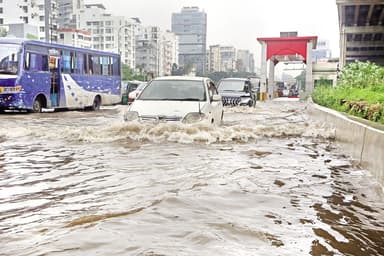
Sustainability is perhaps the most complex issue, especially because Bangladesh is one of the most vulnerable countries to climate change, with sea levels rising, flooding, and environmental degradation. At the same time, Bangladesh is one of the world's leading industrializing economies, especially in textiles, which puts pressure on natural resources and environmental sustainability. What is needed is a fine balance between sustaining growth, protecting the environment, and ensuring social justice.
BEYOND GROWTH TO TRANSFORMATION: Bangladesh's transformation from a 'basket case' to an emerging economy is arguably one of the most compelling economic stories of our time. It is a testament to human determination, innovative policies, and collective resolve.
However, with success comes new challenges. What Bangladesh's development story needs next is a move beyond the pursuit of growth in itself towards inclusive growth, institutional development, and sustainable development.
In a nutshell, Bangladesh needs to rethink the very definition of success -- not just as a rapidly growing economy, but as a just, robust, and future-ready society.
Bangladesh's story in the annals of history will be written not by the name it was once known but by the choices it made after that.
Bangladesh's development from a state of hopelessness to a state of dynamism is now complete.
What is still open-ended is the extent of the challenges and the complexities of its own success pose. Bangladesh's story is now watched -- not with the same level of suspicion as before, but with hope. Bangladesh's success in achieving development is now a proven fact.
What remains to be seen is the sustainability of this success.
Dr Serajul I Bhuiyan is a professor and former chair of the department of Journalism and Mass Communications at Savanah State University, Savannah, Georgia, USA. sibhuiyan@yahoo.com