
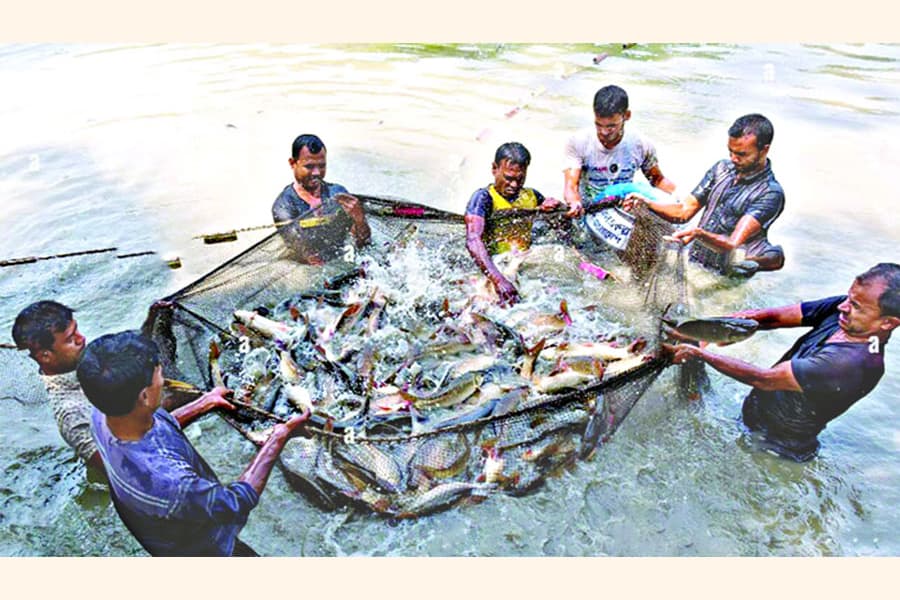
That the country's fish farming has grown substantially over the years-earning it the third position in global ranking-is more than just a comforting statistic. It represents a remarkable transformation in rural livelihoods and food security. The multiplier impact of fish farming on the economy, particularly in terms of employment and income generation among the rural population, makes it a compelling case for poverty alleviation and inclusive growth. According to a recent report of the Food and Agriculture Organisation (FAO), Bangladesh now ranks next only to China and India in farm fish production.
Over the past two decades, fish production in Bangladesh has increased steadily, driven mainly by the rapid expansion of aquaculture. Pond-based fish farming has emerged as the dominant mode of production, accounting for a large share of the country's total fish output. Since the early 1990s, commercial pond fisheries have evolved from small-scale, traditional practices into a dynamic and profitable subsector. This transformation has been fuelled by the introduction of high-yielding fish varieties, better management practices and greater market orientation. Indeed, the market for farmed fish in Bangladesh has reportedly expanded by nearly 25 times over the last three decades-a stunning growth trajectory that few other agricultural sectors can match.
A study by the Washington-based International Food Policy Research Institute (IFPRI) provides a striking insight into the social and economic impact of this sector. It estimates that of the approximately eight million people who escaped the poverty trap during the past decade, more than two million were directly supported by the growth of aquaculture. In simple terms, the development of fish farming has played a direct and measurable role in improving rural livelihoods. The IFPRI report further observes that the rise of aquaculture in Bangladesh has challenged long-standing assumptions that nutrient-rich foods will remain out of reach for low-income groups. On the contrary, it demonstrates how the supply of affordable, protein-rich fish can increase even for the poor when production and market systems are well integrated.
The story of aquaculture in Bangladesh, therefore, is not merely one of economic expansion but of inclusive nutrition and social transformation. Fish now accounts for more than 60 per cent of the country's animal protein intake, and its availability across rural and urban households reflects the success of a production system that has become both efficient and equitable. Technological progress has played a crucial role in this regard. The use of improved fish breeds, scientific feeding practices, better disease control, and water quality management have substantially boosted productivity. Meanwhile, the expansion of rural road networks and the widespread use of mobile communication have reduced transaction costs and enabled better market access for farmers.
According to IFPRI, these factors-combined with value-chain innovations such as improved cold storage, processing, and marketing-have transformed aquaculture into one of the most vibrant subsectors of Bangladesh's economy. The government did play a vital role in the formative years, particularly through research, extension services and credit facilitation. However, in recent years, it is largely private sector dynamism and entrepreneurial energy that have sustained the sector's momentum. Thousands of small and medium entrepreneurs have invested in feed mills, hatcheries, and distribution networks, creating strong backward and forward linkages across the value chain.
Fish farming in Bangladesh today is no longer a subsistence occupation; it has evolved into a commercial enterprise with significant rural industrial linkages. The proliferation of feed mills and hatcheries has stimulated local investment, technological adaptation, and employment generation. This has led to the creation of a vibrant ecosystem of ancillary industries-from fish feed production to net making, transportation, and cold storage facilities. In many rural areas, these linkages have created new forms of entrepreneurship, helping bridge the rural-urban economic divide.
Observers believe that given the present scale of fish farming and its potential for further expansion, Bangladesh holds excellent prospects for developing a strong export-oriented aquaculture industry. The experience of Vietnam is often cited as an example: by focusing on the cultivation and export of freshwater fish such as pangasius, Vietnam has built a billion-dollar export industry that competes successfully in global markets. Bangladesh, with its favourable agro-climatic conditions and abundant water resources, can aspire to follow a similar path. Farmed freshwater species-especially pangas, tilapia, and carp-can potentially capture a significant share of the global market if supported by quality control, certification and branding initiatives.
For this to happen, the government must play an enabling role. Facilitating export-oriented aquaculture will require not only infrastructural and logistical support but also policy reforms to ensure sustainable practices. Access to affordable finance remains a critical bottleneck. The existing agricultural loan policies, often biased towards crop farming, need to be restructured to recognise aquaculture as a priority sector deserving targeted financial incentives. This includes easier access to credit for small and medium fish farmers, insurance coverage for aquaculture enterprises and mechanisms for risk mitigation against disease outbreaks and climate shocks.
Equally important is the role of non-governmental organisations (NGOs) and development partners. Their involvement in capacity building, training and community-based management can help spread modern fish farming techniques more widely, particularly among smallholders and women farmers. Integrating environmental sustainability into aquaculture practices is another crucial challenge. Overexploitation of water bodies, pollution, and unregulated use of feed and chemicals must be addressed through stronger monitoring and enforcement mechanisms.
The success of Bangladesh's aquaculture sector offers a powerful model of how rural enterprises, when combined with technology, infrastructure and market access, can drive inclusive economic transformation. The challenge now is to sustain this momentum, expand its export footprint and ensure that the benefits of this growth remain broad-based and environmentally sound. With the right blend of policy support, investment facilitation, and innovation, fish farming could very well become one of the defining success stories of Bangladesh's journey towards middle-income prosperity.
wasiahmed.bd@gmail.com