

Published :
Updated :
 For all latest news, follow The Financial Express Google News channel.
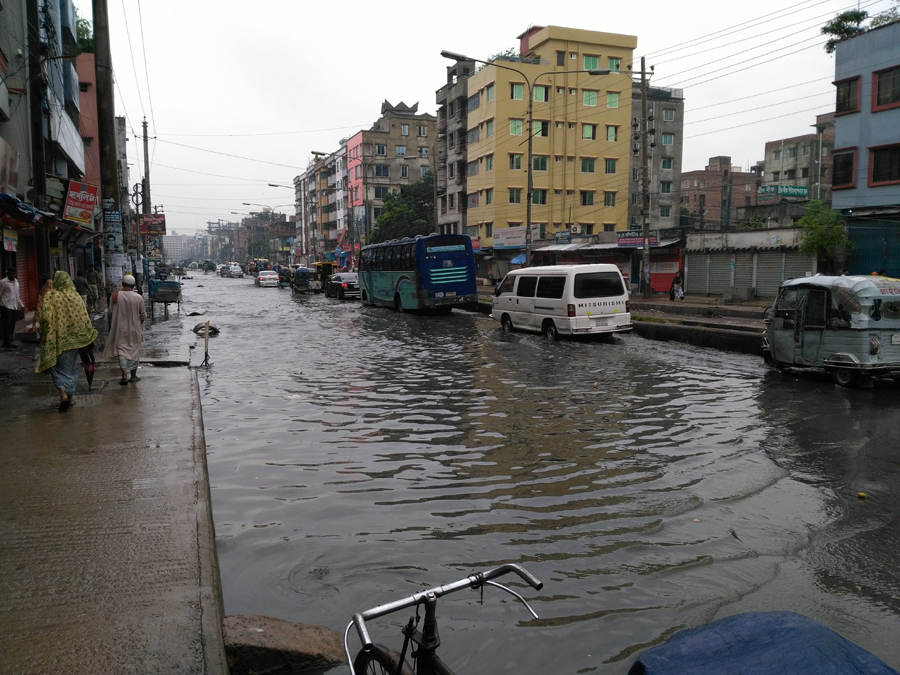
It is the height of summer in Dhaka, so it doesn't rain very often. Even then, the city's residents know from experience that a single shower is all it takes to turn their streets and alleys into stagnant pools. That a city of over fifteen million people should flood from a moderate downpour is no quirk of climate or geography. It's simply what decades of unplanned urbanisation have done to the natural drainage system meant to help the city recover after rain.
What Dhaka has lost goes a long way as an explanation for why it floods the way it does. Historical records show that the city once had more than 65 canals running through it, each connecting its interior to the surrounding rivers. These canals did more than carry away rainwater. They worked together as a system that kept the city's water balance in check. Today, only 43 remain, and many of those are either encroached upon, filled with silt or totally cut off from the rest of the drainage network. According to the Bangladesh Institute of Planners, of the approximately 9,556 acres of water bodies and flood-flow zones in Dhaka, some 3,440 acres have already been lost to filling and construction. As the metropolis expanded outward, it gradually did away with the very features that had once helped it handle rain so well.
The result is a waterlogging crisis that has long since ceased to be seasonal. These days even a normal amount of rain floods areas that used to stay dry. A large part of this comes down to what is blocking the drains which unsurprisingly is the plastic waste. Studies show that roughly 80 per cent of single-use plastics discarded in Dhaka ends up on the street from where it finds its way into the drainage system and reduces its effectiveness. The drains, in other words, clog long before rainwater ever reaches the canals. This also adds behavioural dimension to the problem, one that has to do with how public space is treated. The instinct, naturally, is to reach for civic education as the fix. However, teaching better habits alone cannot resolve a problem that is also a physical one. Without bringing back the drainage infrastructure that was dismantled over the decades, asking people to change their ways simply will not be enough.
The recognition that canals are essential to water management is not a new one. Decades ago, President Ziaur Rahman understood this and launched the first major canal excavation initiative the country had seen. In the late 1970s, he undertook an ambitious programme to excavate and re-excavate thousands of kilometres of canals and rivers across Bangladesh aimed at boosting irrigation and agricultural output. He threw himself into the effort personally, most notably in 1976 when he was photographed wielding a spade at the Ulashi Jadunathpur canal in Jessore, a waterway now renamed the Zia Canal. The initiative relied heavily on voluntary labour, which proved ineffective, and reports of misuse of funds by local partymen further weakened its impact. After his death, the programme gradually lost momentum, leaving behind a mixed legacy of vision and mismanagement. Today, the effort has been revived under his son Prime Minister Tarique Rahman who has returned to that same blueprint with the aim of completing what was started earlier. The current government has the advantage of learning from past shortcomings. At the same time, it carries the burden of proving that this time the outcome will be different and that the excavation effort will not run out of steam the way it did before.
For one thing, the current government's programme is more ambitious in its stated scope. It aims to restore 20,000 kilometres of canals and rivers across the country in just five years. Among those targeted are the canals and rivers that feed into the drainage network surrounding the capital, and their restoration would give Dhaka's blocked urban drains the outlet they so desperately need. The reason this matters comes down to geography. Dhaka sits within a ring of rivers, and Sir Patrick Geddes, who surveyed the city over a century ago, argued that a settlement so surrounded by natural waterways should have no structural difficulty managing rainfall, provided the connections between its interior canals and exterior rivers remain functional. That argument is as valid today as it was then.
Yet the promise of such initiatives has repeatedly run into the same old problems. Billions of taka have been spent in the past decade alone on canal recovery and drainage projects in Dhaka, and still the waterlogging remains. So why has all that money failed to solve the problem? One reason is the way responsibility for the city's water infrastructure is divided. Multiple agencies including WASA, the two city corporations, RAJUK and the Bangladesh Water Development Board hold overlapping jurisdictions without any effective mechanism for coordination. The consequences are predictable. Canals are dredged without being properly linked to drains, and drains are built without ensuring proper connection to canals. Each agency has enough authority to act independently but not enough accountability for the outcome.
For the current programme to succeed, the conditions that caused past failures must be confronted rather than ignored. The most pressing of these is the absence of coordinated institutional authority. A single body with a clear mandate over canal restoration, drainage maintenance and encroachment enforcement would eliminate the blame-shifting that has long served as the bureaucratic excuse for inaction. Then there is the question of sustained follow-through. Canals that are excavated but not maintained will silt up within years as they have before and the money spent on them will have achieved nothing lasting. Encroachment is another piece of the puzzle. GIS mapping and satellite imagery can now establish historical canal boundaries with enough precision to make encroachment very difficult to defend legally, but that clarity must be supported by enforcement that remains consistent even when political pressure mounts. That political will is the one thing no satellite can supply, and it is also the one thing the city has struggled most to find.