


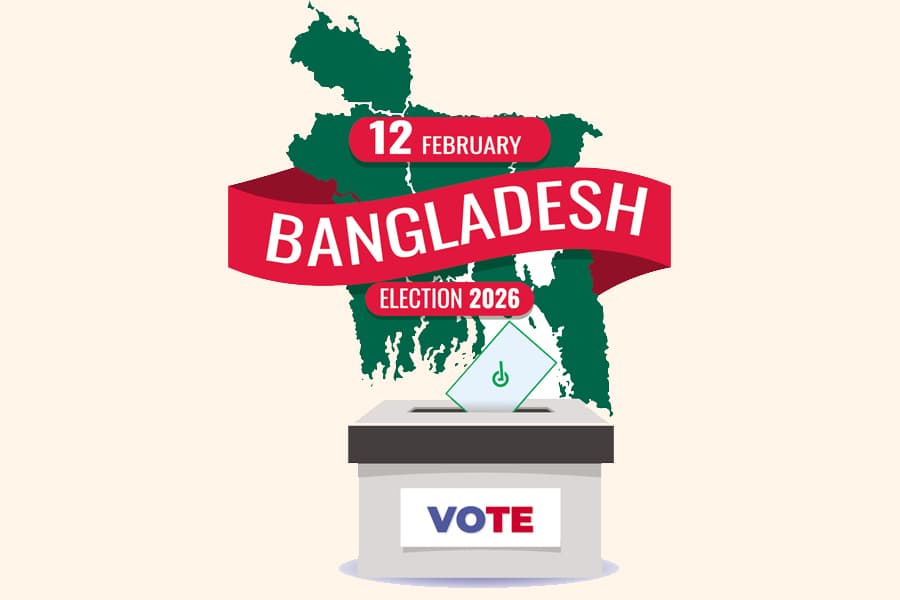
For the first time in nearly two decades, the people of Bangladesh are being offered a genuine opportunity to exercise their right to vote under a non-partisan interim government. The election scheduled for 12 February is more than a routine democratic exercise. It is a moment freighted with history, expectation and fragile hope.
Since Sheikh Hasina returned to power after the January 2009 parliamentary election. Bangladesh witnessed three more national polls -- in 2014, 2018 and 2024. All held under her government were deeply controversial. Opposition boycotts, allegations of voter suppression, irregularities, and pre-determined outcomes hollowed out public faith in the electoral process. To many citizens, elections turned out to be performative rather than participatory, rituals without real choice.
That is why the current transition matters. An interim government led by Nobel laureate Professor Muhammad Yunus has been entrusted with overseeing a pathway back to democratic legitimacy. For millions of voters, this election represents a rare chance to reclaim a basic civic right: to vote freely, without fear, coercion or foregone conclusions. Yet that promise is already under strain.
Since the Election Commission announced the election schedule, more than 200 incidents of violence have been reported across the country. At least five people have been killed in clashes affecting around 50 constituencies. These are not isolated scuffles or unavoidable frictions of political competition. They are warning signs that the culture of electoral intimidation, long normalised in Bangladesh's politics, has not yet been dismantled.
If such violence continues, it will not only endanger lives but also undermine the very purpose of this election. Voting cannot be an act of courage. It must be an act of exercising the right to vote.
Electoral violence in Bangladesh is not new. It has become an ingrained feature of the political landscape, cutting across party lines and election cycles. Activists clash, polling agents are threatened, candidates are attacked, and ordinary voters are caught in the middle. Over time, violence has been treated as inevitable -- an unfortunate but accepted by-product of political mobilisation.
This obviousness is dangerous.
Violence distorts competition, silences marginal voices and skews outcomes long before ballots are cast. It discourages turnout, particularly among women, older voters and first-time participants. It replaces persuasion with intimidation and turns elections into contests of muscle rather than mandate.
In the present context, the stakes are even higher. This election is meant to signal a break from the past. If fear dominates the streets, the credibility of the process will collapse -- domestically and internationally -- regardless of what happens on polling day.
The interim government cannot afford ambiguity. Its legitimacy rests almost entirely on its ability to deliver a peaceful, free and fair election. That requires decisive, visible and impartial action.
Professor Yunus and his advisers must make it unambiguously clear that political violence will not be tolerated, regardless of who instigates it. Statements of concern are not enough. What matters is enforcement.
Law-enforcement agencies must be deployed proactively, not reactively. According to media reports, police have already identified 33 constituencies as particularly vulnerable. This intelligence must be acted upon immediately. Adequate numbers of trained personnel should be mobilised to these areas, with clear instructions to prevent violence before it escalates.
Equally important is accountability. Perpetrators must be identified, arrested and prosecuted swiftly. When violence goes unpunished, it sends a signal that intimidation works. When the law is applied consistently, it restores public confidence and deters repeat offences.
Public apprehension about law and order is one of the greatest threats to turnout. Voters must believe not only that their vote will count, but that they can reach polling stations safely and return home without fear.
The responsibility for a peaceful election does not rest with the government alone. Political parties -- particularly the two dominant parties and their allies -- must confront their own role in poisoning the electoral environment.
In recent weeks, leaders and activists have engaged in a familiar blame game, accusing each other of instigating violence while absolving their own supporters. In some cases, rhetoric has descended into abuse and dehumanisation. Such language does not merely inflame tensions; it legitimises aggression.
Parties that claim to represent the people must act in the public interest. That means instructing supporters to exercise restraint, disciplining those who incite violence, and competing through ideas rather than intimidation.
Leadership matters. When senior figures speak responsibly, it filters down. When they offer tacit approval -- or strategic silence -- violence flourishes.
This election cannot be treated as a zero-sum battle in which victory justifies any means. If democratic rules are broken to win power, the victory itself becomes meaningless.
Bangladesh has a long tradition of festive elections. Older voters remember polling days that felt like communal events -- colourful, noisy, hopeful. Families turned out together. Participation was an expression of pride.
That spirit has been eroded over time, replaced by anxiety and cynicism. Restoring it requires more than procedural correctness. It requires a sense of collective ownership over the process.
A peaceful election is not merely the absence of violence. It is the presence of trust.
Voters must trust that the state will protect them. Candidates must trust that competition will be fair. Journalists must trust that they can report without harassment. And losers must trust that defeat does not mean exclusion or retribution.
These conditions cannot be created overnight, but they can be protected -- or destroyed -- in a matter of weeks.
The world is watching Bangladesh closely. After years of concern over democratic backsliding, this election is seen as a test to determine whether the country can reset its political trajectory.
Foreign governments, investors, development partners and multilateral institutions will judge not only the outcome, but the process. Images of violence, intimidation and chaos will travel far faster than official assurances.
But this election should not be conducted to satisfy external observers. It should be conducted to honour the rights and aspirations of Bangladeshi citizens.
Democracy is not validated by international approval alone. It is validated when people believe that their participation matters.
Moments like this are rare. After 18 years, the opening for democratic renewal is narrow and fragile. It can still close.
If violence is allowed to continue unchecked, disillusionment will deepen. Voters will retreat once again into apathy or anger. The opportunity to rebuild trust will be squandered.
Stopping poll violence is not a secondary concern. It is the central task of this transition.
The interim government must act firmly and fairly. Law-enforcement agencies must be vigilant and accountable. Political parties must restrain their supporters and clean up their rhetoric. Civil society and the media must continue to document abuses and demand transparency.
Above all, the right to vote must be treated as sacred.
On 12 February, Bangladeshis should go to the polls with anticipation, not apprehension. With confidence, not courage. With hope, not fear.
Anything less would betray the promise of this moment -- and the people who have waited nearly two decades for it.
mirmostafiz@yahoo.com