

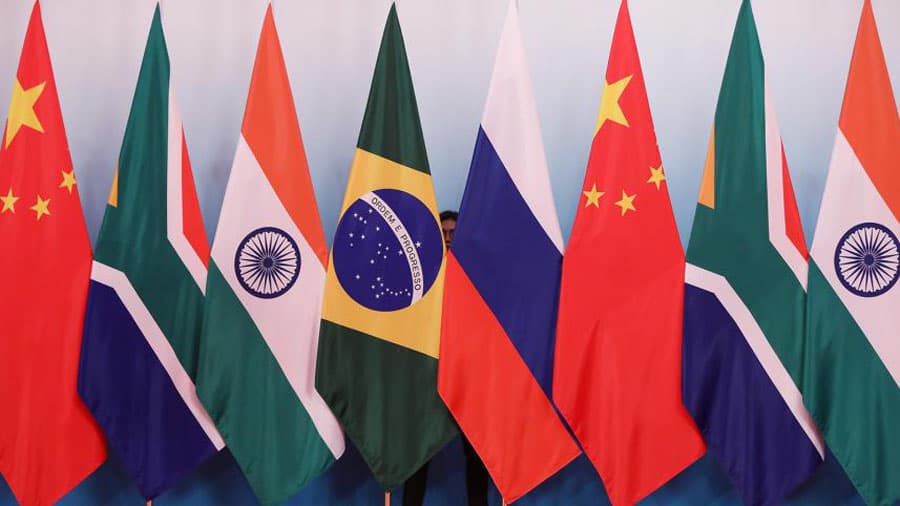
The rise of BRICS (Brazil, Russia, India, China and South Africa) was once portrayed as the beginning of a post-western age. For much of the past two decades, the bloc symbolised the ambitions of emerging powers determined to reshape a global order long dominated by the United States and its allies. Economists predicted its collective rise with excitement. Diplomats from the global south viewed it as an alternative centre of influence. Politicians spoke grandly about a multipolar world.
Today, however, the mood surrounding BRICS is markedly different.
The recent foreign ministers' meeting in New Delhi, which ended without a joint statement because of disagreements over the Iran-Israel conflict, has reinforced perceptions that the bloc is losing coherence and strategic direction. A grouping that once promised to challenge western dominance now appears divided even on issues directly affecting one of its own members.
To understand why BRICS now appears to be losing weight, it is necessary to revisit how the platform emerged -- and why so many once believed it could transform global politics.
The story of BRICS began not in diplomacy but in finance.
In 2001, economist Jim O'Neill of Goldman Sachs coined the term "BRIC" to describe four rapidly growing economies -- Brazil, Russia, India and China. His argument was straightforward: these countries possessed the demographic scale, economic potential and geopolitical importance to reshape the world economy during the 21st century.
The concept soon evolved from an economic label into a political platform.
In 2006, foreign ministers from the four countries held their first meeting on the sidelines of the United Nations General Assembly. By 2009, amid the global financial crisis that badly damaged confidence in western financial institutions, the first formal BRIC summit took place in Yekaterinburg, Russia.
The timing mattered. While the western financial system was shaken by crisis, many emerging economies appeared comparatively resilient. BRIC's message resonated across the developing world: global governance institutions no longer reflected contemporary realities and emerging powers deserved greater influence.
In 2010, South Africa joined the grouping, transforming BRIC into BRICS and giving the bloc representation from Africa as well. The inclusion carried symbolic importance. BRICS increasingly presented itself as a political voice for the global south.
Its ambitions expanded steadily.
The bloc demanded reforms to institutions such as the International Monetary Fund and the World Bank, arguing that voting structures unfairly favoured western powers. It criticised unilateral sanctions and western military interventions. It promoted the idea of a multipolar international order.
Then came perhaps its most concrete institutional achievement: the creation of the New Development Bank in 2014. Headquartered in Shanghai, the bank was designed as an alternative source of development financing for emerging economies.
At the same time, discussions intensified about reducing dependence on the US dollar. Some BRICS leaders floated proposals ranging from local currency trade settlements to a common reserve currency. Countries such as Bangladesh expressed interest in joining or engaging more closely with the bloc, believing BRICS represented the future centre of economic and political gravity.
For a while, the momentum appeared real.
The combined population of BRICS countries accounted for more than 40 per cent of humanity. China became the world's manufacturing hub. India emerged as a major technological power. Russia remained a formidable military actor. Brazil and South Africa projected regional influence.
Many analysts predicted that BRICS would gradually erode American dominance over global finance and diplomacy.
Yet beneath the rhetoric of unity, contradictions always existed.
BRICS was never a military alliance or an ideologically coherent bloc. Its members possessed vastly different political systems, strategic priorities and regional interests. China and India remained geopolitical rivals despite participating in the same platform. Russia's foreign policy increasingly revolved around confrontation with the west, while India simultaneously deepened security cooperation with Washington through the Quad. Brazil's priorities fluctuated with changes in domestic leadership.
These contradictions were manageable as long as BRICS functioned mainly as a platform for expressing dissatisfaction with western dominance. But global crises gradually exposed the limits of the grouping's unity.
The first major rupture came with the Ukraine war.
When Russia invaded Ukraine in 2022, Moscow expected diplomatic solidarity from fellow BRICS members. Instead, responses varied considerably. China offered strategic backing but avoided direct military alignment. India maintained close ties with Russia while strengthening relations with the United States and Europe. Brazil and South Africa attempted neutrality.
The bloc survived, but its internal divisions became increasingly visible.
Now the Iran-Israel conflict has deepened those fractures further.
The latest BRICS foreign ministers' meeting in New Delhi ended without consensus because of disagreements surrounding the Middle East crisis. Iran, one of the bloc's newer members, urged a united condemnation of the United States and Israel. Yet several members resisted adopting language that could damage their own strategic interests.
This was politically significant. A grouping that claims to represent solidarity among emerging powers could not formulate a collective position regarding military actions involving one of its own members.
The absence of Chinese Foreign Minister Wang Yi from the summit further fuelled perceptions of drift. Officially, he remained in Beijing because of the visit of Donald Trump. Symbolically, however, it reinforced the impression that BRICS no longer commands the same strategic urgency it once did.
Expansion may also have complicated the bloc's cohesion.
The admission of countries such as Iran, Egypt, Ethiopia and the United Arab Emirates broadened BRICS geographically and politically. Yet it also imported regional rivalries directly into the organisation. Iran and Gulf states possess sharply different security perspectives. India's priorities differ from China's. Russia's confrontation with the west is not universally shared.
As membership expands, consensus becomes harder.
Unlike the European Union or NATO, BRICS lacks strong institutional mechanisms capable of enforcing collective positions. It has no common security architecture, no binding treaty system and no unified strategic doctrine.
It is ultimately a coalition of convenience.
Yet declaring BRICS irrelevant would also be premature.
The dissatisfaction that fuelled its rise still exists across much of the global south. Many developing countries continue to view western-led institutions as unequal and unrepresentative. The wars in Ukraine and the Middle East have intensified accusations of double standards regarding international law and humanitarian principles.
BRICS still offers emerging powers diplomatic leverage and symbolic autonomy. It still reflects the broader transition from a unipolar to a more fragmented world order.
But the romantic vision of BRICS as a disciplined anti-western alliance now appears detached from reality.
The bloc's core problem is simple: opposing western dominance is easier than constructing a coherent alternative. Shared grievances do not automatically produce shared strategy.
The New Delhi meeting exposed that truth with unusual clarity. National interests prevailed over bloc solidarity. Strategic calculations trumped rhetoric about southern unity.
BRICS is unlikely to disappear. It will continue holding summits, expanding partnerships and demanding reforms to global governance. But unless it can reconcile the competing ambitions of its members and articulate a coherent collective agenda, its influence may gradually diminish.
The irony is striking. BRICS emerged during a moment of western uncertainty and rising optimism about emerging powers. Two decades later, the world is undeniably more multipolar - but also more fragmented and transactional.
In that harsher geopolitical environment, BRICS is discovering that symbolism alone cannot sustain strategic weight.
For now, the bloc remains influential enough to matter, but too divided to lead. And that is why the question echoing through global diplomacy today is no longer whether BRICS will reshape the world order.
It remains to be seen whether the world's most ambitious non-western coalition can avoid becoming merely another talking shop in an increasingly unstable world.