

Published :
Updated :
 For all latest news, follow The Financial Express Google News channel.
For much of the past decade, Bangladesh has been celebrated as a development model-an economy that expanded rapidly while reducing poverty and improving social indicators. Yet, behind the glow of growth figures, a harsh reality has been unfolding. The latest findings from the Research and Policy Integration for Development (RAPID) confirm what many economists have long feared: Bangladesh has entered an era of jobless growth, where economic expansion fails to generate the employment the country urgently needs.
Between 2013 and 2023, the productive sector grew at an impressive annual average of 10 per cent. But instead of creating new jobs, the manufacturing sector shed 1.4 million of them. This paradox-growth without employment-marks a fundamental rupture in the country's development trajectory. In the readymade garment (RMG) sector, productivity soared due to automation and technological adoption. A decade ago, factories needed 220 workers to export goods worth US$ 1.0 million; today, they need only 94. Efficiency has improved, but employment opportunities have shrunk.
Economists at the RAPID-FES dialogue, held sometime ago, warned that this is not a temporary statistical aberration, but a structural crisis. Youth unemployment is now more than double the national average. As Dr M A Razzaque of RAPID pointed out, Bangladesh's policy framework has remained fixated on a single sector-RMG, leaving other industries underdeveloped and unable to absorb the growing labour force. The country is facing premature deindustrialisation, a phenomenon more commonly associated with parts of Africa, where manufacturing declines before economies reach middle-income thresholds.
This unfolding crisis is particularly alarming because it comes at a time when Bangladesh is sitting on a shrinking window of demographic opportunity. Within 15 to 20 years, the country will begin transitioning into an aged society. Without a robust employment engine, the demographic dividend-once hailed as a defining advantage-will slip away unused. Speaking at the occasion, Dr Hossain Zillur Rahman introduced an evocative phrase: Bangladesh, he said, is stuck in a state of "joyless resilience." The economy continues to function, absorb shocks, and grow, but without delivering comfort, opportunity, or security to its people. The resilience no longer inspires optimism; it merely masks the persistent fragility beneath. He outlined how, between 2016 and 2022, the country became trapped in a "triangle of vicious cycles": inadequate employment generation, widening inequality, and governance vulnerabilities tied to corruption and entrenched vested interests. Since 2022, a series of crises-from inflation to political disruptions-has intensified these pressures, exposing deep structural weaknesses that past growth had obscured.
Overcoming this impasse, he argued, requires three fundamental shifts: credible political representation, people-centred governance and a renewed social contract between the state and its citizens. In other words, the path out of economic stagnation is inseparable from reforms in political and institutional accountability.
Speakers at the dialogue underscored how uneven the growth experience has spread across social groups, particularly women entrepreneurs who remain severely constrained by limited institutional support, depriving the economy of a crucial source of innovation and small-business job creation. Some pointed to an emerging generational shift: children from farming families increasingly shun agriculture because it offers little security or social mobility. This has profound implications. Agricultural GDP is shrinking faster than manufacturing is rising, but manufacturing itself is not generating sufficient jobs. Meanwhile, rural Bangladesh-home to the majority of the population-is witnessing stagnating farm wages and declining non-farm income, the latter accounting for 60 per cent of household earnings. Without urgent interventions, rural deprivation could intensify.
Nowhere is the impact of jobless growth more visible than in the resurgence of poverty. According to a recent PPRC dialogue, poverty has risen by nearly 10 percentage points since 2022. One in four citizens is now poor. One in ten is extremely poor. And 18 per cent are "vulnerable non-poor," barely surviving above the poverty line and exposed to every financial shock.
The reasons are clear: unemployment, inflation, and declining real incomes are pushing families backward. When 15.5 per cent of school-age children are out of school because their parents can no longer afford educational expenses-and when households must cover 70 per cent of schooling costs-poverty becomes almost inevitable. Health shocks, too, push families into debt in an underfunded healthcare system.
This is a poverty reversal rooted not only in economics but in policy neglect. Private investment has stagnated at 23-24 per cent of GDP for more than a decade, and foreign direct investment remains below 1.0 per cent-clear signs of an economy failing to expand opportunity. At the same time, the social protection system is fragmented, outdated, and riddled with inefficiencies, with over 20 overlapping schemes offering too little support.
The experts' collective message is unmistakable: Bangladesh needs to reorient its development strategy away from GDP-centric policymaking towards a people-centred framework that prioritises employment, equity, and resilience. Several clear pathways lie ahead:
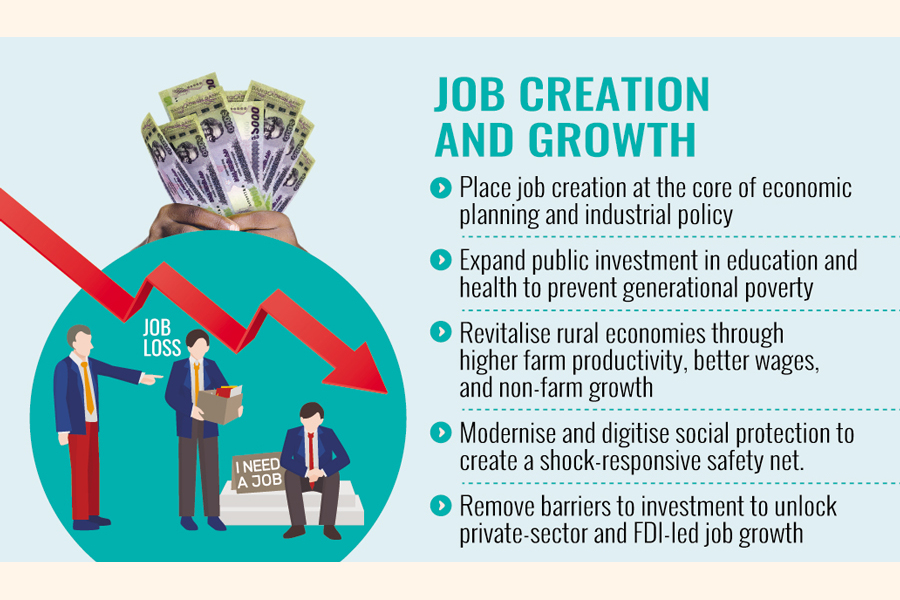
- Place job creation at the core of economic planning and industrial policy.
- Expand public investment in education and health to prevent generational poverty.
- Revitalise rural economies through higher farm productivity, better wages, and non-farm growth.
- Modernise and digitise social protection to create a shock-responsive safety net.
- Remove barriers to investment to unlock private-sector and FDI-led job growth.
Bangladesh's earlier development breakthroughs-expanding primary schooling, empowering women through microfinance, leveraging garments for mass employment-were bold choices that lifted millions out of poverty. The country now faces another historic crossroads. The question is whether today's policymakers will demonstrate similar boldness in placing people, not just production, at the centre of national development.
The answer will decide whether Bangladesh's growth story continues as one of shared prosperity-or devolves into widening inequality masked by impressive but hollow GDP numbers.
wasiahmed.bd@gmail.com