

Published :
Updated :
 For all latest news, follow The Financial Express Google News channel.
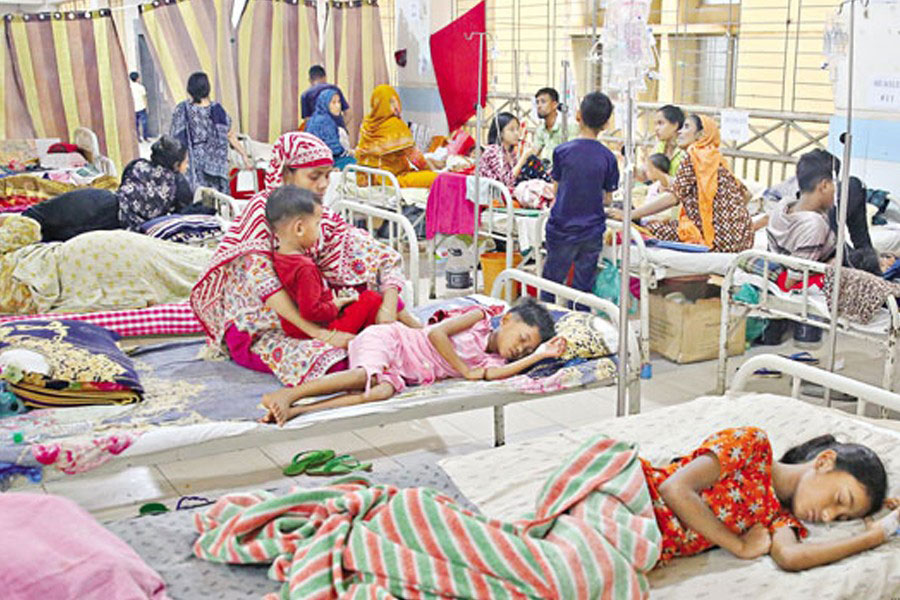
The Middle-Eastern war and the energy crisis it created have been the subject of primary attention of the media, the government and the public since the end of last February. And that is justifiably so. But a mother, whose universe is her child, is more concerned about its (the child's) wellbeing than anything else in the world, be that a war in a faraway land or its fallout impacting the country. And that is more so when her baby is suffering from a serious infectious disease. The serious disease now under consideration is measles or suspected measles which during the past 19 days till April 3 (Friday), according to the government, has caused some 94 deaths mostly among children. Consider how many mothers' hearts the outbreak of measles have already broken and how many more would be in the coming days unless the disease is brought under control. Given the number of deaths related to measles or suspected measles within such a short span of time, the government, or for that matter its health authority should have already raised the alarm about the outbreak of this highly contagious airborne viral infection across the country. What should be further worrying is the rising number of cases which as reported by the government sources has already reached 5,792 till last Friday (April 3). This figure is about the number of officially recognized patients infected with measles or suspected measles. In that case, the actual number of patients suffering from the disease which have mostly gone unreported should be higher than that mentioned in official records. In this connection, the Directorate General of Health Services (DGHS), the government's primary public health agency, has confirmed that that the highly infectious measles has so far caused nine (9) confirmed deaths, noting that the disease has seen a sharp rise this year since March.
According reports from the Infectious Diseases Hospital in Mohakhali, 560 measles patients were admitted to that hospital in the first three months of this year. Whereas, over the entire year of 2025, the number of measles patients admitted was only 69. That means there are far more unvaccinated children this year than there were in the previous year. What is further worrying, as the reports go, is the rate of infection which seems to be far higher in 2026 than it was last year as 90 per cent of the sample cases happened to be positive this time compared to last year's rate at only 10 per cent. Small wonder that most of the positive cases were found to be unvaccinated ones. This is indicative of the gaps created in the vaccination programmes over the years. Clearly, the disease has spread nationwide largely unbeknown to the health authorities at the top. Thankfully, the Ministry of Health and Family Welfare on Saturday (April 4) is learnt to have told journalists that from the next day (Sunday) vaccination drive against measles and rubella (German measles) among children aged from six months to 59 months would begin on a priority basis in 30 upazila under 18 districts. Obviously, the upazilas identified as the high-burden ones are being brought under the vaccination programme initially. This is definitely a good piece of news that government has finally taken the public health threat the contagious disease poses with the seriousness it deserves.
In fact, health experts view that this outbreak of measles has not happened out of thin air. Why has so many children remained unvaccinated rendering them helpless against the virus attack? It goes without saying that all the cases of infection has not been due to the lack of awareness or missing of the dates on the part of the parents to inoculate their children from the immunization centres. There have also been lapses from the government's side, for instance, due to supply issues such as shortages of vaccines or the failure to implement the nationwide anti-measles, rubella catch-up campaign supposed to take place in 2024. The political turmoil was evidently the primary cause. Add to that the restructuring of health management that included abrupt suspension of the 36 Operational Plans (OPs) scheduled for June 2024 by the interim government that took office in August 2024. That definitely crippled the existing vaccine procurement and distribution system. In fact, the dismantling of the established Health, Population and Nutrition Sector Programme (HSNSP) system halted the direct procurement process. In consequence, central vaccine stocks were completely depleted resulting in critical shortages of essential vaccines including BCG, MR and Pentavalent by late 2024 and 2025.
Notably, BCG (Bacillus Calmette-Guerin) is a vaccine that protects children against Tuberculosis (TB). This vaccine is usually applied to children at birth since the pathogen (of TB) can cause the lethal TB meningitis especially among infants. Similarly, MR is measles and rubella, which causes serious respiratory infections, the vaccination against which we are at the moment concerned with. And Pentavalent is a combination vaccine that protects children against five major childhood diseases including Diphtheria, Tetanus, Whooping cough (Pertussis), Hepatitis B and Haemophilus influenza type b. These vaccines are actually the vital components of the Expanded Programme of Immunization (EPI) to protect children against life-threatening infections.
Needless to say, depletion of these essential vaccines led to field-level operational failures. For instance, the routine vaccination services were interrupted multiple times due to strikes and protests often staged by health assistants over their unpaid salaries and benefits. Admittedly, the pandemic (COVID-19) also lay behind a long-term disruption in routine immunization which the system could not fully recover from leading to a large number of children denied access to vaccination. There were also logistical issues and funding challenges. As a result, even after the vaccines were purchased, shortages persisted due to poor supply chain management and failure to monitor cases of field-level disruption. Delays in obtaining funds for logistics, syringes, for example, further came in the way of implementing the immunization campaigns as planned. All these failures to carry out the immunization campaigns against measles-rubella and other childhood infections as noted in the foregoing have their cumulative impact on the public health now facing the nation.
On this score, the target under the emergency drive to immunize 1,203,267 children against measles-rubella in the selected high-burden 30 upazilas is a welcome one. It is believed the incumbent BNP government would not consider the job done through meeting the emergency it is faced with at the moment. In this connection, the measure that the health authority, the DGHS, has taken by cancelling all leaves of its doctors, officials, employees and health workers until te ongoing child health emergency caused by a rapid surge in measles-related pneumonia is brought under control is no doubt a positive one. However, this is a one-off move to meet emergency. But better would it be, if the immunization activities could be carried out normally all year round to avoid the emergence of such emergencies in the first place. In that case, the doctors and other employees of the health directorate would not have to sacrifice their leaves as it is now the case.
sfalim.ds@gmail.com