

Published :
Updated :
 For all latest news, follow The Financial Express Google News channel.
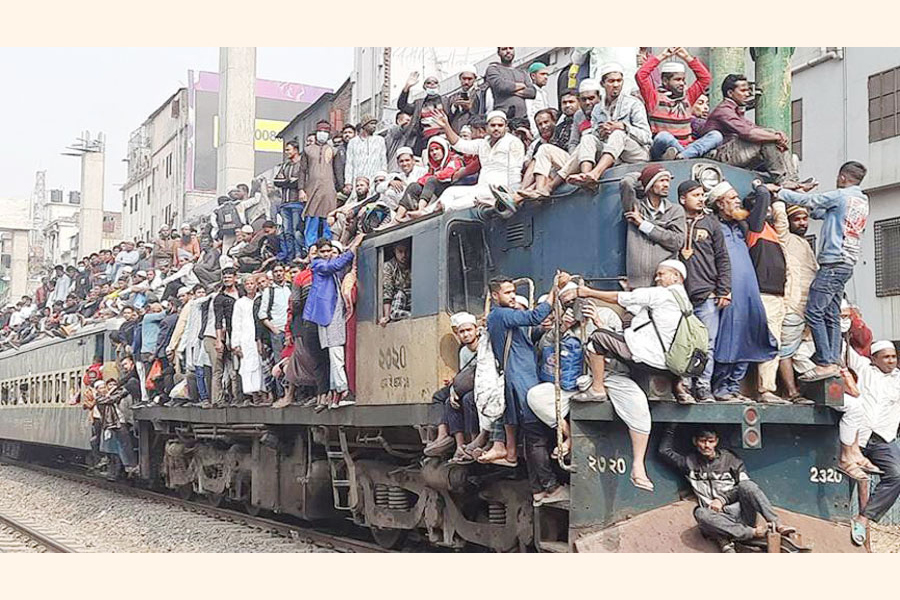
Each year the picture of lumbering trains with a huge rooftop crowd during the two Eids and Tongi Biswa Ijtema exposes not just the scarcity of mass public transports but also the state of underdevelopment of a nation. This is undignified for any country. The launches operating between Dhaka and Barishal along with other southern districts are similarly crammed with homebound passengers. Thankfully, buses on long routes are not allowed to carry passengers on rooftop. But they have their own problems concerning their schedules and other irregularities. For some years, the Eid holidays have been extended to a week or a longer period in order to minimise the rush but to no effect.
However, people with their roots to villages have devised a smart plan of moving members of their families to their ancestral homes days or weeks before. The head of the family opts to stay back and joins the party at a later time preferably on the Eid day proper or a day or two later. Even their return journey follows a staggering strategy. This smart move has lessened the rush to some extent but still the pre-Eid outflow and post-Eid inflow of passengers from and to the capital are overwhelming for the transportation system. A greater number of hired microbuses and cars appear on roads and highways and the traffic becomes thicker than any normal time, raising the chances of road accidents.
The safety issue is hardly taken very seriously. Transport operators use the mad rush to their benefit. Rates of tickets are raised overnight. The practice of allowing a few extra passengers to sit beside the driver and on the engine cover compromises the safety standard. In some cases, the extra passengers obstruct the side view of the driver. These are small things but their contribution to accidents may prove crucial. The same happens in case of the locomotive on the two sides and in front of which sit some desperate passengers, risking their lives.
But where things go really awry is the pressing into service disused buses with some repair and fresh painting to give a look of their road-worthiness. When such vehicles also have inexperienced and untrained drivers at the steering wheel, it becomes a sure recipe for road crash. Train coaches are also refurbished to add those with the existing ones or some of those are attached to the locomotives for arrangement of special trains.
The news is that locomotives are not only insufficient but some also are too old to ensure smooth operation. Railway trucks have become dangerously precarious due to ill maintenance raising the chances of accidents. Reports have it that the railway journey between Chattogram and Cox's Bazar introduced on November 11, 2023 has become hazardous because of a number of problems. In absence of required rail gates and gatemen, the Dohazari-Cox's Bazar segment of railways has turned into a death trap. As many as 35 unsuspecting people and one elephant have been crushed under the wheels of trains since the introduction of train service on this route. There are sharp bends and no bars and gatekeepers at many level-crossings including in the most accident-prone Islamabad-Ramu section. Views of both pedestrians and locomotive masters are obstructed because of sharp bends and trees.
The matter has been further complicated by the ageing locomotives including some of the latest procured ones which abruptly stop anywhere or at the time of approaching railway bridges. Against this background, the railway administration has announced pressing into service five pairs of special trains on the route and tickets for those trains would be available only online. This announcement would have been welcome but for the uncertainty of smooth running in normal times. The ramshackle engines used cannot guarantee smooth running of the trains and on schedule. Particularly when the ageing locomotives will pull the carriages, safety of passengers can be compromised.
So there is many a slip betwixt the cup and the lip. This is true for both railway and road journeys. This government, however, did not have enough time for overseeing the condition of roads and highways as well as railways. But it announced stern measures if extra fare is realised from passengers of both buses and launches. However little is known about what actions will follow if the order is violated. Reportedly, advance sale of tickets left not enough room for price manipulation. But there is no certainty of capacity ticket sale.
Tickets are still available but not straightway. One has to procure those clandestinely. The lackadaisical buses with a fresh coat of paint do not use the main bus terminals and their tickets are available at a higher rate. They use different points outside the main terminals to pick up and drop passengers. Reportedly, these buses and the air conditioned buses do not follow the rules of the business. They fleece passengers on their own terms.
The newly stalled government cannot be blamed for the potholes developed on roads and highways. In this connection, a report was carried in a contemporary that the poor and rough condition at several segments of the road between Rajbari and Barishal has posed risks to the Eid-time heavy rush of traffic. In fact, after the Dhaka-Rajbari excellent highway, the entire road upto Barishal is narrow and if that segment of road is full of potholes and damaged carpeting, the risk is greater now than any other time. There are more such vulnerable roads in the northern and western parts of the country. Mobile traffic teams in charge of oversight need to be deployed in order to stop rash driving and ensure slow but smooth movement on at least the damaged segments of roads and highways.
nilratanhalder2000@yahoo.com