


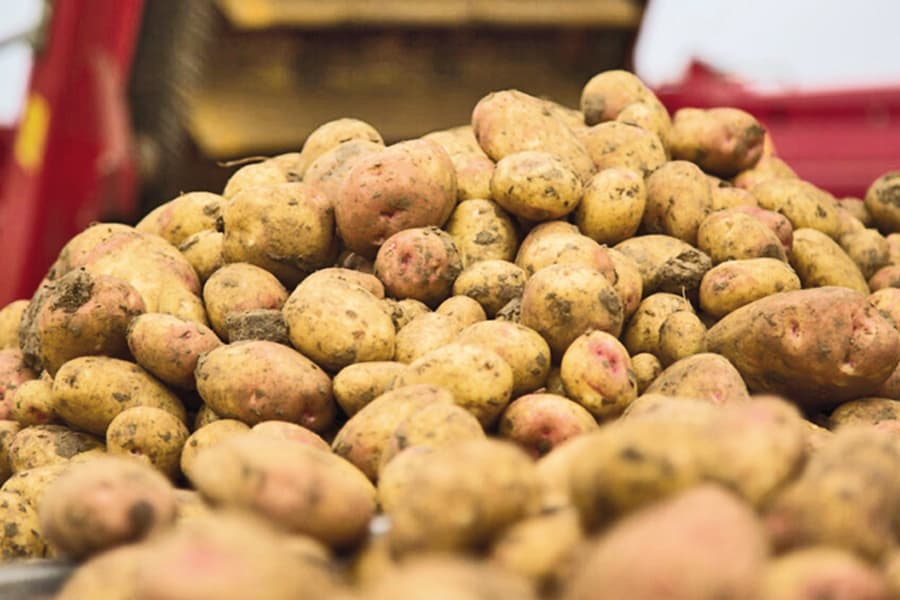
While speaking at an event on the second day of the two-day (December12-13) potato festival 2025 held in the city, experts highlighted the potential of potato as an exportable agricultural commodity of Bangladesh. Notably, the country exported over 62,000 tonnes of potato worth US$14 million last fiscal year (FY2024-25). Of course, the country, according to the Bangladesh Bureau of Statistics (BBS) experienced a record harvest of potato last fiscal year at 1.5 million tonnes, which far exceeded annual domestic demand for the tuber at around 9.0 million tonnes. Of the total domestic demand, however, 1.0 million tonnes of potato would be used as seeds, while the rest 8.0 million would go for the public's consumption. A portion of the potato is processed in the form of chips and crackers. But the surplus production has also left many farmers broke as the price of potato in the market has fallen sharply. In this harvest season, the wholesale prices of the vegetable have gone below even its production costs. The reason is, a large number of farmers had gone for cultivation of potato last fiscal year, FY25. The previous fiscal (FY 2023-24)'s production shortfall and the consequent spike in the farm produce's price as well as last season's good weather was a reason that many farmers even borrowed money to invest in potato cultivation. Now, such low price of potato this year may have discouraged many farmers to go for potato cultivation this year.


As told by the adviser to the ministries of agriculture and home affairs of the interim government at the said festival, potato also saw bumper harvests in 2010, 2014, 2015 and 2017 overshooting domestic demands. Unfortunately, such instances of bumper harvests of potato have not been an unmixed blessing for its farmers. Reports say, farmers in the last season planted this crop on 4.92 lakh hectares, which was 8 per cent higher on a year-on-year basis. So, potato production also increased proportionately by 9.0 per cent Year-on-Year (YOY). In consequence, potato growers this year may either avoid cultivating the crop at all, or allocate fewer acreage of their lands for growing potato which might lead to production shortfall next year pushing up the tuber's price sky-high compelling the government to import potato. Such rise and fall in the production of this highly potential agricultural product has been taking place over the decades, thanks to the lack of a consistent policy of the government towards the potato growers. So, when the potato growers are in deep financial crisis due to falling price following overproduction, the government may come up with help for farmers by way of procuring potato directly from them. Also, consumption of potato could be promoted through, say including 10 kilogrammes per household in the government's social safety net schemes.
In a similar vein, its export could be encouraged by providing businesses concerned with incentives similar to those extended traditionally to the apparel sector. Experts at the said potato festival organised by the Bangladesh Cold Storage Association (BCSA) said, the global potato industry is currently valued at US$120 billion, but Bangladesh, though an agriculture-based country has less than 0.01 per cent share of the world market. M Masrur Reaz, Chairman, Policy Exchange of Bangladesh, said during his presentation at the event that addition of processed agricultural products, such as from potato, can reduce significantly the country's reliance on a single export product and contribute to strengthening its long-term economic resilience. That would, however, require strong policy support, incentives and regulatory reforms, he added. In fact, so far the agricultural products like potato, have not been given as much emphasis as other sectors such as the Readymade Garment (RMG) enjoy. But the challenge of export diversification that Bangladesh is facing now could be met by the potato, among other agricultural products. Globally, for instance, potato accounts for 4.0 per cent of the total crop production. In this context, Asia contributes 54 per cent to global potato production, while Bangladesh ranks among top ten potato growers in Asia, after China and India.
Given Bangladesh's extreme vulnerability to climate change, potato as a climate-resilient agricultural crop has its natural advantage over other local crops. In fact, potato was not part of the country's crops before 18th century. The Portuguese traders first brought it to India in the early 17th century. It remained mainly a curiosity during its early stage of introduction in the subcontinent. By the late 18th century, the British East India Company familiarised the crop in this part of the world. By the 1850s, it gained popularity in Bengal especially under British Kolkata. Seeing that now it has become an essential food crop in Bangladesh, it is hard to believe that potato was ever a novelty in this land.
In ancient times, however, the crop was originally grown in the high altitudes of the Andes mountains of South America where other crops could not grow. It was cultivated mainly in Peru and Bolivia during Inca civilization. Later, the Spanish conquistadors brought it to Europe in the 16th century. But it took centuries before the crop became popular in Europe in the 18th and 19th centuries. Gradually, it became the staple for the masses in Europe. Now it has been turned into a global staple.
Against this backdrop, as Bangladeshi farmers can grow large quantities of this global staple that can be exported after meeting domestic demand, the government should not consider it just as another agricultural product of the country. To encourage potato growing farmers, the government needs first to dispel their fears about the hazards of overproduction they face every alternate season. When its production is prioritised as an export commodity, farmers, provided they receive the matching backing from the government, will be encouraged to grow the crop with due enthusiasm. But the government in that case cannot limit itself to just making promises of support. On the contrary, it should come up with a detailed plan on providing the support including fiscal incentives for the potato growers. At the same time, the required infrastructure for storage of potage has to be developed. Entrepreneurs in the agri-sector interested in potato crop should also be offered necessary incentives to promote its export.
sfalim.ds@gmail.com