


Mob justice has emerged as one of the gravest threats to Bangladesh's fragile transition, provoking deep anxiety among citizens across political, social and professional divides. Despite repeated assurances from the interim government, vigilante violence continues unabated, exposing a dangerous erosion of state authority and a widening gap between promise and practice. If left unchecked, mob justice will not only undermine the rule of law but also imperil the very prospect of democratic renewal.


At its core, mob justice represents the abdication of lawful governance. It is the moment when the crowd replaces the court, emotion supplants evidence, and coercion displaces accountability. No society committed to justice can tolerate such a reversal without paying a heavy price. In Bangladesh today, that price is being measured in fear, intimidation and the gradual normalisation of lawlessness.
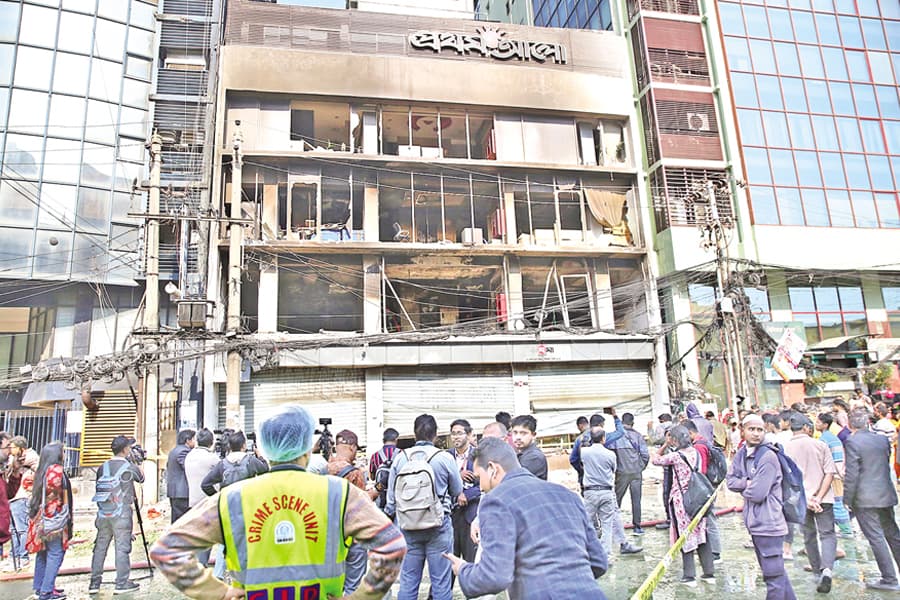
Recent attacks on properties linked to two of the country's most respected daily newspapers -- Prothom Alo and The Daily Star -- illustrate the danger starkly. These were not isolated acts of vandalism, nor spontaneous expressions of anger. They were calculated assaults that targeted institutions central to democratic discourse. When mobs attack media houses with impunity, the message is unmistakable: dissent will be punished, scrutiny will be silenced, and intimidation will prevail.
Even more troubling than the attacks themselves was the failure of law enforcement to prevent them. The absence of timely and effective intervention has raised serious questions about institutional competence, command responsibility and political resolve. In a country where journalists have previously been picked up by law enforcers only to be retrospectively "shown as arrested", the passivity displayed during the vandalisation of media houses is deeply unsettling. It invites an unavoidable question: was this reluctance on the ground, or a reflection of ambiguity -- or worse -- at the top?
Either explanation is deeply problematic. If law enforcers hesitate to act out of fear or confusion, it signals a breakdown of command and confidence. If restraint is politically motivated, it represents a far more dangerous erosion of the state's neutrality. In both cases, the consequence is the same: mobs learn that the cost of violence is negligible.
This sense of impunity is now unmistakable. Those engineering mob violence appear increasingly desperate and emboldened, operating on the assumption that they will face no legal consequences. Such actors thrive in moments of transition, when authority is contested and institutions are recalibrating. History offers a sobering lesson: when the state fails to act decisively at such moments, the vacuum is quickly filled by coercive forces that are hostile to democracy.
The interim government has repeatedly warned against mob justice, as have senior figures in the civil administration and the security forces. These warnings are welcome, but words alone cannot be a substitute for action. The persistence of mob violence suggests that certain quarters no longer take these warnings seriously. That, in itself, should alarm policymakers. When the deterrent effect of the state diminishes, disorder becomes self-perpetuating.
Mob justice is often rationalised as a response to perceived injustice or delayed accountability. But this argument collapses under scrutiny. Vigilantism does not correct injustice; it multiplies it. It does not strengthen accountability; it destroys it. By bypassing due process, mobs erase the distinction between guilt and innocence, replacing justice with collective punishment. The result is not order, but arbitrariness.
For Bangladesh, the stakes could not be higher. The rule of law is not an abstract principle; it is the foundation upon which good governance rests. Without it, institutions lose credibility, citizens lose trust, and democracy becomes illusory. Elections held in an environment where mobs roam unchecked cannot be meaningfully free. A press operating under threat cannot serve as a watchdog. Courts functioning amid fear cannot dispense impartial justice.
Preventing mob justice, therefore, is not merely a law-and-order imperative; it is a democratic necessity. It requires a clear and unequivocal message from the interim leadership that no group -- however loud, organised or politically connected -- will be allowed to operate above the law. That message must be reinforced through visible action: rapid intervention, credible investigations, and prosecution without exception.
Law enforcement agencies must be empowered and instructed to act decisively, not selectively. Their legitimacy depends on consistency. A police force that arrests individuals swiftly in some cases but stands idle in the face of organised vandalism sends a signal of bias and weakness. Restoring confidence will require institutional clarity, operational independence and protection from political interference.
Equally important is accountability within the state apparatus. When mobs succeed because authorities fail to act, responsibility cannot be diffused indefinitely. Identifying lapses, fixing command failures and holding officials accountable are essential steps in reasserting the rule of law. Without internal accountability, public assurances ring hollow.
The role of political leadership is central. Transitional governments often err on the side of caution, fearing that firm action may provoke backlash. But history shows that ambiguity breeds greater instability. The refusal to draw red lines emboldens extremists while demoralising those who rely on the state for protection. Leadership, especially in transition, demands clarity and courage.
Bangladesh stands at a critical juncture. The promise of democratic transition cannot be realised in an environment where mobs dictate outcomes and intimidation is a substitute for debate. Good governance will remain a slogan if anarchic forces are allowed to rule the roost.
The time has come to put a full stop to mob justice. Not tomorrow, not after another warning, but now. Preventing vigilantism is not optional; it is imperative. The rule of law must be enforced uniformly and visibly, or it will cease to exist in practice. If the interim government is serious about steering the country towards a stable and democratic future, it must demonstrate -- through action, not rhetoric -- that the state alone holds the legitimate authority to enforce the law. Anything less risks surrendering that authority to the mob, with consequences that Bangladesh can ill afford.
mirmostafiz@yahoo.com