

Published :
Updated :
 For all latest news, follow The Financial Express Google News channel.
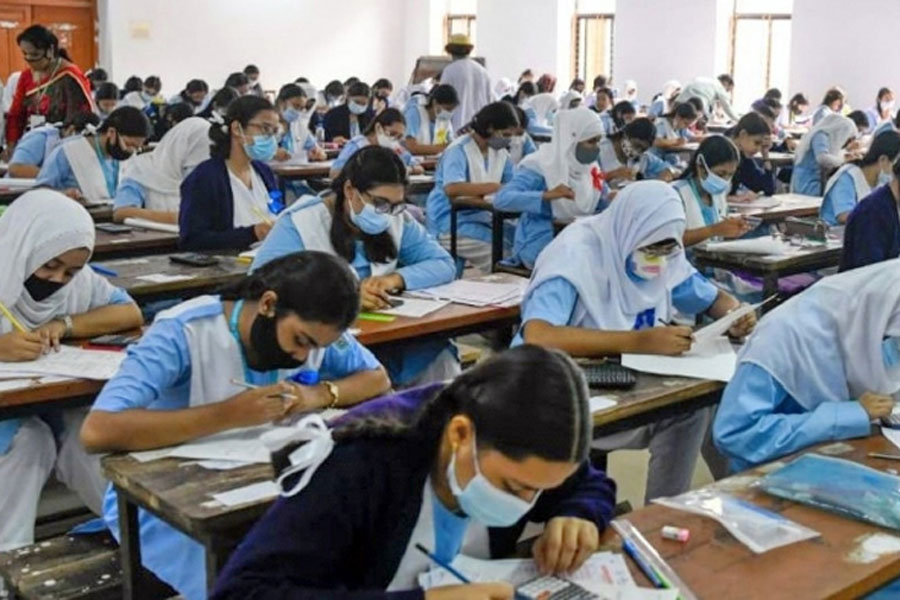
Results of the first public examination, the Secondary School Certificate (SSC) and its equivalent that is, are traditionally published within two months after the completion of the exam. This year the results may be delayed. Many of the examiners who applied for evaluation of examination scripts are now reluctant to collect those scripts allotted to them. A report carried in a vernacular contemporary reveals that 235 examiners of Bangla first paper have ignored repeated instructions of the Board of Intermediate and Secondary Education, Dhaka. Exasperated, the board published the list of these teachers on Tuesday. A final instruction was also issued for them to collect the exam scripts by 5 pm on that day and warned if they failed to comply with the order, they would be penalised.
This is not a problem with only the Dhaka education board, other boards are also facing similar problems. The same happened last year as well but the boards summoned teachers before forcing them to swallow the bitter pill. Problems so created last year also made the matter complicated. The country's education system up to higher secondary level has been managed very badly with different governments carrying on experiments with learners like guinea pigs. Now here is yet another systemic failure that threatens to undermine proper evaluation of examination scripts or for that matter the performances of examinees. The report further reveals that examiners reluctant to collect their shares of exam scripts engage proxy examiners to evaluate the scripts allotted to them. This is criminal.
Rot set to the system has gone too far. Or, how can venerable teachers stoop so low as to engage proxy examiners who may have no involvement with teaching. Usually, teachers with long experiences in teaching are selected for evaluation of exam papers. In reality, this is not strictly followed. That evaluation is often casually done or at times done by unqualified proxy examiners is evident from the fact that hundreds of examinees apply for revaluation and are awarded higher scores. But not all examinees are confident enough to challenge the results. Reportedly, low scores and failure to pass due to mistakes by such examiners have even driven students to commit suicides.
At the same time, there are allegations that re-examination in the true sense of the term is not followed; only the addition of scores carried for individual answer together with the filling of the circles properly is checked. Imagine if an examinee is underevaluated with no appeal for re-examination of answer papers! It is a responsibility that cannot and should not at all be compromised. A student's entire life is shaped by the SSC and HSC results. Examiners have no scope for trivialising this important investment of merit and gruelling preparation for examinations. Misevaluation can unmake an examinee at this stage.
Examiners complain that their honorarium of Tk 35 for evaluation of each exam sheet is too paltry to justify their labour. Then the payment is so irregular that they do not even get paid for last year's evaluation by the time they check this year's exam scripts. Sure enough, the education boards are to blame for such delayed payment. So far as the amount of honorarium is concerned, this should be negotiated between teachers' representatives and the education board. But at no point should students be victimised on account of this.
Well, teachers can earn far more if they give time to private tuition or coaching centres. For long it has become a routine for some teachers to give more importance to private tuition and commercial coaching to the neglect of their class teaching. To them evaluation of each exam paper for only Tk 35 is unacceptable because they can earn far more from their private tuition and coaching centres. This explains why some of the experienced teachers try to avoid checking exam papers. Also, examiners are not given enough time for meticulous evaluation and therefore mistakes occur.
The flawed system of education exposes its weaknesses in multifarious ways but if teachers fail to hold on to the moral high ground, the nation is sure to chart a perilous course. It cannot be denied that teachers are low-paid and the proliferation of coaching centres even in villages has made education at this level private coaching-centric. This has been made worse by intervention of partisan politics in education particularly after the July-August uprising. The way students humiliated their teachers all across the country exposes the degeneration of the sacred bond between students and teachers. Teachers cannot be blamed if they are disillusioned and find maintaining professional integrity a futile exercise. Physical wound may be healed but the psychological laceration and trauma they suffer are beyond healing.
In this country institutions could not take a proper shape mostly because of partisan politics. The highest seats of learning have long faced this problem but at least secondary schools were free from such politics. But during the past one and a half years several schools and colleges have witnessed the ultimate harassment and humiliation of teachers at the hands of their own students.
It is against such a backdrop, teachers are cautiously reviewing their positions in society. The interim government turned a blind eye to their humiliation and in not one single case were the assaulters brought to justice. No civilised society can allow this to happen. Although, it appears that there is no relation between teachers' reluctance to collect exam sheets for evaluation and the disgrace teachers were subjected to, the moral spirit some teachers tried to uphold has been brought down to dust. Non-collection of exam scripts is therefore no aberration but to a large extent fallout of their professional frustration.