


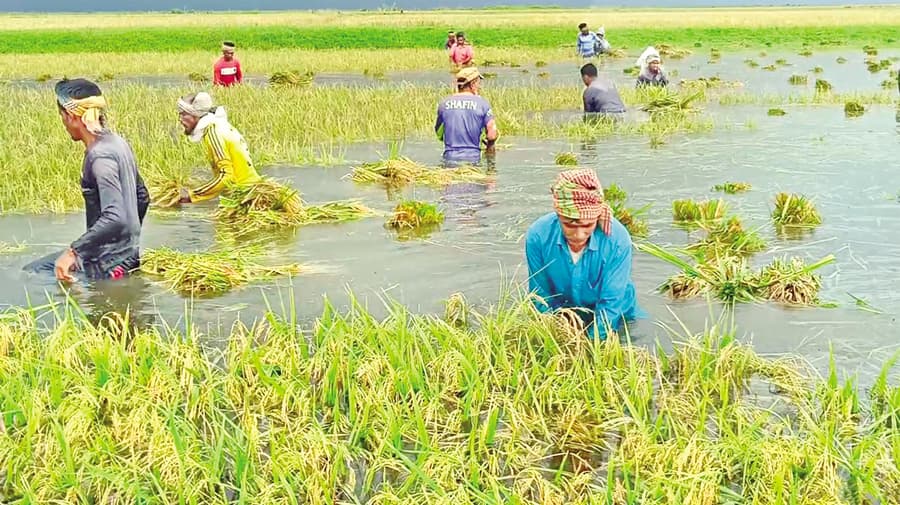
In the vast bowl-shaped wetlands of north-eastern Bangladesh, the rhythm of life is dictated by water. For generations, farmers in the haor regions have lived with the paradox of abundance and vulnerability: fertile land that yields the country's most vital crop, yet remains perilously exposed to the forces of nature. This year, that fragile balance has collapsed, as it happened many times in the past.


This year, across Sunamganj and Kishoreganj, excessive rainfall and upstream flash floods have submerged thousands of hectares of boro paddy -- the backbone of Bangladesh's food security. The scale of devastation is staggering. More than 112,000 farmers have been affected. In Sunamganj alone, around 16,000 hectares of cultivated land lie underwater, with losses estimated at Tk 3 billion. In Kishoreganj, another 9,049 hectares have been inundated, inflicting nearly Tk 2 billion in damage.
These are not just statistics. They represent livelihoods erased overnight, debts that will go unpaid, and households pushed to the brink of destitution.
Boro paddy is not merely another seasonal crop; it accounts for the largest share of Bangladesh's annual rice production. The haor basin, with its unique hydrology, plays an outsized role in sustaining this output. When the haor harvest fails, the consequences ripple far beyond the immediate geography -- affecting national food supply, market prices, and rural stability.
Yet, while floods in the haor are not new, the recurring nature of such losses raises uncomfortable questions. Why, year after year, do farmers find themselves so exposed? Why do protective systems fail at the moment they are needed most?
At the centre of this crisis lies the issue of flood protection embankments -- the very structures designed to shield crops from early flooding. This year, as in many before it, farmers watched in despair as rising waters pressed against fragile embankments. In some areas, the fear of imminent collapse still looms over what little crop remains.
Allegations of irregularities in embankment construction are neither new nor isolated. Local communities have long complained that these projects, often costing thousands of crores of taka, are undermined by poor planning, substandard materials, and, most critically, corruption. Contracts are awarded, funds are disbursed, and structures are built -- but too often they fail to meet even basic standards of resilience.
The result is a cruel cycle. Public money is spent in the name of protection, yet when disaster strikes, that protection proves illusory. Farmers are left to bear the burnt of not just of natural calamities, but of systemic failures.
This raises a deeper issue of governance. Infrastructure alone cannot solve the haor's vulnerabilities unless it is backed by transparency, accountability, and rigorous monitoring. The absence of effective oversight allows irregularities to persist. When no one is held accountable for failure, failure becomes routine.
The human toll of such inaction is evident across the flooded fields. Farmers, standing waist-deep in water, attempt to salvage a part of their submerged crops. Labour shortages compound their struggle; even higher wages fail to attract workers willing to endure such harsh conditions. Mechanical harvesters, often touted as a solution to labour scarcity, are rendered useless by the very water that defines the haor landscape.
For many, the loss is total. Crops have rotted in the fields. Loans taken at the start of the season now hang like a noose. The question that haunts these communities is simple and devastating: what next?
Emergency relief, while necessary, is not sufficient. Compensation can provide temporary respite, but it cannot address the structural issues that make such disasters inevitable. Nor can it restore the dignity of farmers who have invested their time, labour, and scarce resources into a harvest that never came.
What is needed is a fundamental rethinking of how the haor is managed.
First, the integrity of flood protection infrastructure must be ensured. This requires not just increased funding, but better use of existing resources. Independent audits, community monitoring, and strict enforcement of construction standards should be non-negotiable. Those found responsible for irregularities -- whether through negligence or corruption -- must face consequences. Without accountability, reform will remain a hollow promise.
Second, early warning systems and water management strategies need to be strengthened. Flash floods, particularly those driven by upstream rainfall, are difficult to predict but not impossible to anticipate. Improved forecasting, coupled with timely communication to farmers, can allow for earlier harvesting and risk mitigation.
Third, agricultural practices in the haor must adapt to a changing climate. The increasing frequency and intensity of extreme weather events suggest that traditional cropping calendars may no longer be viable. Investment in shorter-duration, flood-resistant crop varieties could provide farmers with a crucial buffer against early inundation.
Fourth, social protection mechanisms must be expanded. Crop insurance, low-interest credit, and targeted subsidies can help farmers absorb shocks and rebuild after losses. At present, many are forced into cycles of debt that deepen their vulnerability with each failed season.
Finally, and perhaps most importantly, farmers themselves must be placed at the centre of decision-making. Too often, policies are designed in distant capital offices, with little input from those who understand the haor best. Local knowledge -- of water patterns, soil conditions, and risk -- is an invaluable resource that remains underutilised.
The crisis in the haor is not simply a story of natural disaster. It is a story of choices -- about how resources are allocated, how projects are implemented, and whose voices are heard. It is a test of whether governance can rise to meet the needs of those most at risk.
Bangladesh has made remarkable strides in agricultural production over the past decades. But those gains cannot be taken for granted. As climate change intensifies and environmental uncertainties grow, the vulnerabilities of regions like the haor will only become more pronounced.
Saving the farmers of the haor is therefore not just a matter of compassion; it is a matter of national interest.
The government must act -- decisively and transparently. Compensation for affected farmers should be immediate and adequate. Investigations into embankment irregularities must be thorough and impartial. Reforms in infrastructure, agriculture, and governance must follow.
Anything less would be a disservice to the millions of farmers who feed the nation, and who now find themselves abandoned at their moment of greatest need.
The waters will eventually recede. The fields will dry. But unless meaningful action is taken, the cycle will repeat -- and with it, the quiet devastation of a community that deserves far better.