


From time immemorial, rivers have meant much more to the people of Bangladesh than mere sources of water. The rivers system has made civilization possible and supported agricultural and livelihood activities, while also serving as the cultural and emotional centerpieces of a country that rests on its delta. Among 54 transboundary rivers, at least two -- the Padma (Ganges) and the Teesta -- have been of major political significance.


Today, the proposed Teesta River Comprehensive Management and Restoration Project with possible financial and technical backing from China has emerged as one of the most important infrastructure and geopolitical undertakings in recent years. The initiative aims to address the long-standing challenges, including water scarcity, severe river erosion, flood control issues, declining agricultural productivity, and ecological degradation across northern Bangladesh. However, beyond its engineering and environmental dimensions, the Teesta project has become deeply connected to regional diplomacy, strategic rivalry, and the broader future of Bangladesh-India relations.
In essence, the Teesta question reflects the wider South Asian dilemma of balancing development, sovereignty, environmental conservation, and collaboration amid a changing global context.
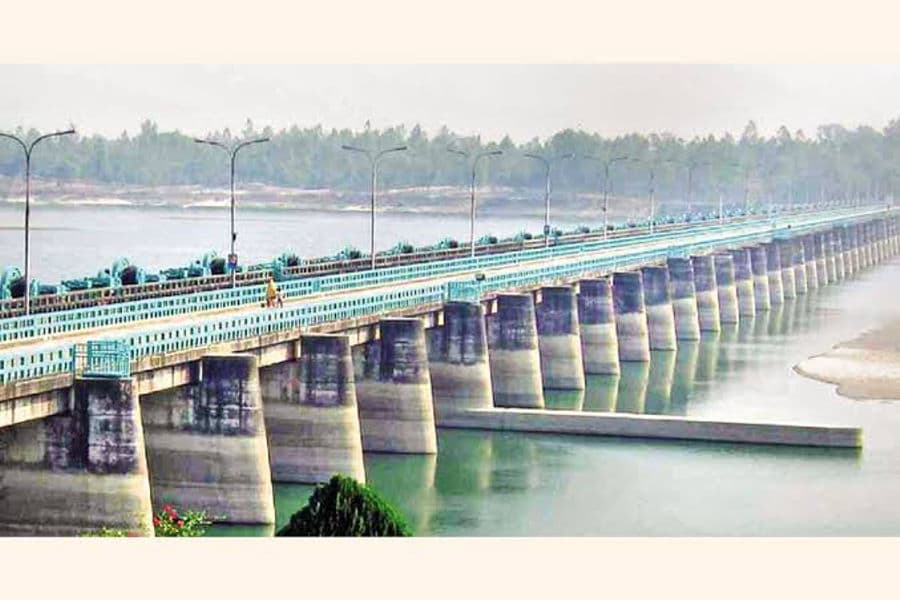
People in the northern parts of Bangladesh have suffered for years from the dual jeopardy of drought and flooding in the Teesta Basin. During the dry season, there is minimal water in the river due to upstream water diversion by India through the Gajoldoba barrage in West Bengal. Consequently, local farmers suffer from water shortages for irrigation, resulting in crop losses. However, with the onset of the monsoon, there is an unexpected release of water upstream, causing floods and river erosion.
The human consequences have been profound. Thousands of families have been displaced over the years by riverbank erosion, creating recurring cycles of poverty, migration, and social insecurity. Communities dependent on agriculture already vulnerable to the effects of climate change remain trapped between extremes of water scarcity during dry season and destructive flooding in the monsoon.
The project aims to alter the status quo by adopting an integrated river management approach that incorporates elements such as dredging, embankments, irrigation system improvements, river engineering, urban planning, land reclamation, economic zone development, tourism development, and ecological restoration. Clearly, the objective is to turn the basin into a sustainable economic zone for northern Bangladesh.
If implemented successfully, the initiative could become one of South Asia's most significant river management transformations.
China's involvement introduces an important geopolitical dimension to the project. Over the last decade, China has become one of Bangladesh's largest development partners, investing heavily in roads, bridges, ports, energy, telecommunications, and industrial infrastructure under the Belt and Road Initiative (BRI).
Beijing's interest in the Teesta River project stems from its broader strategic goal of connectivity and relationship-building in South Asia. In the context of Bangladesh, it would give it the opportunity to carry out a difficult project, as it can do so with funding from China.
Proponents believe that, as a sovereign country, Bangladesh can freely choose the assistance it wants for its development, meaning Chinese involvement in such projects is nothing more than another form of economic diplomacy.
For the Indian capital of New Delhi, however, this project does not represent merely an issue of economic development. India is extremely wary of China's growing presence in neighboring states, especially those bordering its northeastern states.
The Teesta River originates in the Indian Himalayas and passes through the strategically vital Siliguri Corridor commonly referred to as the "Chicken's Neck" which links mainland India to its northeastern region. Any major Chinese involvement in infrastructure near this corridor naturally raises concerns within Indian security circles.
At the same time, the Teesta water-sharing dispute itself has remained unresolved for more than a decade despite repeated diplomatic efforts between Dhaka and New Delhi. Although a draft agreement was nearly finalized during former Indian Prime Minister Dr. Manmohan Singh's visit to Bangladesh in 2011, opposition from the West Bengal government prevented its implementation.
This prolonged delay has fueled frustration in Bangladesh. Many Bangladeshis see the Teesta issue as a measure of the sincerity and effectiveness of regional cooperation between the two neighboring countries. While Bangladesh has often addressed several of India's security concerns particularly regarding insurgency and regional connectivity, many in Dhaka feel that Bangladesh's own water concerns have not received the same urgency or attention.
Against this backdrop, China's willingness to support the Teesta project inevitably reshapes the diplomatic equation.
The Teesta project finds itself at an intersection within the emerging geopolitical landscape of South Asia. It is not only the competition between China and India that has shifted from territorial disputes to armed confrontation, but also into areas like infrastructure and development finance.
Bangladesh has become one of the most strategically significant countries within this competition because of its geographic location, economic growth, demographic strength, and access to the Bay of Bengal.
However, the nation faces an equally difficult task. Too much allegiance to one side would drive away the other. The key to Bangladesh's sustainability lies in striking a balance between its policies on the international stage and its development.
For this reason, the Teesta initiative demands exceptional diplomatic maturity from all parties involved.
If properly controlled and executed openly, the Teesta project would bring significant transformations in northern Bangladesh from economic and social perspectives.
In the past, the area was less developed industrially than other regions of Bangladesh. Improvements in irrigation would greatly increase productivity, alleviate poverty during certain seasons, and ensure food security. Moreover, restoring the rivers would help regain the lost lands due to erosion and protect against environmental threats.
In addition, the project is expected to offer job opportunities across various fields, including construction, engineering, agriculture, transportation, and environmental management. Increased access to the river basin will encourage investment, thereby integrating the region's economy.
Most importantly, successful implementation would strengthen Bangladesh's climate adaptation capacity at a time when the country remains among the world's most climate-vulnerable nations.
Nevertheless, success will depend on transparency, environmental protection, local participation, and financial accountability. Mega-projects often entail risks of displacement, ecological damage, debt dependency, and governance failures. Bangladesh must therefore ensure that national priorities -- not geopolitical symbolism remain at the center of decision-making.
In essence, the dispute over the Teesta goes beyond water management. It highlights the level of trust between Bangladesh and India.
Indeed, the bilateral relations between the two nations have a long history that is both emotional and strategic. India had a critical influence on Bangladesh when it gained its independence from Pakistan in 1971. Today, Bangladesh-India cooperation spans a range of areas, including commerce, energy security, regional connectivity, counterterrorism, and regional security.
However, enduring relationships require reciprocity and comprehension. An example of that is the very emotional issue of sharing water resources in Bangladesh. Thus, a proper agreement on the Teesta River will not only solve the problem but also reinforce the ethical dimension of the relationship.
The Teesta River can either become another flashpoint of geopolitical rivalry or emerge as a model for cooperative regional development. The choice ultimately depends not on the river itself, but on the political wisdom of those who govern around it.
As former United Nations Secretary-General Kofi Annan once observed:
"Fierce competition for fresh water may well become a source of conflict and wars in the future. But it can also be a catalyst for cooperation."
Dr. Serajul I. Bhuiyan is a professor and former chair of the Department of Journalism and Mass Communications, Savannah State University, Savannah, GA USA. sibhuiyan@yahoo.com