

Published :
Updated :
 For all latest news, follow The Financial Express Google News channel.
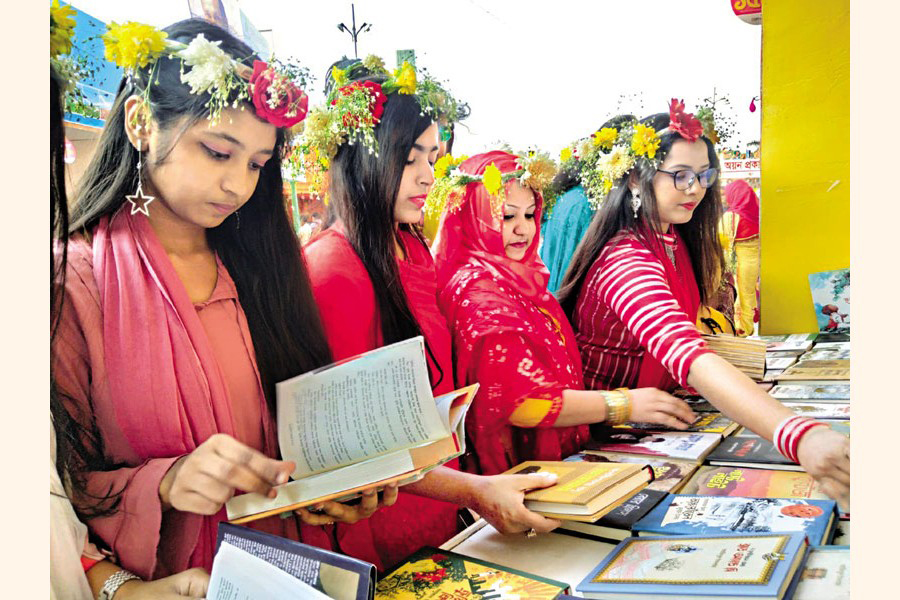
The Amar Ekushey Book Fair kicks off today, keeping alive a cherished annual tradition that celebrates new books and the world of print. For the thousands who visit each year, buying books is only one part of the experience. The fair has grown into a cultural ritual that connects them to language, memory and identity. It is perhaps no surprise, then, that the crowds remain as large as ever, even as purchasing books has become a smaller part of why many come. For authors, publishers and booksellers, however, this presents a difficult contradiction. They see the crowds coming in, yet the number of books sold does not match the enthusiasm. Each passing year brings reports of lower sales and those who make their living from books are finding it increasingly difficult to cope. Given the situation, it is hard not to feel that the very reading habit this fair is meant to honour and nurture is slowly losing its hold on people.
This decline does not mean that people have stopped reading altogether. In fact, the average person today is exposed to more written words than at any other time in history. The digital age still depends on literacy and it keeps people constantly engaged with text in one form or another. However, this reading is not for pleasure and it is not happening in books. The time once dedicated to losing oneself in a novel or an essay is now consumed by the infinite scroll of social media and the captivating pull of streaming services. What books offer is depth and lasting satisfaction but that reward comes slowly whereas digital content delivers instant, fleeting engagement. Just like media theorist Marshall McLuhan famously argued decades ago, media technologies have truly become extensions of ourselves.
Building on this, the pressures of modern urban life have further weakened the bond between people and books. A fast-paced city-centric existence leaves little space for the quiet focus that reading demands. At the same time, constant connectivity to the virtual world has created an environment where attention is fragmented and easily pulled in multiple directions. The problem is not only technological but also social. The new generation is rarely introduced to reading beyond the textbook. Children, adolescents and young adults are given neither the time nor the encouragement to explore the wider world of literature. In many households and communities, there is little visible culture of reading that could inspire imitation. Over time, this absence of example and guidance has diminished the foundation on which a strong reading habit depends.
It is in this context that the recurring complaints from publishers and authors at the book fair must be seen. Their familiar concern is that even with the large crowds, books are not finding buyers. A few well-known writers may enjoy high sales but this does not reflect the state of the market as a whole. It seems the fair's crowds are increasingly composed of those carried by the festive current, visitors more interested in being seen than in seeing a book. While this does not diminish the importance of the gathering, it does call into question whether it is fulfilling its core purpose of nurturing readers.
Decades ago, Syed Mujtaba Ali remarked that no one ever went bankrupt from buying books. In his time and even just a few decades ago, people bought books for the love of getting lost in imaginative worlds and for the simple joy of intellectual discovery. The goal was rarely to collect them or display them on a shelf. Writers wrote with the expectation that someone would read and their work depended on that engagement. As writer Mohammad Badrul Ahsan once said, "a writer shouldn't write without a readership for the same reason a speaker shouldn't speak without an audience." Yet now, as the rates of formal education rise, the reading habit paradoxically declines and writers in turn find their motivation waning. The result is a loop that feeds on itself, leaving both readers and writers at a loss.
Of course, a crucial part of this decline must also be attributed to a shortage of writers who can truly capture the reader's imagination and compel them to buy. Globally, literature continues to evolve with diverse genres such as fantasy, thriller, mystery and young adult fiction attracting large audiences. Compelling writing still draws readers, even if not at the levels of the past. It is often said that for years after Humayun Ahmed's death, readers still flocked to the book fair searching for his works and publishers still speak of an absence that cannot be filled. Similarly, the earlier success of Sheba Prokashani showed how engaging narratives could inspire young readers to even spend their tiffin money on books. The truth may sound harsh, but in Bangladesh, the absence of similarly appealing works in sufficient numbers today is likely contributing to the current stagnation.
Books have long been valued for their ability to cultivate critical thinking, empathy and imagination. The switch from reading books to consumption of quick online content therefore may have implications that go beyond individual habits and affect the cultural and intellectual life of society. Yet it would be simplistic to place the blame entirely on changing preferences. Books themselves must adapt to remain relevant in a rapidly evolving world.
In many parts of the world, this adaptation is already visible in the steady rise of digital publishing. E-books and online platforms have expanded access and opened up new ways of reading. Although this transition is still unfolding in Bangladesh, online book sales are gradually increasing, suggesting that the future of reading may not be confined to printed pages. Change is an inevitable part of any society, and books, like other forms of media before them, are likely to evolve with time. The real challenge is not to preserve books in their traditional form at all costs, but to ensure that the habit of deep and meaningful reading continues, no matter what form it takes.
showaib434@gmail.com