


Bangladesh's readymade garment (RMG) sector stands at a crossroads. For decades, the industry has been the backbone of the country's export economy, transforming Bangladesh into the world's second-largest apparel exporter and creating employment opportunities for millions. However, the global apparel industry is now undergoing a major transition from a linear to a circular production model. Although Bangladesh has made considerable progress in increasing the number of green factories, the majority of its apparel manufacturers still follow the traditional "make, use and throw away" model. Speaking at a recent seminar, industry leaders warned that without urgent policy support, use of modern technology and infrastructure upgrades to develop advanced recycling capacities, Bangladesh risks losing not only competitiveness in major export markets but also a massive economic opportunity from waste recycling estimated to be worth $8 billion annually.
A circular economy is fundamentally different from the conventional production model. In a circular system, products are designed and manufactured in a way that allows materials to be used, reused, repaired and recycled repeatedly, thereby reducing waste and extending the lifecycle of resources. Rather than allowing products to end up in landfills after a single use, circularity seeks to recover value from materials at every stage of production and consumption. It also emphasises responsible sourcing, reduced water and energy use, minimisation of waste and lower carbon emissions throughout the supply chain.
This transformation is no longer driven solely by environmental concerns; it is increasingly becoming a trade and business imperative. Legislative initiatives in the European Union, including the Green Deal and the Digital Product Passport (DPP), are accelerating the shift towards sustainable and traceable supply chains. These regulations will require apparel exporters to ensure greater transparency regarding sourcing, production methods, recycling practices and environmental impact. Since the European Union remains Bangladesh's largest apparel export destination, these developments carry enormous significance for the country's textile and garment industry.
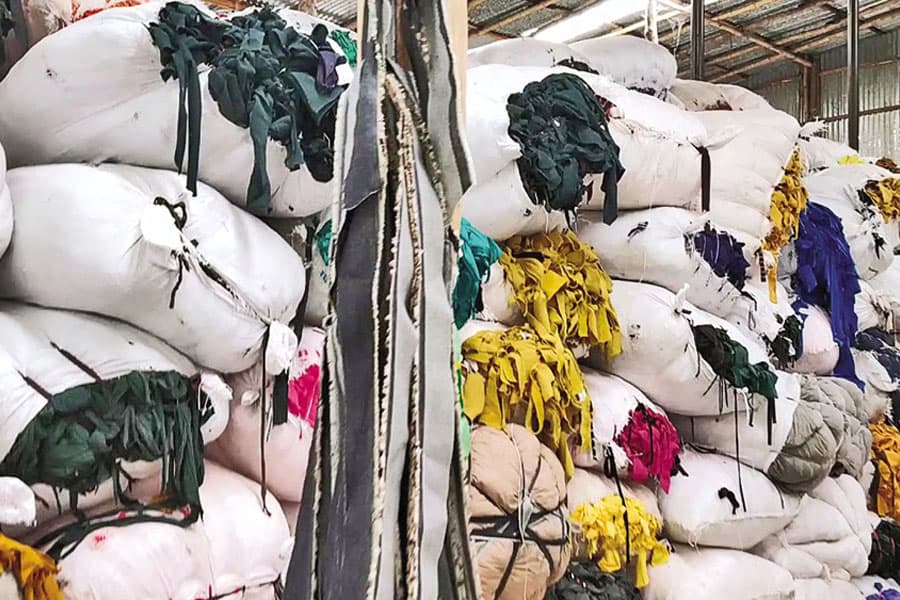
As the world's second-largest garment supplier, Bangladesh's apparel industry generates a substantial amount of textile waste. However, Bangladesh mainly deals with pre-consumer waste generated during the manufacturing process rather than post-consumer waste collected after products are used by consumers. According to BGMEA, the industry produces nearly 600,000 tonnes of pre-consumer textile waste annually. Yet this enormous volume of waste remains largely underutilised.
Currently, most textile waste is collected and traded through informal channels, with only a very small portion recycled domestically. A significant amount of recyclable garment waste is exported to neighbouring countries such as India and Pakistan, where it is processed into recycled yarn before being sold back to Bangladesh at higher prices. This represents not only a loss of valuable foreign exchange and domestic value addition but also a missed industrial opportunity. If textile waste is properly collected, sorted and processed within the country, it could become a valuable raw material for producing recycled fibres, yarns and fabrics, creating a new high-value industrial segment.
Industry leaders have rightly pointed out that formalising the recycling ecosystem would generate multiple benefits. It would reduce health and safety risks associated with unregulated waste handling, create new employment opportunities, strengthen industrial organisation and encourage safer working conditions. More importantly, it would help Bangladesh reduce its dependence on virgin raw materials at a time when global resource constraints and climate concerns are becoming increasingly severe.
Bangladesh's upcoming graduation from Least Developed Country (LDC) status adds further urgency to the issue. As preferential trade benefits gradually decline after graduation, maintaining export competitiveness will require stronger compliance with environmental, labour and sustainability standards. In this context, the transition to a circular economy should not be viewed merely as an environmental obligation, but as a strategy to preserve market access.
Experts also emphasise the importance of upstream circularity, which focuses on reducing waste at its source during design, production and cutting processes. Technology can play a transformative role in this regard. Innovations such as digital design systems, automated cutting technologies, 3D sampling and customised manufacturing platforms can significantly reduce fabric wastage and improve production efficiency. These technologies also enable closer collaboration between manufacturers and global buyers, helping both sides share responsibility for minimising pre-consumer waste.
However, upstream circularity alone cannot eliminate textile waste entirely. The next crucial step is to embrace the principle of "recycle and recover," whereby textile waste can be converted into fibre, fibre into yarn and fabric, and eventually into new RMG products. Recycling textile waste into new fabrics and apparel products would reduce the need for virgin resources while simultaneously lowering environmental pressure and carbon emissions.
A coordinated national strategy is therefore urgently needed to accelerate Bangladesh's circular transition. Such a strategy should include fiscal incentives for recycling investments, tax benefits for sustainable manufacturing, easier access to green financing and support for technological upgrading and research. Strong collaboration among the government, BGMEA, development partners, financial institutions and private entrepreneurs will also be essential. Special emphasis should be placed on developing domestic capacity for chemical recycling, improving waste traceability systems and encouraging innovation in eco-friendly materials and sustainable production techniques.
The future of Bangladesh's apparel industry will depend not only on how much it produces, but also on how environmentally responsible and sustainable its production processes are. If Bangladesh can successfully transform textile waste into economic value, it will not only protect its position in the global apparel market but also pave the way for a more resilient, resource-efficient and sustainable industrial future.