

Published :
Updated :
 For all latest news, follow The Financial Express Google News channel.
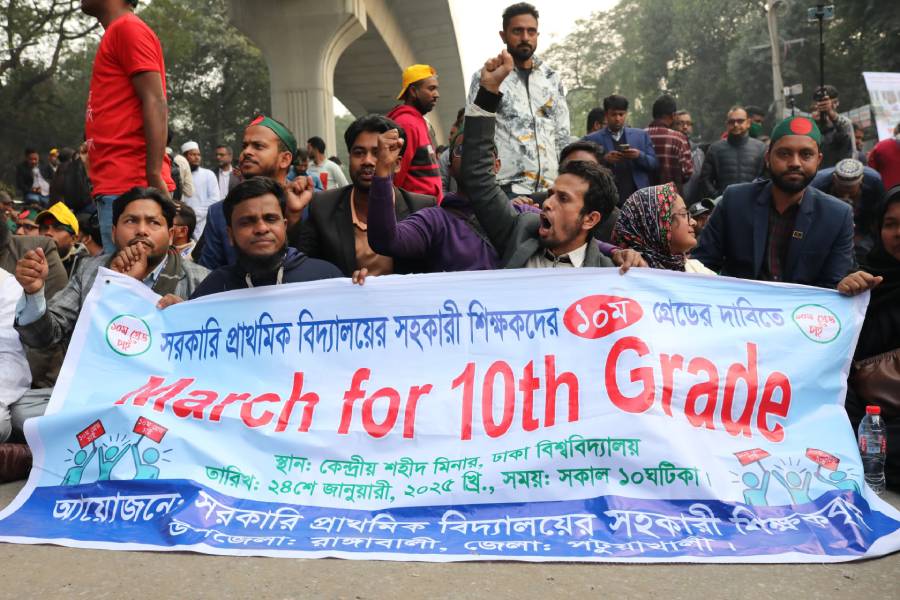
Annual examinations in most government primary and secondary schools across the country have been thrown into disarray and uncertainty as several groups of teachers launched an indefinite strike on Monday to press home their various demands, including upgrading their posts and securing a pay hike. While the fact that teachers are poorly paid and deserve a better salary is undeniable, the timing of the movement, enforced while annual exams are underway, has stunned guardians and conscious citizens alike.
Many guardians and students were not even aware that teachers would launch a strike from December 1. Students who arrived to sit for their exams on Monday were shocked to find that although teachers were present at the school they refrained from participating in any academic activities. In many areas, angry altercations erupted between guardians and teachers. Faced with vehement protests, principals of some schools conducted the examinations with the assistance of staff and guardians who volunteered to carry out exam related duties.
Launching a movement over legitimate demands is a democratic right of every citizen. But the question is why the teachers chose to enforce the strike in the middle of the annual examinations, a period of critical importance in every student's academic life. In plain sight, it appears that the timing of the protest was deliberately chosen to create additional pressure on the government to accede to their demands. Why would the teachers stoop so low as to use students' future as a bargaining chip for their own benefit?
In the face of widespread criticism, secondary school teachers called off their protest on Tuesday, saying that they would resume the movement after the examinations are over. But a section of primary teachers have threatened to organise an even tougher movement by 'locking the school' from Thursday if the government fails to fulfil their demands.
The teachers have to perform their duties with a sense of dedication. When the students cannot sit for their final examination at the fag end of the academic year, they are going to be affected adversely. The teachers themselves are aware of the damage they are causing to the students and have promised to take compensatory measures once the government meets their demands. It does not, however, sound very convincing.
One must also ask what toll this disruption would take on the mental state of students in government schools. Their peers in non-government institutions have already completed their exams and are preparing to enjoy the much-awaited December holidays, while they are stuck in a limbo.
Besides, many are also questioning the legitimacy of some of the demands of the striking teachers. For example, one of the four key demands of the secondary school teachers is the inclusion of assistant teachers in the ninth pay grade under the Bangladesh Civil Service (BCS) General Education cadre. They took the job fully aware that the post of an assistant teacher at a secondary school falls in the 10th pay grade of the government's pay scale. This pay grade was known to them when they applied, sat for the recruitment test, received the appointment letter and joined the post. Why, then, do they now claim they are subjected to "injustice"?
A job in the Bangladesh Civil Service (BCS) is one of the most lucrative and prestigious in the country. The BCS exams are also the most competitive public recruitment process in Bangladesh, with success rates as low as 0.2 per cent for all cadres and 0.05 per cent for general cadres, on average. Those who ace this test go through years of rigorous preparation, proving their dedication, brilliance and intellectual mettle in each step of this fiercely competitive recruitment process. How can one possibly demand recognition as a BCS cadre by resorting to a protest movement and holding students hostage?
That said, the quality of education at primary and secondary level in the country has indeed become a matter of concern. Most of the schools do not have the required infrastructure and other facilities needed to impart quality education. The saddest part of the story is that the schools, particularly in the rural areas, do not have qualified teachers. The result has been disastrous, to say the least. Today everybody is talking about poor standards of education and the ever-widening gap between private schools and the shabbily run government schools. As a result, a large chunk of the population is left out of the competition for lucrative jobs. The neglected primary education is responsible for this lopsided state of affairs.
Against this backdrop, it is ironic that teachers appear more concerned about augmenting their benefits through recurrent protests, with one group after another taking to the streets. During the tenure of the interim government over the last 16 months, schools were reportedly closed for at least six months as teachers protested in regular intervals, demanding higher salaries, post upgrades, nationalization, MPO enlistment and so on. As one group of teachers succeeds in realising demands through street protest, another is inspired to follow suit. In the process, millions of students are severely affected, at a time when they are yet to recover from the learning loss suffered during the Covid-19 pandemic.
Education has the highest budgetary allocations and, as such, it is really not desirable that the issue of teachers' salary will remain a perpetual concern. Given the complexity of the hierarchy in the government's pay scale, experts' call for a separate pay scale for teachers sounds logical. Why should teachers have to take to the street regularly for a pay hike? However, the education authorities must ensure that the performance of the teachers improves and that they are not neglecting classroom education to teach in coaching centers. So, the issue needs to be examined in all its ramifications. The government should initiate a dialogue with the teachers immediately and resolve the crisis without wasting any more time.
aktuhin.fexpress@gmail.com
Caption:
Secondary school teachers observed work abstention to press home their various demands
—Photo collected