

Published :
Updated :
 For all latest news, follow The Financial Express Google News channel.
The Road Safety Foundation (RSF), a private organisation involved with the study of road accidents in the country, reveals that in the just departed year 7,359 people were killed in 7,584 road accidents. More than 20 people met with the unnatural death on an average day in 2025. The RSF puts the number of injured at 16,476. Bangladesh does neither record the high fatality rates like some of the African countries such as Guinea and Nigeria nor as low as 2.1 casualty rate per 100,000 Japanese. Bangladesh's rate of fatality at 18.6 per 100,000 of its inhabitants is still higher than the global average. The rate is lower than Guinea's rate of 29.7 but higher than neighbouring India's 12.6 per 100,000 people although the absolute number of fatalities in India is the highest in the world. This is because of the enormous size of population in India. No wonder, China follows India with the absolute head counts.
Usually, the more developed a country is, the lower the fatality rates. But the United States of America is certainly an aberration in this regard. It is ranked third in terms of absolute number after China with the casualty rate of 14.2 per 100,000; whereas, the rate is only 2.6 in the United Kingdom. In a limited geographic area crammed with a large population, Bangladesh faces a heavy congestion in its poorly shaped urban centres and high risks on ill-managed roads, highways and rural streets. The majority of cars imported are second hand and other vehicles such as public buses and trucks hitting the roads too are well past their road-worthiness. There are complaints galore that those at the steering wheels of a significant number of such public transports manage driving licences without going through the standard driving tests. At times conductors and helpers of buses and trucks on the run replace the exhausted drivers.
The list of complaints comes out after almost every accident. Then it is conveniently forgotten without any follow-up action. The most important question here is, if the moderately high incidence of accidents can be brought down to the level of developed nations. There is no separate statistics of child fatalities in road accidents across the world and therefore the country or countries with highest child casualty in road accidents cannot be singled out. But like the high incidences of road accidents in lower- and middle-income countries in South Asia and Africa, the child fatalities are more likely to be in those countries as well.
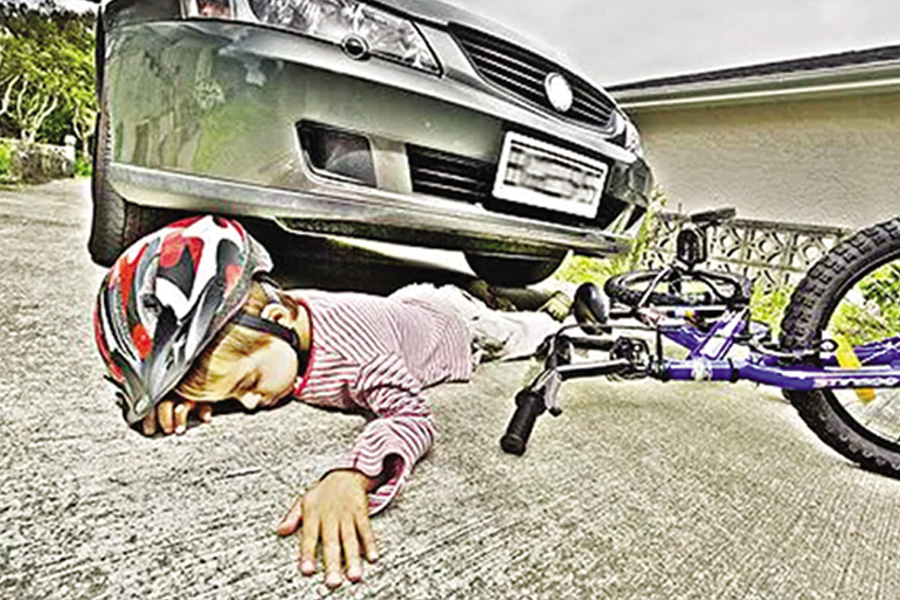
The RSF has shed light on this aspect of child vulnerability to accidents. Of the 7,359 persons killed in road accidents in Bangladesh, 1,008 are children in the age group of 1.0-17. Again, the percentage of children aged between 13 and 17 meeting with their premature death on account of road accidents is the highest. In fact, this teenage group of population enjoys some kind of freedom to roam about but are not thoroughly briefed of the traffic rules and regulations. According to the RSF, 179 children aged one month to five years met with fatal road accidents, accounting for 17.75 per cent of child fatality on roads. This number for children aged between six years and 12 years who met their end in road crashes was 382 comprising 37.89 per cent and the last group aged between 13 and 17 numbered 447 attributing to 44.34 per cent of the total number of road crashes.
What is particularly significant is that children meet with accidents more on rural roads than on urban ones. In cities like Dhaka, teenage students are seldom allowed to go to schools or any other place alone particularly when road crossing is necessary. But the roads and highways that run alongside homesteads in rural areas may not be as busy as those in urban centres but allows children to throw caution to the wind when playing nearby or on road itself or going to schools or returning home. There is no designated lane for pedestrians to walk on. In the absence of the traffic police, the drivers drive their vehicles at breakneck paces. Small children's low height also does not come into sight from afar. But when the small figures do, it is too late. Yet child pedestrians are not the majority of road-accident victims, rather they fall victim to road crashes when they move from one place to another as passengers, helpers and significantly as drivers.
Fatal accidents do not discriminate between men and women, children and adults. But small children are not allowed to travel alone without an adult company. Yet reckless driving and a lack of awareness on the part of children are responsible for road accidents. It is understandable that roads and highways have little option for constructing designated lanes for pedestrians all along the entire length of inter-district roads and highways. But at least such lanes can be created alongside certain lengths of roads and highways near schools, bazaars and mosques. In case, hats or bazaars sit right on the roads, convenient venues should be found for arrangement of local financial hubs.
Road use is a very important subject. The anarchy people witness to on a daily or weekly basis in rural areas calls for disciplining such activities. So far as schools and other educational institutions are concerned, a campaign for responsible road use among students should be launched at those institutions. Such programmes along with creation of designated lanes or sidewalks like footpath in town and cities can at least arrest road fatalities among children. When this happens, the spill-over benefits can be reaped by the elders as well. Streamlining the traffic movement either in the capital or in rural areas is daunting but it is not impossible provided that there is a strong will to find a way out.
nilratanhalder2000@yahoo.com