


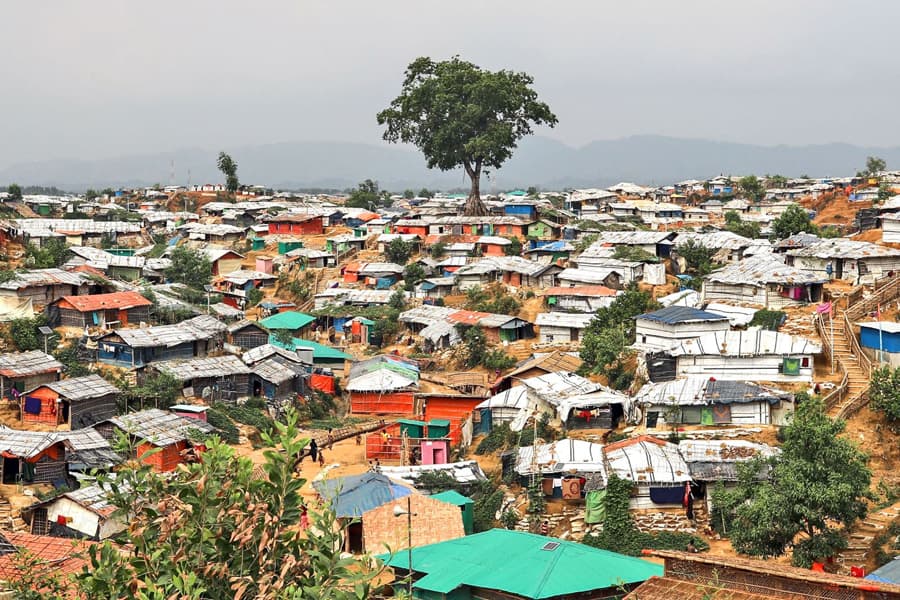
In the wake of a violent crackdown by the Myanmar military against the Rohingya population in the Rakhine State of Myanmar starting on August 25, 2017, more than seven hundred thousand Rohingya people fled to Bangladesh for safety. Before the massive influx from Myanmar army's August 2017's genocidal campaign against the Rohingya, between 300,000 and 500,000 Rohingya refugees had already been living in Cox's Bazar. Those arrivals were also triggered by Myanmar regime's previous instances of ethno-religious persecution of the Rohingya in 1978, 1991and in October 2016.


Such widespread atrocities, including killings, sexual violence and arson perpetrated on a massive scale, brought the total number of Rohingya in Bangladesh to over a million, most of whom were sheltered in camps in the Cox's Bazar district. Despite its being one of the Least Developed Countries (LDCs) with a very large population of about 170 million to feed and the attendant socio-economic problems it has been grappling with, Bangladesh still showed the goodwill and generosity to give shelter to these victims of persecution in the neighbouring country. International community including the UN praised Bangladesh's role and promised that efforts would be there to put pressure on the Myanmar authorities to take back their nationals. Meanwhile, promise of adequate relief and aid was made by the donor community so Bangladesh could accommodate more than a million refugees for the time being. But now about nine years after the last genocidal campaign against these people by their own government in Myanmar, there is still no sign that Rohingya crisis is going to be resolved anytime soon.
The Rohingya repatriation talks between the Bangladesh government and Myanmar regime has remained effectively stalled due to the ongoing conflict in the Rakhine State of the country. Believing that the Myanmar authorities would make good on their word that Rohingya refugees would be repatriated, Bangladesh previously submitted the data of over 829,000 refugees to them. Through verifying a list of close to 355,000 individuals, they also recognized some 180,000 as eligible for repatriation in early 2025. But worsening security situation in that country seems to have dimmed that prospect, too. Now with drastic cuts in aid for the Rohingya refugees by the donor community, there is reason for concern in Bangladesh. Is then Bangladesh going to bear the burden of hosting the Rohingya regugess forever? Worse yet, the ongoing civil war in Myanmar has forced another wave of over 150,000 Rohingya to enter Bangladesh to add to more than a million Rohingya already residing here as refugees. The refugees who have been living here for about a decade are also increasingly getting frustrated about their own as well as their children's future. So, many of them are trying to settle elsewhere across the sea.
Meanwhile, the United Nations High Commissioner for Refugees (UNHCR), the global agency for refugees, has recently revealed that nearly 900 Rohingya were reported dead or missing in the Bay of Bengal and Andaman Sea last year (2025). The UN agency added that it was the deadliest year on record for maritime movements in South and South East Asia. As if that was not enough, thousands of fresh members of this community continue to make dangerous journeys. More than 2,800 Rohingya have reportedly attempted such dangerous crossings this year. Going by the trends in recent years, more than half of these Rohingya trying to cross the sea are women and children. In this connection, a spokesman for UNHCR further noted at the UN agency's headquarters in Geneva recently that in this manner some 5,000 Rohingya refugees are thought to have drowned at sea over the last decade. Clearly, Rohingya people from both the refugee camps at Cox's Bazar in Bangladesh and from the Rakhine State in Myanmar where civil strife is continuing, are risking their lives in overcrowded trawlers in their desperation to go overseas in search of a better life.
It is against this backdrop that the Bangladesh Foreign Minister Khalilur Rahman has called upon the global community to scale up funding, ensure stability and security in the Rakhine State and take urgent measures to safeguard human rights. The foreign minister made this well-meaning statement during a discussion event at the Antalya Diplomacy Forum 2026 in Turkey. But will the global community hear his appeal when the Trump administration has paused nearly all foreign aid in January, 2025? This has practically halted contributions from the world's biggest contributor, the USA, to all the humanitarian aid at the UN or other refuge-related international fora. So, to ensure that it is not a lone voice in the wilderness, it is time we also looked for alternative sources of financial support for the Rohingya as well as the required political backing to resolve the issue of repatriating the Rohingya in their own homeland. However, that effort should also involve prevailing upon the Myanmar authorities and the insurgents in the Rakhine State to end hostilities so the Rohingya might return to their homeland safe, voluntarily and with dignity. Recalling his previous efforts as adviser to the interim government towards resolving the complicated Rohingya issue, it is indeed reassuring to learn that he has described the Rohingya crisis as something 'resolvable'. Hopefully, he would be able to mobilize necessary international support to this end so Bangladesh might get rid of the burden of Rohingya refugee in the foreseeable future. Notably, earlier, the UN refugee agency, UNHCR and the International Organiztion for Migration (IOM) made urgent appeals to the international community to step up solidarity and sustain funding to support lifesaving assistance for the Rohingya refuges in Bangladesh.
The government should draw on the genuine international efforts to help the country get around the apparently intractable issue of Rohingya refugees. And this should also be to the best interests of the Rohingya people who are our fellow human beings in distress. There is no reason to think that they are a disposable lot. Unfortunately though, falling under the toxic spell of identity politics, the world is now seeing the return of tribal hatred that has shattered the veneer of Western democracy and all the lofty values they claimed they stood for. The fate of Rohingya is linked to the rise of such hate politics in Myanmar. One would like to believe that through sustained and concerted efforts of the international community, the darkness would soon be over and the Rohingya refugees would be able to return home with dignity.