

Published :
Updated :
 For all latest news, follow The Financial Express Google News channel.
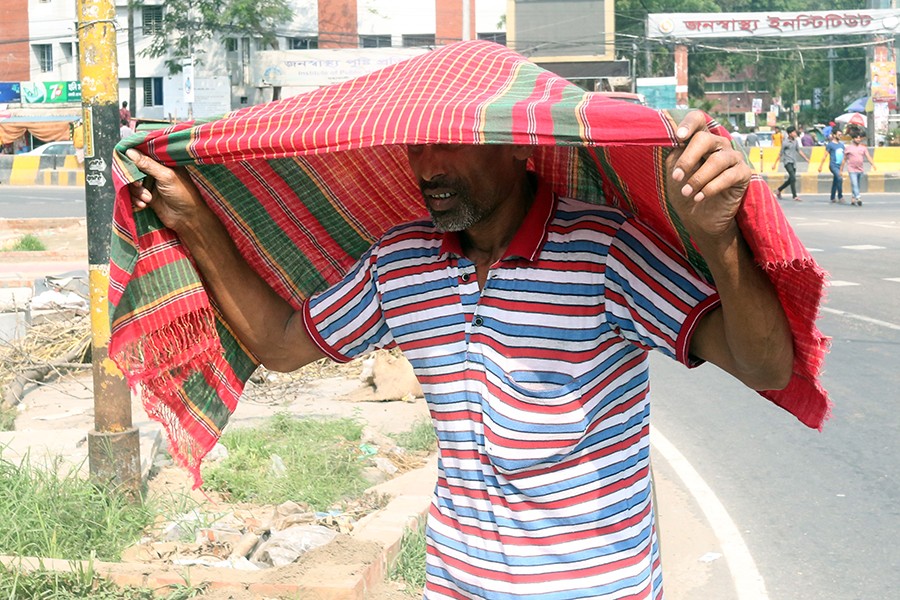
A heatwave is now sweeping over most parts of Bangladesh. Dhaka has recently recorded its hottest day in 58 years with the temperature rising to 40.6 degrees Celsius on Sunday (April 19). The intensity of the heatwave is more or less the same elsewhere in the country with the mercury hitting above 42 degrees in some areas. But when it comes to the feeling of heat or of temperature in Dhaka city, it is five to six degrees more than the actual mercury reading. The 'feels like temperature' is a measure of how hot it really feels for a human body when humidity is factored in. The heat is particularly felt more in congested cities like Dhaka, than where there is hardly any room for greenery and water bodies. A survey of the Centre for Atmospheric Pollution Studies has found that summertime temperature in Dhaka is 3-5 degrees Celsius higher in heavily urbanised areas than in areas with more green coverage and water bodies. That means the more trees we have around us, the less heat we feel in the environment.
Heat often gets intensified in cities, a phenomenon known as the urban heat island effect. It is a condition in which a city experiences much warmer temperature than rural areas. Researchers have found that many areas in Dhaka are turning into urban heat islands very quickly because of unplanned urbanisation. Asphalt and concrete of a city absorb and retain more heat than vegetation. So, temperatures in Dhaka city are often hotter than villages. In areas with fewer trees and water bodies, the feeling of heat is more intense than in the areas with more greeneries. As temperatures rise, so does the use of air conditioners, which requires more electricity. And to generate more electricity, we need to burn more fossil fuels, which contribute to global warming. The increased heat, along with poorer air quality, gives rise to various health issues, especially among the elderly and children. Extreme heat is often responsible for heat stroke and other illnesses, which can be deadly.
Bangladesh is quite experienced in tackling cyclones and floods. But we have yet not taken heatwaves into consideration as a natural disaster. In fact, we do not even keep statistics of heat-related deaths. This year's hot season has just set in. And temperatures will continue to rise in the days to come. So, it is time for all of us to help people survive the impending heatwaves. Our rooftops should be painted white so that they can reflect, rather than absorb, heat. Measures should be taken to expand green spaces in cities because trees, plants, and grass cool down surrounding areas. One way to curb urban heat is to plant deciduous trees. These trees are good for cities since they block sunlight during the summer, lessening the impact of the urban heat island. Another way could be having as many rooftop gardens as possible in Dhaka city since such gardens help ease the intensity of heat in the city.
bjoy177@gmail.com