

Published :
Updated :
 For all latest news, follow The Financial Express Google News channel.
Bangladesh is a nation shaped by water. With approximately 3,865 kilometres of navigable inland waterways in the dry season and nearly 5,968 kilometres during the monsoon, the country relies profoundly on river and coastal transport for commerce, connectivity and livelihood. The national fleet comprises 12,433 inland vessels, 107 foreign-going ships, 187 coastal dry cargo vessels, 210 coastal tankers, 21 LPG tankers, 23 container vessels, 21 passenger vessels and 265 fishing boats. These figures alone demonstrate that maritime and river transport is not a peripheral sector-it is central to the country's economy and daily life.
Yet, despite this vast and active fleet, Bangladesh still lacks a strong, internationally recognised national classification society. A classification society is an independent technical institution responsible for developing construction and maintenance standards for ships, conducting surveys and inspections, and issuing certificates to confirm compliance with safety and environmental requirements. Around the world, successful maritime nations have relied on strong national classification bodies as technical guardians of safety and as engines of maritime growth.
In India, the Indian Register of Shipping evolved from a domestic initiative into a globally respected institution, supporting ship safety, regulatory compliance and technological advancement. In Japan, Nippon Kaiji Kyokai-widely known as ClassNK-has long played a decisive role in strengthening Japan's fleet and shipbuilding industry. Similarly, China Classification Society has contributed significantly to China's maritime expansion, maintaining strict standards while enhancing global credibility. These examples illustrate that a well-structured national classification society is not merely a certifying authority; it is a cornerstone of maritime sovereignty and industrial development.
For Bangladesh, the establishment of a technically competent and independent classification society could dramatically improve vessel safety across inland and coastal waters. Many domestic maritime accidents are linked to substandard construction, poor maintenance, weak enforcement of technical standards and inadequate inspection regimes. A professional classification body could introduce structured survey systems, digital inspection records and transparent certification procedures tailored to the realities of Bangladeshi waterways. Such reforms would reduce loss of life and property while strengthening the confidence of cargo owners, insurers and international partners.
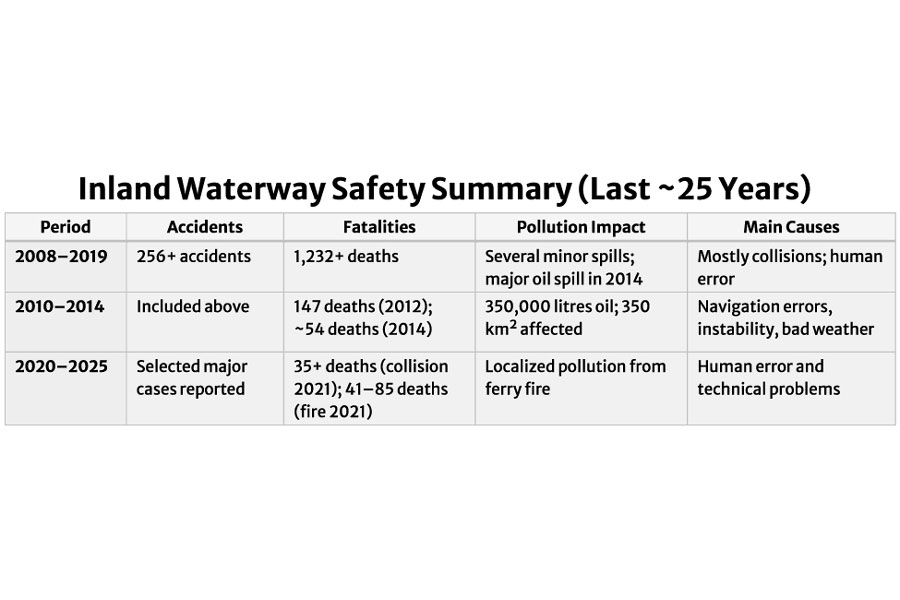
The urgency of reform becomes clearer when examining the accident record. Between 2008 and 2019, more than 256 inland waterway accidents were officially recorded. During this period, over 1,232 people lost their lives, at least 129 were injured and 359 were reported missing. Collisions remain the most frequent type of incident, particularly during the monsoon season when rivers become swollen, congested and unpredictable.
Among the most tragic incidents in recent decades was the sinking of MV Shariatpur-1 in 2012, which claimed 147 lives. In 2014, MV Miraj-4 capsised, resulting in approximately 54 fatalities. In 2021, ML Rabit Al Hasan sank following a collision, and MV Avijan-10 was devastated by a catastrophic fire, leading to further loss of life. Environmental consequences have also been severe. In 2014, approximately 350,000 litres of furnace oil got spilled into the Sundarbans following a tanker collision, contaminating roughly 350 square kilometres of fragile mangrove ecosystem and threatening biodiversity in one of the world's most sensitive natural reserves.
A review of accident patterns over the past 25 years reveals consistent root causes: human error, poor watchkeeping, navigational misjudgment, overloading of passenger vessels, inadequate crew training and weak adherence to safety procedures. Technical deficiencies-including structural weakness, poor machinery maintenance and engine room fires-have compounded these risks. Regulatory enforcement gaps and inconsistent inspection practices have further aggravated the situation.
A national classification society could address many of these systemic shortcomings. By developing localised construction rules suited to riverine conditions, enforcing structured maintenance standards and maintaining secure digital survey databases, it could bring discipline and transparency to vessel certification. Regularised inspection regimes would reduce discretionary approvals and limit opportunities for corruption. Over time, a culture of compliance would replace reactive enforcement.
Beyond safety improvements, such an institution would create high-value employment opportunities for marine engineers, naval architects, surveyors, auditors and maritime administrators. Bangladesh produces qualified maritime professionals every year, yet many seek opportunities abroad due to limited technical institutions at home. A national classification society would help retain domestic talent and foster a knowledge-based maritime economy. It would also reduce reliance on foreign classification bodies for domestic vessels, thereby lowering costs and reinforcing national autonomy in maritime governance.
In this framework, the Department of Shipping would retain a crucial but distinct role. Rather than directly managing technical certification processes, the Department should act as the regulatory authority overseeing and auditing the activities of the classification society. Clear institutional separation between regulatory supervision and technical certification would create essential checks and balances, promoting transparency, accountability and integrity.
Regrettably, attempts by Bangladeshi marine entrepreneurs to establish a national classification society in the past did not materialise. Within the sector, it is widely understood that such initiatives encountered bureaucratic resistance, allegedly influenced by personal interests and opportunities for discretionary control. Whether through inertia or vested interests, these failed efforts have delayed institutional reform and allowed opaque processes to persist.
For a future initiative to succeed, the government should establish an independent expert committee comprising experienced Bangladeshi mariners, naval architects and surveyors working both domestically and internationally. Many Bangladeshi professionals currently serve in foreign maritime administrations and global classification societies, gaining exposure to advanced regulatory frameworks and best practices. Their technical expertise and international experience could form the foundation for drafting governance structures, operational rules and compliance systems aligned with global standards while tailored to local conditions. Building the institution on merit and professional competence-rather than bureaucratic control-will be essential to its credibility.
Above all, strong political commitment is indispensable. Meaningful reform requires courage to confront entrenched interests and eliminate avenues for corruption. Establishing a transparent, autonomous and technically robust classification society is not merely an administrative decision; it is a statement of national intent. If Bangladesh aspires to modernise its inland and coastal shipping sector, prevent avoidable maritime tragedies and restore public confidence, it must move decisively toward institutional reform.
Bangladesh possesses vast waterways, a growing fleet and a proud maritime heritage. What it now requires is the institutional backbone to safeguard that potential. By creating its own credible classification society-guided by national expertise and supervised through firm regulatory oversight-the country can strengthen safety, promote transparency, stimulate maritime innovation and secure a sustainable future for its shipping industry.
Capt. Faisal Azim, Marine Operations Specialist - ISM Standards, Group Ocean, Quebec, Canada. Ex Principal, National Maritime Institute, captfaisalazim@gmail.com