

Published :
Updated :
 For all latest news, follow The Financial Express Google News channel.
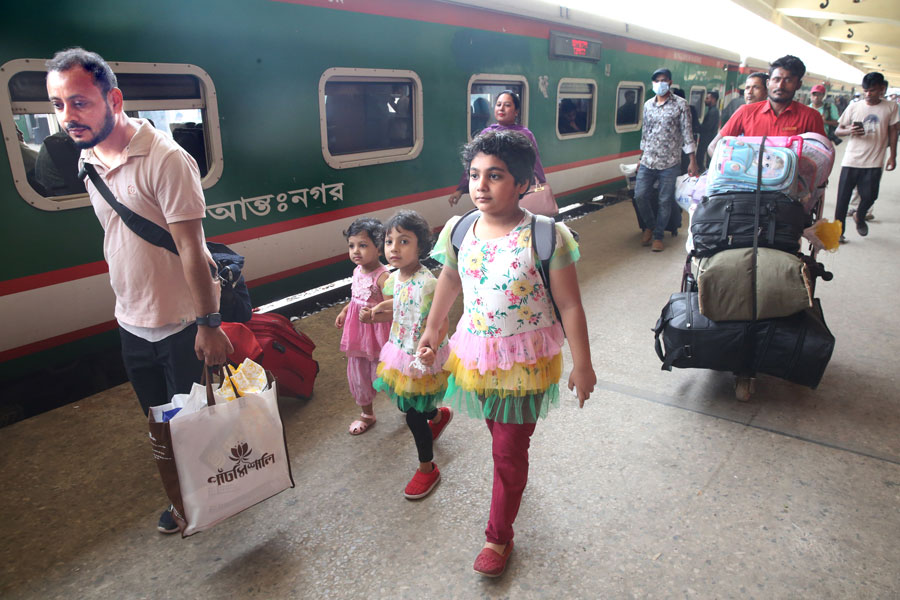
That modern Dhaka, the nation's capital city, is still young, can be observed during each Muslim festival of Eid when the city crowds get thinner and the roads become near empty. The city already looks sparse as a large segment of its population has meanwhile left the city to reunite with their parents and kith and kins in the countryside. During this Eid-ul-Fitr around 15 million people will leave greater Dhaka area, according to an estimate. That means it's an exodus on a humongous scale and 60 per cent of these Eid holidaymakers are expected to be travelling by road, while the rest are going to use railway and waterway. The overall transport sector is preparing for about 227.4 million passenger trips across road, rail, water and air between March 20 and March 31. Despite the rising cost of travel due to fuel price hike, millions will still travel to distant corners of the country to celebrate the Eid festival with their close relatives.
It appears, the people who live and work here in the capital city the rest of the year, become homesick on the eve of each Eid festival and leave the city in droves for their real homes in rural Bangladesh. They live in the city like domestic expatriates for work and return where their root lies in the countryside during the Eids. Here we are talking about the very modern Dhaka, not the four centuries old capital of the Mughal province of Bengal that was established in 1610 under the reign of Emperor Jahangir. It is not even the provincial capital of the then-East Pakistan when it was a sleepy town of hardly one million. The new Dhaka is the one that burst into prominence after it became the capital of an independent nation. As the migration towards the capital Dhaka began on a massive scale after Independence, the city population exploded. According to the estimate of the UN World Urbanization Prospects, in 2026, the population of Dhaka megacity is 32.6 million. Other estimates say, the population of metropolitan Dhaka is 25.4 million. Whatever the estimates, the overwhelming majority of the capital city's population cannot be called urbanites as they are yet to put down roots in the capital city. Even so, it is they who dictate modern Dhaka, not the urbanites who have been living in the city for many generations. In fact, the new residents of the city who do not stay in the city to celebrate the Eid contribute more to the city's economy than its permanent residents.
Actually, they contribute the lion's share to the city's Eid economy. According to an estimate Dhaka contributes about 46 per cent to the country's GDP. And the manufacturing workforce of of the city's garment industries contributes 55.58 per cent to the city's economic output. A large segment of the professional, administrative and industrial labour classes who are the driver of the city's rapid economic growth belong to the population who are not permanent residents of the city. The rickshaw-pullers who are part of the city's informal economy in the service sector numbering roughly around one million supporting the livelihood of some two million people do not belong to this city and leave it during each Eid festival. So are the restaurant workers, shop assistants, street hawkers and domestic aids of the capital city.
The night before the Eid prayers (Chand Raat), which is the critical high-volume last-minute shopping period serves as the culmination of the overall Eid-ul-Fitr retail trade frenzy. The total pre-Eid retail sales in Bangladesh is estimated to be around Tk.2 trillion and a significant portion of this trade is transacted during the chand raat. The capital city's chand raat definitely contributes substantially to the nation's Eid economy. And this is despite the fact that the Eid trade at the shopping malls in the city is reported to have been rather dull though the crowds were as large as during the previous Eids.
sfalim.ds@gmail.com