


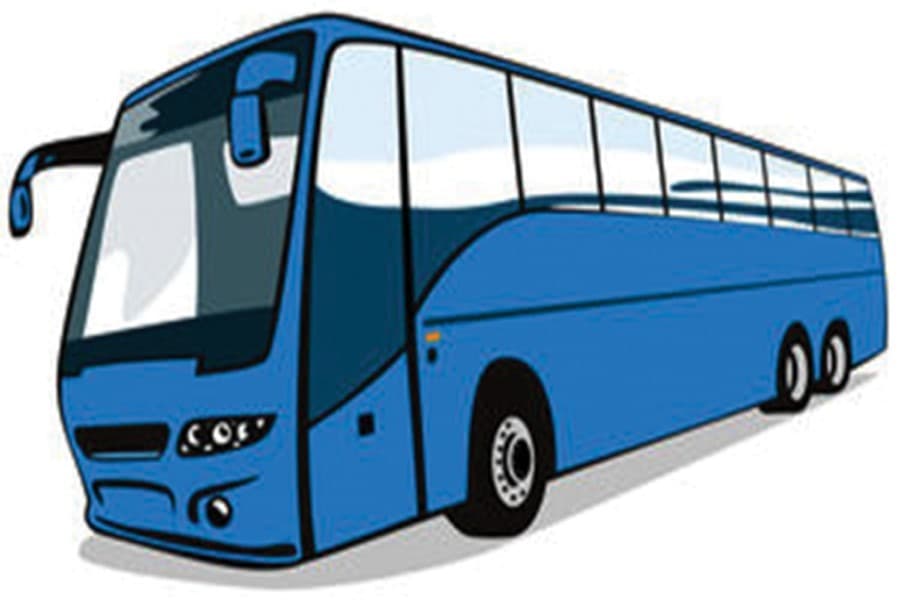
To facilitate commute for visitors to the 30th Dhaka International Trade Fair, taking place at the Bangladesh-China Friendship Exhibition Centre in Purbachal, the Bangladesh Road Transport Corporation (BRTC) has pressed into service shuttle buses. The shuttle buses will operate daily from multiple locations in Dhaka and surrounding districts to the fair venue. The trade fair-bound shuttle service is not new; the state-owned transport corporation has been operating it for the past few years. Though the service is still not efficient, it suggests that a dedicated shuttle service could make commuters' daily journeys easier to some extent.
Shuttle service is a transportation service meant for vehicles' frequent travel between two locations. Generally, there is no drop-off or pickup point in between the two end destinations to make the journey smoother and safer. In Dhaka City, where public transport is chaotic and public buses are a nightmare, a well-designed shuttle service is necessary at key destinations such as the airport, rail stations, metro stations, and inter-city bus terminals.
Shuttle service from different metro stations to nearby key junctions can easily reduce traffic congestion caused by the proliferation of battery-run rickshaws. For instance, shuttle buses can easily transport large numbers of commuters from Farmgate metro station to Asadgate intersection, or from Agargaon station to Shamoly intersection. Airport shuttle service can pick up airport-bound passengers from several dedicated points in the city and transfer them to both domestic and international terminals. In a similar vein, passengers who arrive at the airport can board shuttle buses to key points in the city for onward transfer. In a city where commuting is a daily test of patience and stamina, an extensive shuttle service can be a relief.
Students at schools and colleges also need a shuttle bus service to help reduce congestion. Only a few educational institutions provide transport services for their students and teachers. For the others, BRTC can offer shuttle buses with dedicated boarding and departure stops.
Many office-goers, who mostly depend on chaotic public buses, may also opt for shuttle services if they are provided on time. Busy commercial areas like Motijheel need to be free of rickshaws during the morning and evening when offices start and end, respectively, to ensure free movement of shuttle buses. For instance, shuttle buses will stop at a certain point in Motijheel to drop off and pick up passengers. Those who avail of the service will walk up to the boarding point.
As shuttle services for offices and educational institutions are time- and area-bound, they will not operate during off-peak hours. In that case, the authorities need to allow the operators to run buses on dedicated, short routes to earn some money. The authorities also need to ensure that the shuttle service does not become a competitor to the regular public bus services.
Both the BRTC and private operators can run the services. At present, a few private shuttle bus services are available for limited destinations at high fares. These are quite inadequate for the thousands of commuters in Dhaka, where the daily travel is not just about time and distance, but about day-to-day survival.
A number of barriers, however, exist to make a shuttle service effective and efficient. Setting the routes is the biggest challenge due to the many overlapping and mixed public bus routes. To avoid conflicts with unruly bus services, shuttle routes need to be designed to focus on offices, educational institutions, and key public services. Again, commuters in Dhaka are largely undisciplined and unwilling to follow strict rules. Since shuttle service usually does not offer drop-off or pick-up between the dedicated departure and arrival points, it is necessary to ensure there are no stops along the route. The buses have to run in gate-lock mode, with the gates open at arrival and departure points.
As the public transport sector is heavily criminalised by the prevalence of rent-seekers, it is a major challenge to contain them through strict regulations. Otherwise, shuttle services will not deliver optimal outcomes, and commuters will continue to suffer despite paying more.