

Published :
Updated :
 For all latest news, follow The Financial Express Google News channel.
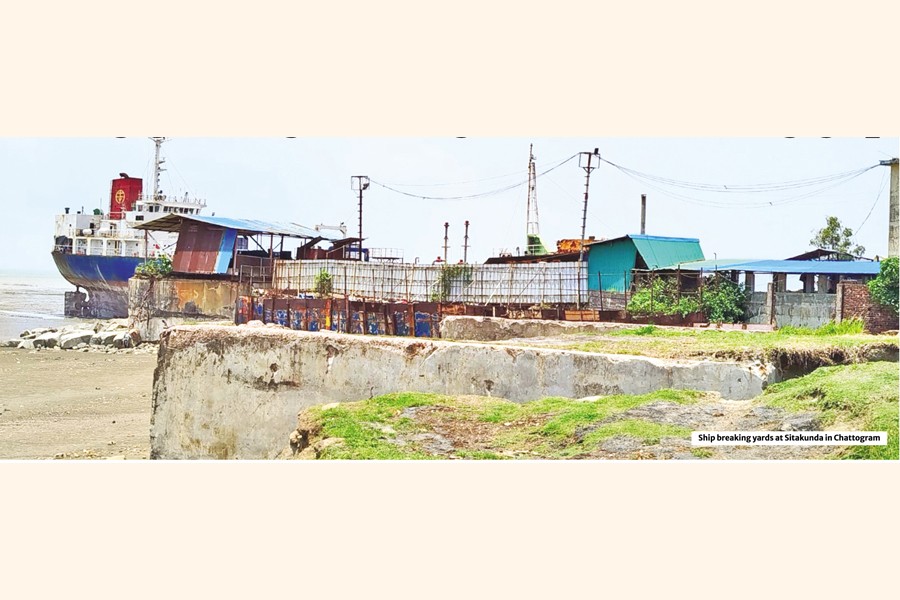
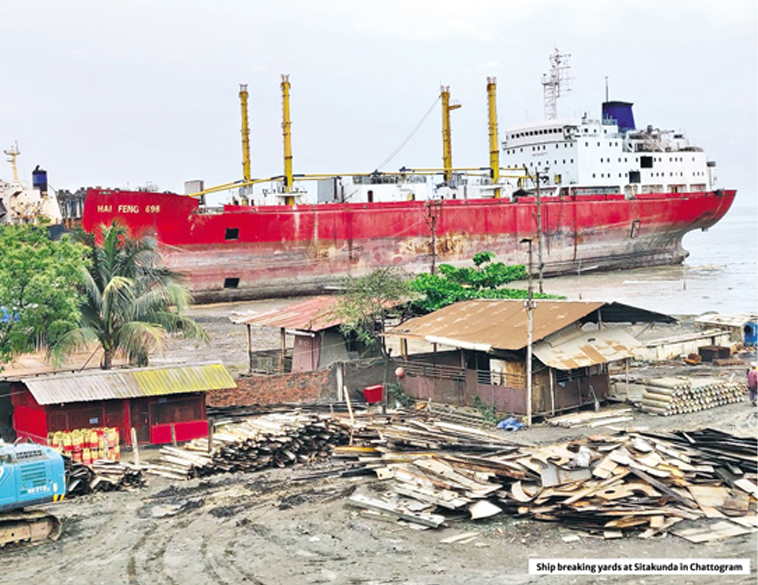
The ship-breaking industry in Chattogram, which was categorised as "Red" by the Department of Environment (DoE) on April 26 of 2023 is yet to be categorised as "Orange. As a result, the industry is suffering a lot and the supply of scrap iron for re-rolling mills in the country is being hampered. Although there are about 150 shipyards in the country, only 25 to 30 are currently operational.
Bangladesh Ship Breakers and Recyclers Association (BSBRA) urged the government several times to re-categorise the ship-recycling industry (SRI) as 'orange' from the current 'red' classification.
The BSBRA has expressed concern that the ship-breaking industry has been classified red again without taking any opinion from the stakeholders and the Ship Recycling Board.
Now, the industry is facing significant headwinds, with import of scrap vessels plunging by 36 per cent in the first half of 2025. The setback is largely due to new regulatory requirements, delayed clearances, and procedural complications under a stricter global compliance framework. The ship breakers imported a total of 57 end-of-life ships during the January-June period in 2025, down from 89 ships in the same period of 2024. The downturn comes as Bangladesh transitions into compliance with the Hong Kong Convention (HKC), which officially took effect on June 26, 2025.
Besides, the annual data also reflects a broader slowdown. Bangladesh dismantled 130 vessels in 2024, compared to 170 in 2023, 122 in 2022, and 254 in 2021. The number stood at 144 in 2020, 236 in 2019, and 185 in 2018.
Industry insiders blame the sharp drop on the absence of DASR (Document of Authorization to Conduct Ship Recycling), which is now mandatory under the HKC regime. The government has yet to finalise the necessary criteria for issuing DASR, making it impossible for local yards to import vessels legally.
Ship-breakers are now facing multiple bureaucratic hurdles, including prolonged delays in obtaining environmental clearance and other approvals. No Objection Certificates (NoC) have not been issued since March in 2025. The industry's reclassification from 'orange' to 'red' has only increased paperwork and waiting times.
Acting president of BSBRA Zahirul Islam said, "In June 2023, the HKC was ratified for the safe and environmentally sound recycling of ships and its enforcement started on June 26 this year, meaning all yards have to be compliant by this time."
He urged the government to extend the HKC enforcement time until 2030 to help all shipyards become compliant. He said some seven so far received green certification while 15 others were under the process.
Bangladesh remained the top ship breaker during the last decade, he said, adding the industry has been facing a number of challenges including absence of green financing, high rate of US dollar and bank interest rate.
He said an additional investment of US$5.0-10 million was required to make a yard compliant in line with the HKC while the banks were not willing to invest.
Moreover, due to red categorization of the industry, they needed additional two to three months to get the cutting permission from the environment ministry, he alleged.
 Md Abu Taher, former president of BSBRA, said, "Environmental Conservation Rules-2023 has classified the ship breaking industry red, imposing the obligation to obtain a second round of clearance from the office of the Director General of the DoE for each ship prior to division, so there will be an additional delay of one and a half to two months in getting any permission for breaking a ship. Also, industrial entrepreneurs are afraid of being subjected to additional complications and harassment."
Meherul Karim, Chief Executive Officer (CEO) of KSRM Group, told The Financial Express that Kabir Ship Recycling Facilities, a ship-breaking yard of Kabir Group, obtained the certificate of 'Green Yard'. The yard received certificate as 'Green Yard' from three different international certification bodies. He said, "A total of four recycling yards have obtained green certification while dozens are in the pipeline."
"Owners have been working for developing the ship-breaking sector and upgrading it to a safe and environmentally sound ship recycling yard under the Hong Kong Convention (HKC) for a long time. But, unfortunately, the industry is categorized as "Red" by DoE," he said.
He said, "Yard owners count huge loss for a delay in obtaining an environmental clearance from the DoE. The Chattogram office of DoE cannot issue the certificate and yard owners have to come to Dhaka office. The owners need an additional one to two months only to meet the procedures."
The owners of ship breaking yards alleged that while the industry was moving forward to meet HKC and become environmentally compliant, putting the industry in the red category had been pushing it back. They demanded that the government simplify the process of classification of ships by reclassifying them from red to orange-B.
The Ministry of Forest, Environment and Climate Change published the Environment Protection Regulations-2023 on April 26 in 2023, reclassifying the shipwreck industry from orange to red. Entrepreneurs of this industry as a result landed in trouble now.
A 14-member delegation of the Japanese Ship-owners' Association (JSA) came on a 4-day visit to the port city in May 2023. The delegation visited 6 ship-breaking yards in Sitakunda including three green yards -- PHP Ship Recycling, Kabir Ship Recycling Facilities and SN Corporation.
The team was led by Keiji Tomoda, Vice President of the Japanese Ship-owners Association. Keiji Tomoda said, "Government support can help exhilarate the development of ship-breaking industry in Bangladesh which has a bright future. Ship-breaking industry of Bangladesh is developing very rapidly. Many of the ship-breaking yards have upgraded their technologies and trying to comply with the Hong Kong Convention."
A Greek ship named "MV Alpine" was stuck on the coast of Sitakunda in Chattogram in 1960, following a cyclone. The sight of this colossal ship ignited curiosity among the locals. People flocked to see it, some even attempting to board. However, for five long years, the ship remained stranded, unable to be salvaged.
Later, in 1965, the Chittagong Steel House purchased the ship. Without any prior experience, they employed local labourers to dismantle the ship using traditional methods and recover scrap metal. This marked the introduction of the term 'shipbreaking' in the port city.
During the Liberation War in 1971, a Pakistani ship, "Al Abbas", was damaged by allied forces and was salvaged and brought to Faujdarhat at Sitakunda in Chattogram. Karnaphuli Metal Works Limited purchased the ship and later sold it as scrap in 1974, making a profit. This marked the beginning of commercial shipbreaking in Bangladesh. In the 1980s, the import of scrap ships began commercially for the first time. Gradually, shipbreaking activities increased, and it was recognised as an industry.
Domestic businessmen and industrialists started investing in shipbreaking. Since then, it has been known as a profitable industry. In addition to old investors, new entrepreneurs are now joining this industry. The flourishing industry in the Sitakunda coastal area significantly increased the income of people in the shipbreaking yard area. A shipbreaking yard involves a variety of work and trade in various goods. Thus, it provides employment for thousands of people.
The shipbreaking industry started its journey in 1970 at Sitakunda in Chattogram. Around 40,000 workers are engaged in the ship breaking industry of Chattogram. On average more than 3.0 million (30 lakh) tonnes of scrap ships are imported by Bangladesh now, which is more than 25 per cent of total scrap ships of the world. The total turnover of the ship breaking industry is around 50 billion (5000 crore) taka per year. A total of four types of old vessels are scrapped in the shipyards of Sitakunda. The vessels are Turbine Tanker (TT), Motor Vessel (MV), Steam Vessel (SV) and Fishing trawler (FT). Of them scrapping of Turbine Tanker is very much dangerous.
nazimuddinshyamol@gmail.com