

Published :
Updated :
 For all latest news, follow The Financial Express Google News channel.
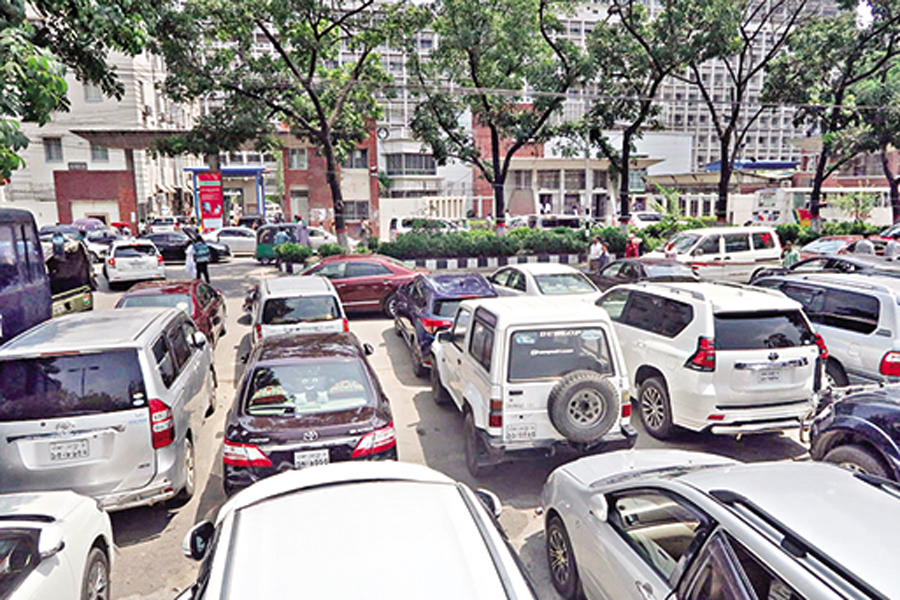
Dhaka is often called a city in motion, but for millions of its residents, movement is what the city cannot ensure. Time is wasted in the congestion on roads, and the journey becomes an arduous affair. Among the myriad reasons for this perennial congestion on the city roads, one factor stands out as the most conspicuous -- the illegal parking on roads.
The city faces the critical challenge of insufficient road space with only 7 to 9 per cent of its total area dedicated to roads. This figure sharply contrasts with the globally recommended 25 to 30 per cent of space for roads. The situation becomes compounded by the fact that even this insufficiently provided road space cannot be used for movement due to the large amounts of the roads being occupied by parked vehicles.
This can be seen most prominently in and around transportation hubs like Gulistan, Mohakhali, Sayedabad, and Gabtoli. Though these places are supposed to act as important transportation arteries for the city, they have virtually turned into open parking lots. Buses are parked haphazardly on busy roads, leaving little room for other vehicles to move and at some places choking multi-lane streets to single-lane passages, causing traffic snarls that affect the entire city.
The economic implications of it are staggering. According to the Bangladesh Passenger Welfare Association, traffic congestion costs Dhaka about 8.2 million working hours daily. This means loss of productivity, increase in fuel consumption, and aggravation in mental stress.
At the center of this problem is the lack of regulatory oversight. Any company or person wishing to obtain permission from the Bangladesh Road Transport Authority (BRTA) to operate buses is obliged to show that they have adequate parking facilities for their vehicles. On paper, this condition is met but in practice, the vast majority of bus owners do not have parking facilities. Rather, they make use of public roads to serve as their parking facilities.
There are rules against such illegal parking but they are hardly being enforced. It is the responsibility of the traffic police to ensure that no parking takes place on roads. However, this is not always the case. There is a general belief that parking is being done illegally with the knowledge and acquiescence of those responsible for preventing this practice.
The allegations of collusion are hard to ignore. It is a general perception that politically powerful segments control some areas of the transport sector - they receive money from bus owners in return for permitting them to use public roads and share part of this money with law enforcement personnel. Whether or not these accusations are substantiated, the prevalence of illegal parking suggests that these operations are permitted to a certain degree.
What is most disappointing is that this brazen misuse of public space occurs before the eyes of everyone. Policymakers and law enforcement agency people pass by it, ordinary people commute past it, and pedestrians go around it on a daily basis. Though sometimes the authorities run drives against illegal parking but they are sporadic and lack consistency. Soon after the drives finish, things go back to normal as if nothing has changed.
This is an outcome of an even deeper problem within our system of governance. Over time, it is noticeable how a handful of powerful players have come to dominate our system. This was particularly evident within our system of governance during the long period of rule by the Awami League. It was believed that with a change in political leadership, things would improve. However, as is often the case, things continue as before, with only the beneficiaries of such systems changing. The failure to eradicate illegal parking with successive changes in political leadership is an outcome of this. Bad systems, once rooted, do not automatically disappear with changes in leadership. However, there is hope for our system of governance. The present government of the Bangladesh National Party has come to power with an overwhelming mandate from the people. As is to be expected, hopes are high. The people, who have been suffering for decades, are eager to see if this leadership is able to make things better.
rahmansrdk@gmail.com