

Promulgating ordinance to protect fast-shrinking farmland urgent
Published :
Updated :
 For all latest news, follow The Financial Express Google News channel.
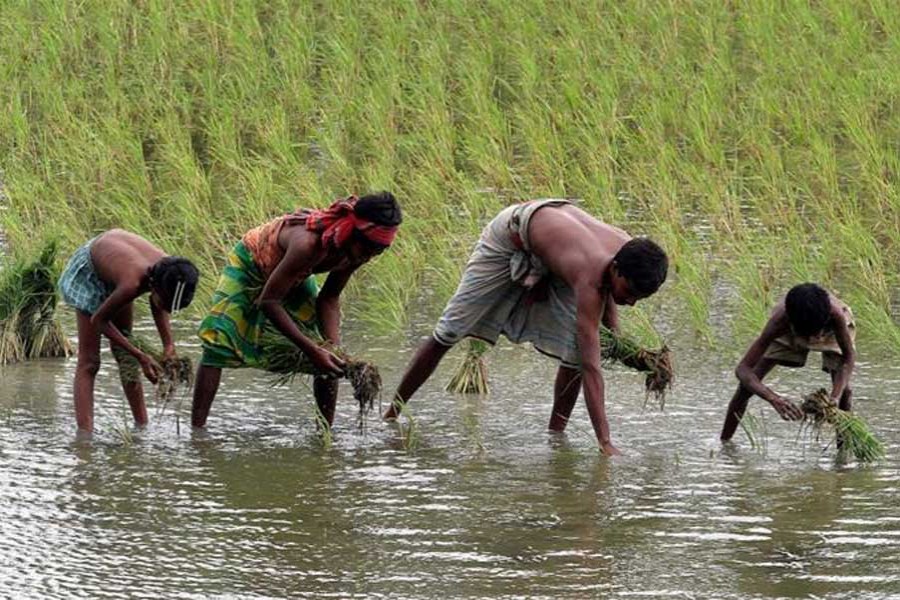
Bangladesh is a country of 175.7-million-strong population, with a limited landmass. It is one of the most densely populated countries in the world. Growing population coupled with shrinking agricultural land has appeared as a matter of big concern in respect of food production and food security.
The arable land is fast depleting following uses of that land for non-agriculture purposes like the setting up of industries, widening and building new roads, housing and other purposes. The situation has come to such a pass that it is very much urgent to conduct land zoning in order to protect farmland.
Protecting agricultural land has been a long-pending issue but yet no effective measures were taken to this effect. All the governments in the past have shown sincerity in protecting agriculture land, but no practical progress was seen so far. Of late, however, the interim government as well as the sector- insiders are seriously thinking that it is the high time an act was formulated that will protect agriculture land.
Agriculture land is the fundamental base of our existence. If agricultural land is lost at such a pace, food security, environmental balance and our glorious agriculture-based culture would be at stake. So, it now an urgency to promulgate an ordinance for protecting agricultural land and its swift implementation.
The people of the country are directly or indirectly dependent on agriculture. But the increasingly growing population, mismanagement, fast-running urbanisation and industrialisation are dangerously reducing precious agriculture land.
Each and every day many acres of fertile agriculture land were transforming into commercial and industrial land and thus posing a threat to the livelihood of the farmers and also food security to the nation as whole.
If agriculture acreage gets reduced, then automatically food production will decline and it might create scarcity of food in the country. It is necessary to legally protect agriculture land considering food security for future generations.
Agriculture plays an important role in ensuring food security, rural economy and keeping environmental balance. Farmland is not only for agriculture purposes but it is also the part of maintaining environmental balance, protecting water bodies and biodiversity. Protecting agriculture land means keeping environmental balance.
Building houses, setting up industries and brick kilns by earth filling on agriculture land are still going on uninterrupted without taking permission from the authority concerned. If there was a strict law, then this type of acts could have been avoided.
Agriculture and food security is one of the UN-designated sustainable development goals (SDGs).
Talking to THE FINANCIAL EXPRESS a high official at the ministry of land (MoL) says that the government has so far earmarked 18 land zoning in the country. Government ministries and departments concerned would work to protect the lands through determining their nature and characteristics of land through zoning.
He says the government has prepared a draft ordinance for protecting agriculture land. The draft ordinance titled "Control of Land Uses and Agriculture Land Protection Act" is almost finalised. They were expecting that Act would come into effect through a government ordinance soon.
Apart from issuing ordinance, the government has also taken some other measures to check land-related forgery and ensure people-friendly land -management system. As part of the move the MoL is set to cancel six types of land deeds from June next year aiming to ensure a transparent, accountable and fraud-free land management in the country. Land deeds that were faulty and prepared through fraudulence/ deceitful manner would be treated as illegal and thus be cancelled.
With the cooperation from a company of the Republic of Korea or South Korea the MoL is conducting Bangladesh Digital Land Survey (BD Land Survey) in six places of four districts in a piloting on the modern-day land management. This type of survey is highly likely to start from June next year across other parts the country that will help preserve legal land deeds online on a government-designated website.
The land deeds that would be cancelled in the process of digitising are Heba (or Hiba) Dalil (deeds) prepared through fraudulence manner or taken tipsai (Bengali) or thumb impression or thumbprint from physically ill and unable person.
Heba or Hiba is an Arabic word means "gift" or "blessing". In Islamic Sharia law, it refers to voluntary transfer of property or ownership from one person to another without any consideration or exchange of value. Therefore, a "Heba Dalil" is the legal document used to formalise a gift of property under Muslim personal law, requiring registration with proper authority to be effective. It is often used for transferring property among family members.
As per the existing law, one-third of total land could be done through "Will deed" or "Osiatnama (Bengali) dalil" to the persons that the land owner doesn't have blood relation or not any link with heirs. If any Will deed done ignoring the existing law, then that deed will be cancelled.
Will deed or Osiatnama (Bengali) Dalil is a legal document that declares a person's wishes regarding the disposal or management of their property after their death. It only takes effect upon the death of the testator. A testator is a person who makes a legally valid will to dispose of their property after death. The key requirements include having "testamentary capacity", meaning they must be of sound mind and understand the significance of creating the will.
The land deeds that were done without registration would stand cancelled.
The land deeds that were prepared through fraudulence manner and forgery would be cancelled and claiming ownership through this type of deeds will also be null and void in the cleanup process of ages-old jumble.
The land deeds that were prepared by using political influence or muscle power would also be done away with.
The land that was sold more than actual share would be cancelled, too. Those who have sold their joint ownership of lands more than their legal stakes/ proportions would be cancelled.
The real heirs would get back their respective portion of land through court verdict.
The land ministry official says, "If the government move is implemented completely, it would reduce years-old land-related forgery, dual land deeds and complexities centering around determining heirs."
He say that they are working sincerely to complete online- based land -record system and best land-deed management so that people could have access to hassle-free land services.
The government has also taken a move to recover encroached land and help get back it to the real owner through administrative process. As per the Land Crime Prevention and Remedy Act 2023, if a real owner's land is/was being encroached upon by others, then that land could be recovered through administrative process, and the land owner doesn't need to go to the court for legal battle in settling the issue.
In the past, if a land was encroached, then the real owner had to file title suit at the court to get back the land or ownership after spending many years and bearing litigation costs. The vicious circle of land grabbers used to usurp other people's land by capitalizing on this existing lengthy legal process and bureaucratic complications. But the new land Act has closed that chance, once and for all.
The fundamental purpose of this Act is to ensure the rights of the actual owner of land and dispose of land-related issues rapidly.
The new legislation has prescribed punishments for certain acts defined as offences. For instance, if someone performs any fraudulent act related to land, the highest punishment prescribed for it is 7 years imprisonment and fines as per section 4 of the Act. And the punishment for land-related forgery is again 7 years imprisonment and fines as per section 5.
The law also has empowered an executive magistrate to perform judicial functions under sections 8 and 22 of the Act.
As per the Act, to recover grabbed land, the real land owner should file a petition to the office of the deputy commissioner (DC) along with submitting land-deed documents, Khatiyans and other legal documents. After the filing an application, an executive magistrate would scrutinise the papers to determine whether the applicant is a real owner of the land or not. If the applicant's pleas proved right, then the district administration with police force will evict the land grabber and hand over it to the real land owner.
If anyone's land was encroached, then he or she could also file complaint at local police station. Police will investigate the complaint through visiting the spot physically, and if found real, then the local administration and police will help the real owner to get back his/her lands.
Besides, if a land dispute is/was running for a long time, the problem could also be solved by filing application at district Legal Aide office. If needed, an executive magistrate may investigate it practically on spot and carry out eviction drive with police force for recovering encroached lands and hand over it to the real owners.
Legal aide offices in all districts are engaged to resolve all land-related disputes, including family dispute, over land sharing and determining heirs.
The government has taken initiatives to revolutionise land management through digital pish. The initiatives aim to make Bangladesh's digital land-management system more transparent, accountable, and accessible to citizens. As part of that, the land ministry has undertaken a project titled "Establishment of Digital Land Management System (EDLMS)" to digitise the land-management system in order to keep up with the technology-driven world.
Project Director (Joint Secretary) Md Mominur Rashid has told The Financial Express that EDLMS is an initiative taken by the government to ensure a modern, technology-based land -management system which will open a new horizon to provide faster land-related services. "The role of information technology is inevitable in the current era to bring public services to people's doorsteps," he says. It makes the process "smarter, transparent, and people-friendly".
The project director says EDLMS will resolve all land-related complexities and determine the proper demarcation of land and real land ownership, while also ensuring the optimum utilisation of land. One of the biggest benefits of digital land surveying is the accurate measurement and preservation of land records. Previously, manual surveys often led to human errors, irregularities, and forgery, Rashid explains.
Now, with the use of satellite technology and Geographic Information System (GIS), it has become possible to precisely determine land areas and boundaries, significantly reducing ownership-related disputes, he says. In the past, land surveys were done using handmade maps, as well as paper-based khatiyan and records, which were time-consuming, expensive, and mostly faulty. By using digital technology, this work has now become faster and flawless, he says.
Digital land surveys under EDLMS will preserve land records properly. Measuring and demarcating land flawlessly is now done using satellite and GIS, which is helping reduce land-related disputes and ownership claims. As land records are now prepared and preserved digitally, they are verifiable.
Thanks to the system, it is impossible to prepare fake papers and make false ownership claims.
Rashid says the technology-driven initiative has enhanced administrative efficiency and made public service delivery more effective and transparent. He says the project is being implemented in six places of four districts - Narayangaj City Corporation (Narayanganj), Rajshahi City Corporation (Rajshahi), Chattogram City Corporation (Chattogram), Manikganj Pourashava (Municipality), Kushtia Sadar upazila, and Dhamrai upazila (Dhaka).
It is expected to be finished by October 2026, he also says, adding that the project will gradually be implemented in other areas.
A Korean company is implementing the project for completing the Bangladesh Digital Survey (BDS).
The digital land survey is playing a positive role in implementing the state's planning and development properly. Besides, it also helps make proper plans for agriculture, forest, and industrial land.
The digital survey is helping build the base of a modern land -management system. Once the project is completed, it will make land administration smarter, digital, and people-friendly.
Taking on a note of concern, Land Adviser Ali Imam Majumder says the agriculture land of the country is decreasing day by day. "It becomes very urgent to issue ordinance for protecting agriculture land." Agriculture land is not only the present generation's property rather it is the future of the country and also for the generations to come.
"Building mass awareness is critically required to save our much precious agriculture land. If we protect our agriculture land, then everything will be saved, and for this reason, we must have the "Control of Land Uses and Agriculture Land Protection Act".
talhabinhabib@yahoo.com