


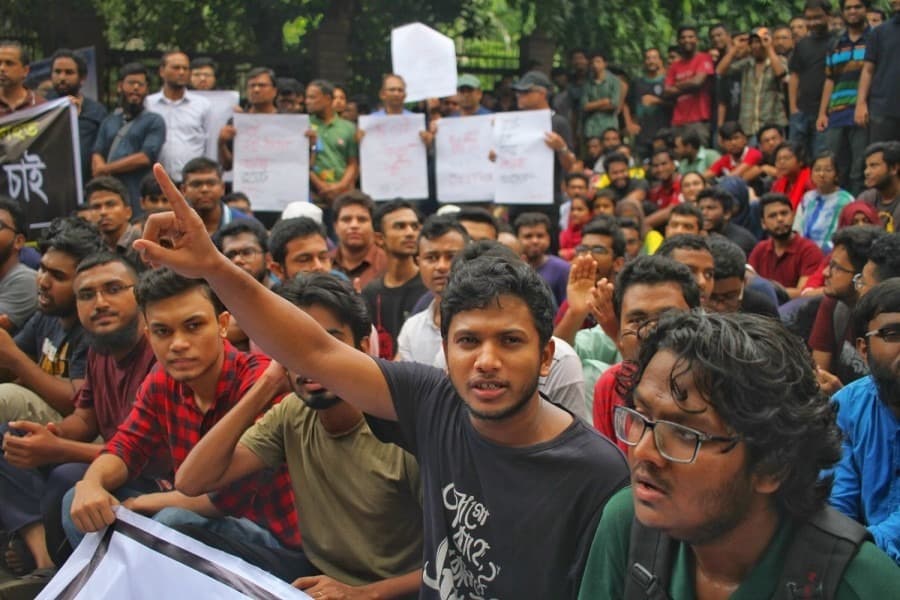
Water Resources Minister Md Shahiduddin Chowdhury Anee gave vent to national sentiment when he called upon the Jatiya Sangsad on Thursday to initiate a discussion on the issue of student politics, saying that the current generation doesn't like aggressive student politics. His comment came amid a tense situation in numerous university and college campuses across the country following clashes between rival student wings of ruling and opposition parties. The resurgence of such confrontations, reminiscent of the muscle-power-driven politics of the past, raises concerns about whether student politics is returning to its old form.


Students had grown so disgruntled with traditional, party-based violent politics on campus that, following the July-August uprising of 2024, there was a rallying cry to ban student politics altogether. Subsequently, over a dozen universities and medical colleges imposed bans on political activities on their campuses. Many eagerly anticipated a change in the academic atmosphere of higher educational institutions where students would engage in research and debate their points of view in a disciplined and respectful manner. It was hoped that a congenial atmosphere would prevail, which is a foremost prerequisite of providing quality education and building skilled manpower and a morally enriched nation. That hope was dashed when rival student groups were once again seen engaging in clashes, wielding bamboo sticks, machetes, and other sharp weapons. Thus, the likelihood that the public universities might once again become embroiled in chaos and violence looms large.
The question now is why, even after an unprecedented student-led mass uprising that claimed over 1,400 lives, has there been no meaningful change? The July uprising offered a watershed moment for lasting reform, but the opportunity it created now appears to have been largely squandered. Nepal, too, went through a mass uprising, after which the post-revolutionary government banned party-based politics in schools, colleges and universities. In many respects, Nepal has been able to reap the benefits of the mass-uprising through meaningful state reforms, but everything is seemingly reverting to the old ways in Bangladesh.
Many attribute the failure to bring about meaningful reform in campus based politics to the unwillingness of major political parties to abandon their tendency to use students as a tool of political influence. Ironically, some of the students who led the July uprising and have since formed a political party have also established its own student wing, even though they had earlier called for a ban on student politics.
Most students in public universities come from poor and middle-income families who make considerable sacrifices, often-selling land or livestock, to arrange their children's education. However, over the years, too many lives have been lost on public university campuses due to the pervasive violence linked to campus politics. The sacrifices made by students will only become meaningful if universities can be transformed from political battleground to centre of excellence.
The call, therefore, to initiate a parliamentary discussion is timely. Interestingly, parliament does not need to enact new laws or ordinances to address the problem vitiating the educational institutions. The Representation of the People Order (RPO) already prohibits political parties from having affiliated student or teacher organisations. What is required from political parties is the willingness to abide by this law in the greater national interest. At the same time, the pariament should take stock of how to stop exploitation of religion for political ends.