
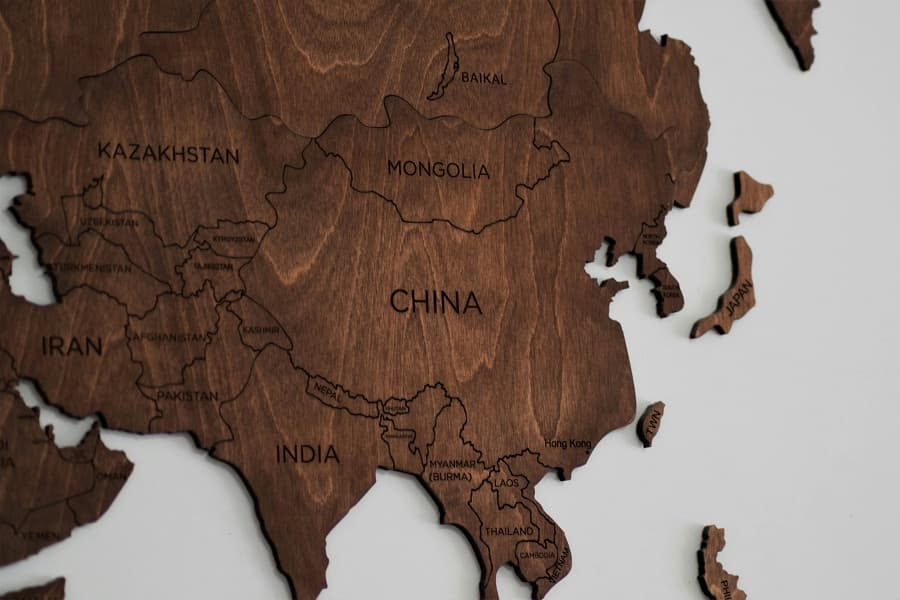
South Asia, a geographic region crisscrossed with a plethora of transboundary rivers and comprising countries with often mutually exclusive and contested interests, is a hotbed of hostility.
Even though the relation between India and Pakistan, two nuclear-powered rivals with their longstanding antipathy towards one another, remains the flashpoint in this region, tensions exist below the 'flashpoint threshold' between Bangladesh-India and India-China, among others. One of the chief catalysts of such hostility is not hard power, but water.
In most major arteries of the region, India, the largest nation in the neighbourhood, is the upstream country, followed by Bangladesh, Pakistan, and other states.
Some of the most notable river basins of this region are the Indus Basin, the Ganges River Basin, the Brahmaputra River Basin, and the Teesta River Basin. The Ganges and Brahmaputra, along with the Meghna River, form the larger Ganges-Brahmaputra-Meghna (GBM) System.
The Indus 'Water warfare'
The Indus Water Treaty (IWT) was signed in 1960, dividing the six rivers of the Indus Basin between the two countries, with India receiving the three eastern rivers (Ravi, Beas, Sutlej) and Pakistan receiving the western rivers (Indus, Jhelum, Chenab, and 70% of the total flow).
Jeff Nesbit, the author of This Is The Way The World Ends, published in 2018, contends that, "Water has long been seen as a core strategic interest in the dispute over the Kashmir region, home to the Indus' headwaters."
This was most visible in 2025 when India declared the 'abeyance' of the IWT following the Pahalgam terrorist attack. The decision was considered as an 'act of war' by Pakistan, calling it 'water warfare.' The move was further exacerbated by India's fast-tracking of stalled hydroelectric projects in Kashmir.
This series of incidents begs the question: Is the abuse of water by upstream states going to be the new reality of political disagreement among South Asian nations?
Scholars and experts are already exploring the potential of water not just as a natural resource, but also as a strategic tool of statecraft capable of directly triggering military conflicts.
Scholars have also noted that, in today's world, issues and crises do not exist in isolation from one another. The entanglement of multiple crises has given rise to 'polycrisis', and in the South Asian context, India's hydro-hegemony vis-à-vis downstream countries can provoke a sharp response from China.
Even though China is not a South Asian country, it is the upstream country of the Brahmaputra River Basin, where India is a downstream country.
The Eastern front: Deadlock and dwindling faith
In contrast to the India-Pakistan relationship, disagreement over the Ganges River Basin has not yet led to open military conflict between Bangladesh and India. However, the future of the Ganges Water Treaty (GWT), signed in December 1996, hangs in limbo, not least due to West Bengal's staunch opposition to sharing the Ganges water and due to the loss of good faith among Bangladesh and India after the ouster of former Prime Minister Sheikh Hasina in August 2024.
Even though the Treaty is set to expire by the end of this year, there have been no noteworthy negotiations among the relevant stakeholders of both nations.
Moreover, Chinese infrastructure plans along the Brahmaputra River, a part of the larger GBM system, have raised alarms in India, as India's northeast states are heavily reliant on Brahmaputra waters.
As for the Teesta River Basin, the absence of a fair and equitable water sharing treaty has been a longstanding bone of contention between Bangladesh and India. Even though the Teesta waters have immense practical value for the farmers and fishermen of Northern Bangladesh and are an emotive issue for the people of Bangladesh, no talks have taken place since 2011. Recently, Bangladesh, as a downstream country, has sought international assistance by being a signatory to the 1997 United Nations Watercourse Convention. However, India, the upstream country, has refrained from signing this convention, meaning it is not obligated to yield to international pressure.
The climate multiplier: Global water bankruptcy
In addition to the interrelationships among upstream and downstream nations in South Asia, another key factor remains, which is climate change. Climate change has undermined the natural hydrology of river basins across South Asia through increased glacial melt, erratic rain patterns, and more frequent droughts and floods.
This impending scarcity intensifies competition over diminishing resources, putting the future of water cooperation under intense pressure. The United Nations (UN) has already declared that the world has entered a new era of 'global water bankruptcy,' in which water bodies are overexploited to the point of no return.
To make matters worse, the Indus Water Treaty, or Ganges Water Treaty, lacks specific measures to address climate-related stressors or seasonal flow variability.
A new vision for survival
South Asia confronts a dilemma between intentional cooperation and inadvertent conflict.
The rivers of this region are being suffocated by dams, by drought, by politics. This should prompt a new vision regarding water sharing among stakeholders.
A fundamental shift is imperative if South Asian countries hope to reduce hostility over water among themselves, especially amid the acute impacts of climate change.
Treaties have to be renewed, renegotiated, and restarted, and they have to reflect current and projected realities.
Water security should be given the same significance as national security, not merely as an afterthought, but as a primary focus of both foreign and domestic decision-making. Historical evidence demonstrates that significant cooperation is achievable, yet it also indicates that complacency regarding hostility can prove fatal.
The ability of the major rivers in South Asia to foster cooperation or trigger conflict depends on the wisdom of today's leaders to act in collaboration, not against, one another.
The author is a graduated from the Department of International Relations, University of Dhaka, and can be found at mdmashrurhaque-2020217808@ir.du.ac.bd