

Published :
Updated :
 For all latest news, follow The Financial Express Google News channel.
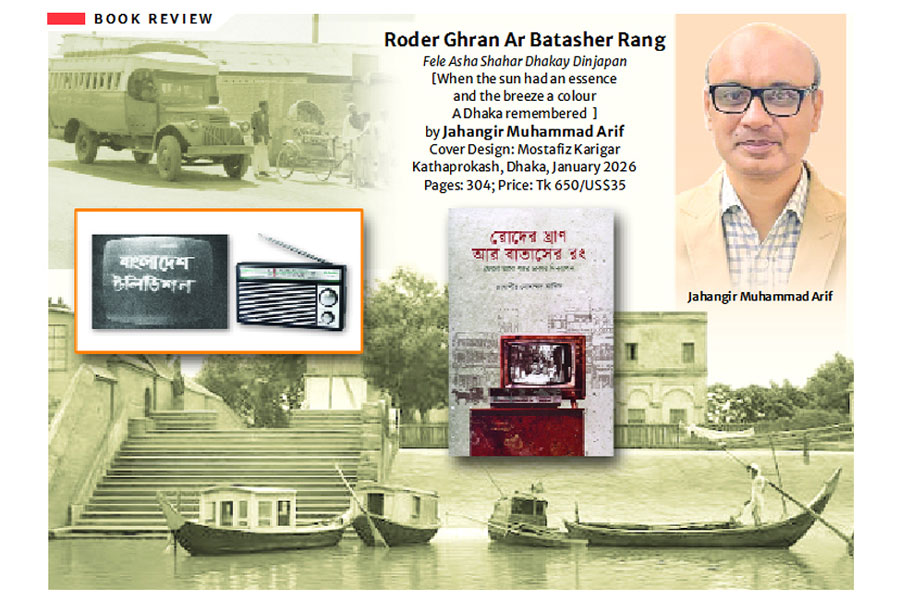
We often look into our past in search of the meaning of the time spent, the bonding and happiness we shared with our loved ones and of our endurance to reach where we stand at present. Our passion to catch lost times may even make us forget our present. We weave stories of our past as we trace it down our memory lanes. Their physical appearance on paper helps us clear the dust off the mental image of our experience. Recalling the past is easier if one has maintained journals with references to past events. Some of us, however, may depend almost entirely on sharp memories to produce vivid accounts of things that no longer exist or exist with different colours and dimensions. Jahangir Muhammad Arif belongs to the latter group. As he narrated events in the ‘70s and ‘80s, he was both a participant and a witness. The outcome is his first book, Roder Ghran Ar Batasher Rang: Fele Asha Shahar Dhakay Dinjapan. The literal English translation of the title is: When the sun had an essence and the breeze a colour: A Dhaka remembered. The title is enough to stir enthusiastic readers to pick up the book and read page after page.
Arif grew up in Narayanganj, an important river port and commercial hub near Dhaka. Much of his trip down memory lane takes place in this port city, known as the Dundee of the East. The nickname was earned in the mid-19th century due to its status as a major hub of jute mills, similar to Dundee in Scotland. He visited the capital city regularly during his childhood and, after completing secondary education, gradually settled there. As a student at Bangladesh University of Engineering and Technology (BUET), he had to stay in the dormitory. That is why some stories are entirely Dhaka city-based.
The book has several chapters, most of which were published earlier in various newspapers and drew readers’ attention. Friends encouraged the author to compile the write-ups into a book. Readers will be charmed by the table of contents, where 38 titles will instantly cast a spell of nostalgia. The subjects include ice-cream, radio, view cards, stamps, ration cards, exhibitions, circus, VCR, jatar, beauty parlour, television, science club, textbooks, Qazi Da and Masud Rana, and the writer’s personal memories of early conjugal life. The topics are diverse but somehow linked.
Just think about the radio, which has lost much of its appeal, even though it was essential for most middle-class and some poor families during the ‘80s. Arif vividly sketches how Radio Bangladesh (now Bangladesh Betar) morning news and programmes were transmitted and how people listened eagerly despite the morning rush to offices, schools, and markets. Radio magazine Dorpon was popular in the ‘80s and ‘90s. Kaushick Ahmed was the popular broadcaster, along with a few others, while Kazi Farook was the compiler and occasional presenter.
In those days, Shabe-Borat (the night of the 15th of Saban in the Islamic lunar calendar) was special for all Muslim families. There was a tradition of distributing roti-halwa (chapati and dense sweet) to beggars. Women worked hard to prepare these from early morning, and children enthusiastically gave them to beggars, sharing the joy of the festivity. The evening used to unfold with familial rituals. Those fasting broke the fast with a modest iftar once the call for Magrib prayer was announced from nearby mosques. Wearing clean pyjama-punjabis, people went to the nearby graveyards to pray for deceased parents, relatives, and friends. Some dared to go at midnight. Mosques were decorated with lights. An almost vanished tradition of Shabe-Borat was sharing modest meals with neighbours. Arif provided a detailed description of the day’s activities at his Narayanganj house and neighbourhoods, delineating his capacity to observe what happened around him.
Though Arif depended almost entirely on his memory, he likely used scattered notes, clippings from old newspapers, family albums, talks with old friends, a few books, and personal collections to refresh it. While he wrote down many details for some events, readers will find it hard to believe that the precision emanated from his memory. It would be better if he provided references or sources in footnotes or endnotes to authenticate his assertions.
Moreover, some errors exist, though they may not be seen as serious misinformation. For instance, while describing a popular TV show for children in the ‘80s on Bangladesh Television, Arif mistakenly said the central character, Bhondul, was played by the then-famous juvenile actor Shishir. Actually, Tapu played the role and drew applause. Readers reminiscing about their days can easily detect such errors. The author may consider correcting the errors in the next edition.
There is no way to relive our past. Nevertheless, the book may be considered a time machine that brings readers back to those old days to feel the colourful wind brushing against the edge of their present and to inhale the fragrance of the sun. You may close your eyes as you finish the book, before you find yourself nudged awake to the present. Don’t mind if a few drops of tears roll down your cheeks.