


The Ready-Made Garments (RMG) industry remains the backbone of Bangladesh's export economy, contributing over 80 per cent of total export earnings and employing more than four million workers-around 80 per cent of them women. Its performance directly influences the country's macroeconomic stability, foreign exchange reserves, and overall growth trajectory. Yet, the sector is currently navigating a complex global environment marked by economic uncertainty, geopolitical tensions, and intensifying competition.
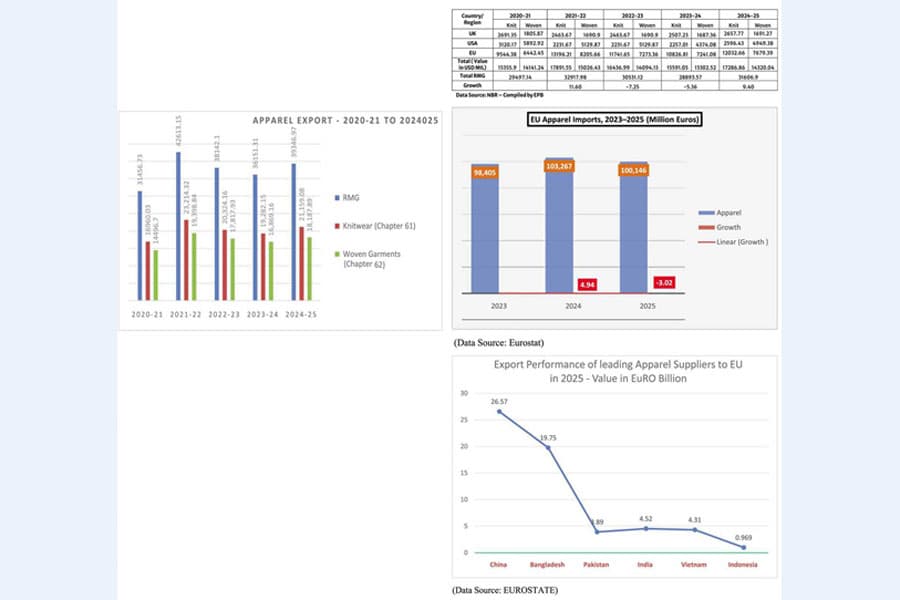
Over the past five years, Bangladesh's RMG sector has experienced significant fluctuations. After a strong post-pandemic rebound that drove exports to a record $42.61 billion in FY 2021-22, the industry entered a phase of contraction due to global inflation and weakening demand in key Western markets.
By FY 2024-25, the sector showed signs of recovery, reaching approximately $39.35 billion, reflecting modest growth of 2.33 per cent over the previous year. Despite this improvement, export performance remains below earlier peaks, indicating a fragile recovery.
External pressures have played a major role. Ongoing geopolitical conflicts, including the Russia-Ukraine war and tensions in the Middle East, have disrupted global supply chains and increased costs of raw materials and freight. At the same time, reciprocal tariffs and cautious consumer spending in major markets have led to order cancellations and deferred shipments, contributing to a slowdown in export growth.
HEAVY RELIANCE ON KEY MARKETS: Bangladesh's apparel exports are highly concentrated in three major destinations: the European Union (EU), the United States, and the United Kingdom. Together, they account for over 80 per cent of total RMG exports.
The EU is the largest market, absorbing more than half of Bangladesh's apparel shipments. The United States follows as the second-largest destination, while the UK maintains a smaller but notable share.
While this concentration has historically ensured stable demand, it also exposes Bangladesh to external shocks. Economic downturns, policy shifts, or changes in consumer behavior in these regions can significantly impact export performance.
THE EUROPEAN UNION: STRENGTH AMID SLOWDOWN: The EU remains Bangladesh's strongest market, where it holds the position of the second-largest apparel supplier after China. In 2025, Bangladesh exported around €19.75 billion worth of garments to the EU, underscoring its strong presence.
However, the EU apparel market is currently under pressure. Total imports declined by 3.02 percent in 2025, reflecting weaker consumer demand driven by inflation and economic uncertainty.
Despite this contraction, Bangladesh has maintained its position due to several advantages: competitive pricing, specialisation in mass-produced garments, and preferential access under the EU's Generalised System of Preferences (GSP). Improvements in compliance and workplace safety have further strengthened buyer confidence.
China continues to dominate the EU market, exporting over €26 billion worth of apparel, supported by advanced infrastructure and a diversified product range. Other competitors such as India, Vietnam, and Pakistan occupy mid-tier positions but remain significantly behind Bangladesh in scale.
THE UNITED STATES: A COMPETITIVE ARENA: In the United States, Bangladesh ranks as the third-largest apparel supplier, exporting about $8.20 billion in 2025. The market is led by Vietnam, followed by China.
Vietnam's strong position is driven by its diversified production base, efficient supply chains, and favorable trade agreements. Its ability to supply a wide range of high-value products gives it a competitive edge.
Bangladesh, on the other hand, relies heavily on basic garment categories. While its cost advantage and large-scale production capacity remain key strengths, limited diversification restricts its ability to compete with more versatile suppliers.
Recent data from early 2026 show Bangladesh briefly surpassing China in export value and quantity, signaling growing competitiveness. However, overall demand remains weak, and Vietnam continues to dominate with a significantly larger market share.
STRUCTURAL CHALLENGES: Despite its achievements, Bangladesh's RMG sector faces several structural challenges:
Limited Diversification: The country's heavy reliance on apparel exports makes it vulnerable to sector-specific shocks. In contrast, competitors like China, Vietnam, and India have diversified industrial bases.
Narrow Product Range: Exports are concentrated in basic items such as t-shirts, trousers, and sweaters, with limited presence in high-value segments like technical textiles or fashion-forward apparel.
Infrastructure Constraints: Logistical inefficiencies, including port congestion and transportation delays, increase lead times and reduce competitiveness.
Price Pressures: Declining unit prices combined with rising input costs are squeezing profit margins, while buyers demand higher standards at lower costs.
THE PATH FORWARD: To remain competitive in an evolving global market, Bangladesh must adopt a strategic approach focused on resilience and innovation.
Product Diversification: Expanding into higher-value segments such as activewear, technical textiles, and sustainable fashion can enhance competitiveness and profitability.
Market Expansion: Exploring emerging markets in Asia, the Middle East, and Latin America can reduce dependence on traditional destinations.
Technological Upgrade: Investments in automation and digital manufacturing can improve productivity and reduce costs.
Sustainability Focus: Strengthening environmental and social compliance will be crucial as global buyers increasingly prioritise sustainable sourcing.
Trade Policy Support: Securing favourable trade agreements, especially in the context of Bangladesh's graduation from Least Developed Country (LDC) status, will be essential to maintain market access.
Bangladesh's RMG sector stands at a critical juncture. While it continues to hold a strong position in global apparel markets, the challenges it faces are becoming more complex and multifaceted. Sustaining growth will require more than cost competitiveness. It will depend on the country's ability to diversify products and markets, adopt new technologies, and align with evolving global standards. In a rapidly changing trade environment, Bangladesh's success will hinge on how effectively it transforms its traditional strengths into long-term, sustainable advantages.
Abu Mukhles Alamgir Hossain is Director (Policy), Export Promotion Bureau. amahepb75@gmail.com