


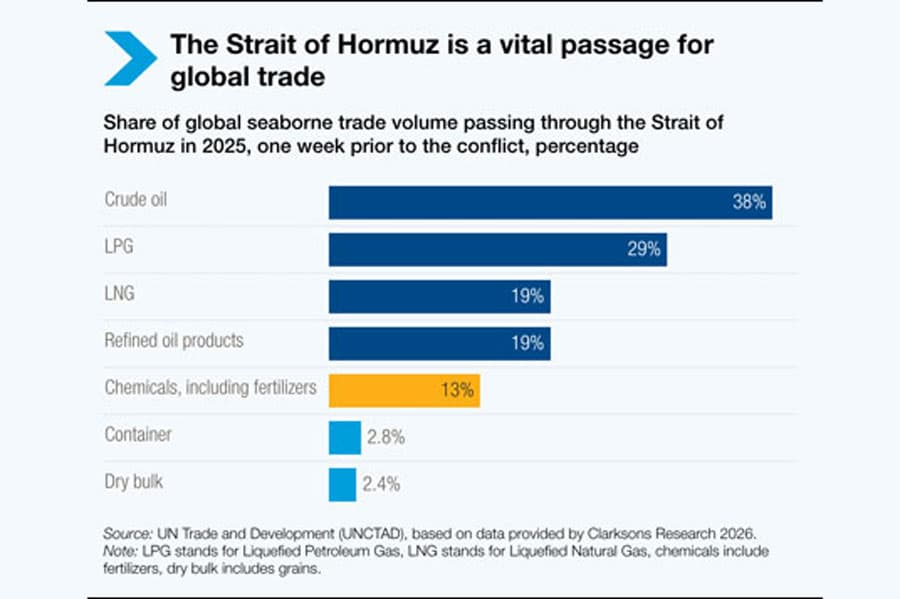
There are few places on earth where the interplay between geopolitics and the global economy is as evident as in the Strait of Hormuz, a small strait of water located between Iran and Oman, which serves as the primary conduit through which the energy resources of the Persian Gulf are delivered to the global economy. Even though the strait itself is only 33-50 kilometers at its broadest, this small strait of water carries a massive percentage of the world’s oil supplies.


According to estimates of global energy agencies, 20 per cent of the world’s daily oil consumption, or 20 million barrels per day, flows through the Strait of Hormuz. This includes oil exports from Saudi Arabia, Iraq, Kuwait, the UAE, and Qatar, all of which must pass through this small strait of water before they are delivered to hungry energy consumers in Asia, Europe, and the rest of the world.
Because of this massive percentage of global oil supplies, even a minor disruption of this small strait of water has the potential to create shockwaves throughout the global economy. In addition, as tensions increase in the Middle East, particularly between Iran and Western nations, as well as between Iran and other Middle Eastern nations, the global oil markets react almost immediately.
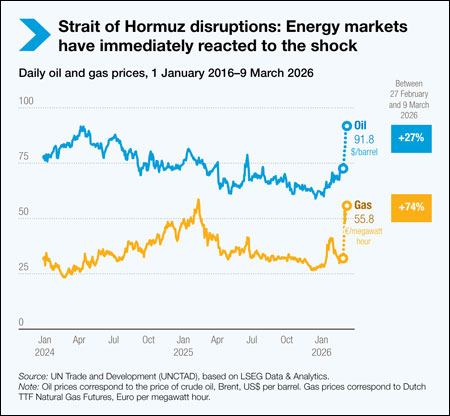
Oil prices increase not only as a result of a disruption, but also as a result of the perceived threat of a potential disruption, which affects oil prices even before a blockade takes place.
Geopolitical Tensions and Oil Market Volatility: The Strait of Hormuz has repeatedly emerged as a focal point during periods of geopolitical tension in the region. Iran has repeatedly offered a veiled threat that in case of military pressure or stringent economic sanctions, it can stop or disrupt shipping in the Strait of Hormuz. Conversely, the United States and its allies have consistently maintained a powerful military presence in the region to ensure the free movement of shipping.
Even in cases where no ships are attacked or blocked, the potential for conflict can dramatically affect oil prices. Oil markets function on expectations rather than on actual happenings.
For instance, during periods of regional tension—whether due to military conflict, sanctions, or political tensionsoil prices tend to rise by several dollars a barrel within a matter of hours. Insurance premiums for shipping rise sharply, shipping routes become more cautious, and companies begin seeking alternative routes for shipping oil.
The reality is that there are very few alternative routes available for shipping oil around the Strait of Hormuz. Some pipelines exist that transport oil across this strategic region in the Middle East. For instance, the Saudi Arabia-East West pipeline or the Abu Dhabi-Fujairah pipeline in the UAE can be used for this purpose. However, these pipelines can only carry a fraction of the total amount of oil normally shipped through this region.
Oil Price Shocks Matter for Bangladesh: Bangladesh is a country in South Asia that imports the majority of its petroleum products to meet domestic energy demand. Therefore, for a country like Bangladesh, which lacks abundant petroleum resources, a conflict in this region can have significant economic implications. Unlike many oil-producing countries in the Middle East, Bangladesh lacks abundant petroleum resources.
Bangladesh is one of the largest importers of oil and liquefied gas from the Middle East region. Therefore, Bangladesh is extremely vulnerable to the instability of the Persian Gulf’s energy supplies.If the tensions in the Strait of Hormuz cause global oil prices to increase, Bangladesh will immediately be subject to the following economic challenges:
Rising Import Costs. Bangladesh already spends billions of dollars annually on import bills. If oil prices increase, Bangladesh will face higher import costs. This will increase Bangladesh’s trade deficit.
Inflationary Pressure. Bangladesh is extremely vulnerable to oil prices because they are directly linked to the cost of transportation, food, and other products. If oil prices rise, transportation costs will rise. This will cause inflation across the transportation, food, and manufacturing industries.
Challenges in the Production of Electric Energy. Bangladesh is facing a growing demand for electricity. Bangladesh uses oil-fired power plants to generate electricity. Therefore, if oil prices increase, Bangladesh will face challenges in producing electricity at reasonable prices. This is a critical challenge because the government will be forced to raise electricity prices or subsidize the people of Bangladesh. This is a critical challenge because electricity prices are a sensitive issue in Bangladesh.
Challenges to the Growth: Bangladesh is one of the largest importers of textiles and textile-based products. Bangladesh is facing a growing demand for textiles from the global community. Therefore, price instability will pose challenges to the growth of Bangladesh’s economy.
Strategic Energy Vulnerabilities: Bangladesh is extremely vulnerable to instability in the Persian Gulf’s oil supplies due to the Strait of Hormuz. Bangladesh is facing a growing energy demand as the country is growing rapidly. Therefore, the country will be forced to import a significant amount of energy from the Middle East region.
As a result, this rising reliance on imported energy sources puts Bangladesh at risk of global disruptions, whether caused by wars, sanctions, or geopolitical tensions far removed from the nation itself.
Diversification and Energy Resilience: To counter this rising threat, Bangladesh has begun exploring a range of new strategies to strengthen its energy resilience.
The first strategy might be to diversify the sources of imported energy. By seeking new suppliers of oil, gas, and other energy sources beyond the Middle East, Bangladesh might begin to reduce its reliance on a single geopolitical hotspot.
A second strategy might be to increase the pace of renewable energy production, including solar power and wind power. While not a solution to Bangladesh’s rising reliance on imported energy, a more rapid transition to renewable energy might begin to reduce the nation’s reliance on imported oil.
Bangladesh might also increase its investment in liquefied natural gas, a new form of energy infrastructure that allows the nation to purchase energy supplies from a wider variety of global suppliers.
A Global Chokepoint with Local Consequences: While the Strait of Hormuz might be located far from Bangladesh, its economic impact feels no such constraint. In a global economy as interconnected as the one Bangladesh operates in, a disruption in a single, small maritime passage can affect nations on every continent.
For Bangladesh, this global disruption has a clear local consequence: the nation’s energy security cannot be divorced from global geopolitics.
While the waters of the Strait of Hormuz are distant, the impact of global events on electricity and gasoline prices, and even on the global competitiveness of Bangladesh’s export industries, is felt directly.
Looking Ahead: Given the ever-changing geopolitical landscape in the Middle East, the Strait of Hormuz will remain one of the world’s strategic locations under close watch. This is especially true in Bangladesh, which is growing rapidly and is highly dependent on imports.
However, the key to economic resilience in such a setting will be a combination of “diplomatic awareness” of the situation, a “diversified” approach to energy policies, and “long-term” investment in alternative forms of sustainable energy production.
Finally, the restricted waters of the Strait of Hormuz serve as a reminder that, in today’s interconnected world, the fortunes of nations thousands of miles apart can be dictated by a single passage.
Dr Serajul I Bhuiyan is a professor of journalism and mass communications at Savannah State University, Savannah, GA, USA.
sibhuiyan@yahoo.com