

Published :
Updated :
 For all latest news, follow The Financial Express Google News channel.
The July Revolution of 2024 will forever be remembered as a turning point in Bangladesh’s history. It’s a time when ordinary citizens rose with extraordinary courage to reclaim their voice and destiny. Among those at the forefront were the women of this nation, brave and unyielding, driven by a deep love for justice. Their stories are the heartbeat of this revolution, yet too often, their sacrifices have remained in the shadows.
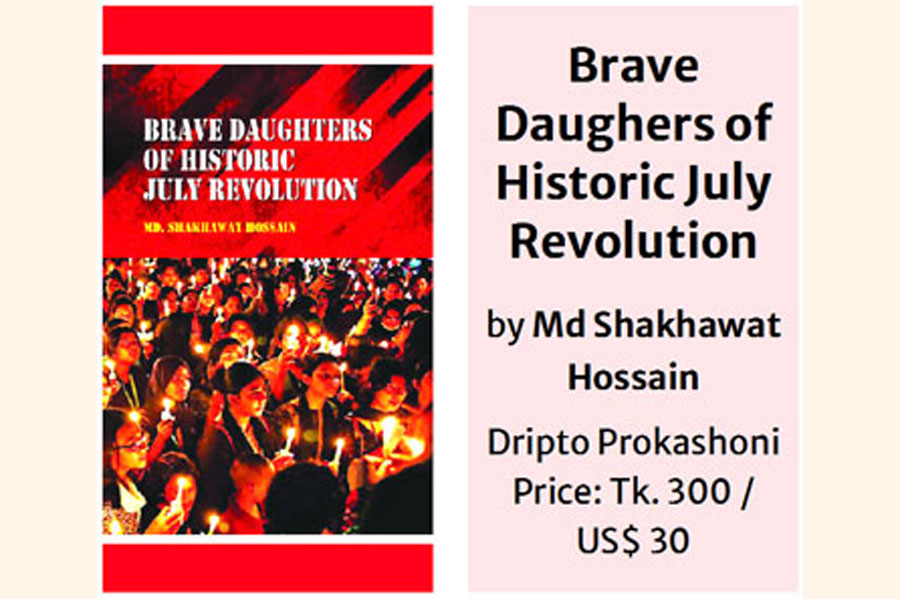
Brave Daughters of Historic July Revolution, written by Md. Shakhawat Hossain, a UC Berkeley Visiting Scholar, brings those stories to light with tenderness and truth. This book is more than a historical record. It is a tribute to the women who defied fear, carried the wounded, raised their voices when silence was safer, and stood guard over the dreams of a nation in turmoil.
This compilation of historic documents, testimonies, and reflections captures the spirit of women whose bravery, sacrifice, and resilience shaped the movement’s heart. Through chapters exploring their leadership, resistance, grief, and enduring quest for justice, the book powerfully reminds us that the revolution’s triumphs were deeply intertwined with women’s struggles.
Through its pages, we meet women from all walks of life: students and journalists, garment workers and mothers, singers and actresses, each bound by an unbreakable spirit of resistance.
They were the faces in the crowd, the voices behind the microphones, the hands that lifted banners high, and the hearts that refused to surrender. These stories remind us that revolutions are not only fought on the streets but also carried in the hearts of those who dare to believe in change.
The July uprising, a watershed moment in the nation’s history, will be remembered not only for its political ramifications but also for the powerful, defining role of women, particularly mothers and daughters. Their collective action, a blend of seasoned wisdom and youthful idealism, became the uprising’s driving force, shaping its character and outcome. This movement stands in stark contrast to the mass uprisings of 1969 and 1990, distinguished by its methods, inclusivity, and deeply personal yet profoundly political motivations.
The synergy between mother and daughter was perhaps the most potent weapon of the July uprising. In countless instances, a mother’s experience tempered a daughter’s impulsiveness, while a daughter’s technological prowess amplified a mother’s organisational efforts. They marched side by side, a physical embodiment of the intergenerational struggle for a better future. This partnership was not merely logistical; it was deeply emotional. The shared experience of protest forged new bonds of respect and understanding across generations, breaking down traditional patriarchal structures within the family unit.
So, the July uprising stands in sharp contrast to the mass uprisings of 1969 and 1990. The 1969 uprising, while successful in its immediate goal of toppling a dictator, was largely a male-dominated affair. The narrative of heroism and sacrifice was almost exclusively centred on male student leaders and political activists. Women’s roles, though present, were relegated to the background — largely undocumented and uncelebrated. These movements’ ideology was also more rigidly hierarchical and driven by established political parties.
May this book stand as a living memory of their courage, their pain, and their hope for a Bangladesh that continues to rise on the strength of its brave daughters.
The writer is an under-graduate student at Melbourne Institute of Technology (MIT), Australia.
fahim.faisal26@gmail.com