


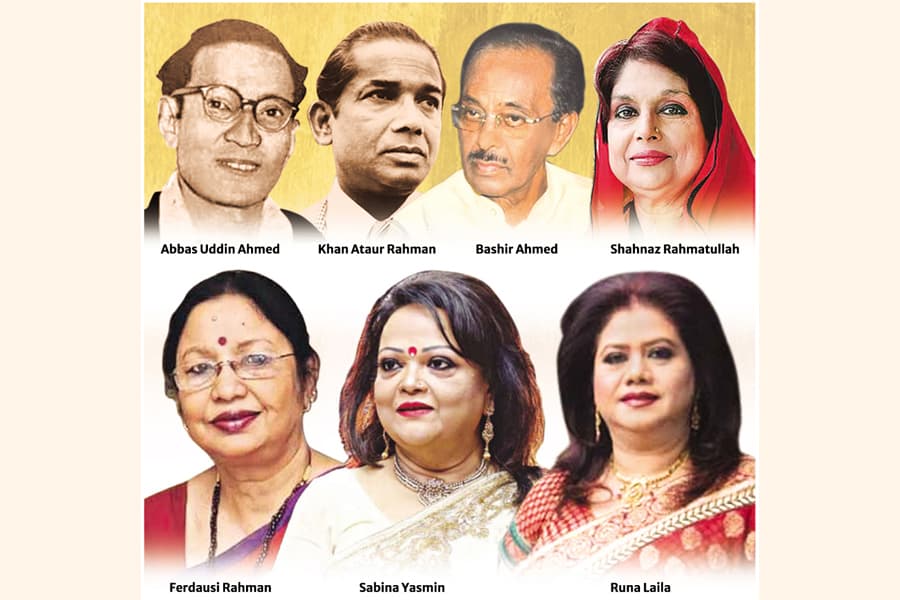
In early 1940s, the folk song composer and singer Abbas Uddin Ahmed (1901-59) met a young man named Hemanta Mukherjee (1920-89) at a Kolkata radio station. After listening to him singing, Abbas praised Hemanta profusely. “Please bless me,” Hemanta beseeched him. Abbas’s blessings must have worked wonders, because Hemanta trailblazed a path that led to his becoming the most influential and successful modern and Rabindra Sangeet singer in the history of Bengal. Cooch Bihar-born Abbas was already established as the foremost folk-song singer of Bengal, specialising in the local musical genre, such as Bhawaiya (“Fandey Poria Bauga Kandere”,1939), as well as Bhatiyali (“Nodir Kool Nai Kinar Nairey”), Jaari, Murshidi etc.: (“Allah Megh Dey Pani Dey Chhaya Derey Tui”, lyrics: Jalaluddin, music: Girin Chakraborty); (“Shono Momin Musalman”, lyrics: Jasimuddin). Abbas collaborated extensively with Kazi Nazrul Islam and sang many of Nazrul’s Islamic songs (“O Mon Ramzaner Oi Rozar Sheshey Elo Khushir Eid”, 1931). Abbas Uddin Ahmed’s greatest contribution to Bangladesh’s vocal music was that, he was the patriarch of Bangladesh’s First Family of Vocal Music.
There was no infrastructure for film-making in Bangladesh when Abdul Jabbar Khan bravely made Bangladesh’s first movie, ‘Mukh O Mukhosh’ (1956). There were no singers to speak of, save Abbas’s successor in folk-singing Abdul Alim (1931-74), and Mahbuba Rahman, (1935-) – both of whom sang in the film. Abbas’s teenage daughter Ferdausi Begum (Rahman) (1941-) stepped in to fill the void. Like her father, she excelled in Bhawaiya (“Sundari Kamala Nachey”) and Nazrul Sangeet. It was in the 1959 movie ‘Edesh Tomar Amar’ that Ferdausi made her singing debut in films. The movie’s music director was actor-singer-lyricist-composer Khan Ataur Rahman (1928-97), and it featured singer Farida Yasmin, a member of the illustrious Yasmin family of Bangladesh, which produced several renowned singers. Khan Ata himself would become a member of that family by marrying Farida’s younger sister and an accomplished singer herself, Nilufar Yasmin (1948-2003).
Khan Ataur Rahman: In 1960, industrialist and film producer Fazle Dossani (owner of Bangladesh’s first air-conditioned cinema halls, Gulistan and Naz, which screened only English movies, as well as Chinese restaurant Chu Chin Chow, and Baby Ice Cream), invited Bollywood singer Talat Mahmood (1924-98) in 1960 to visit the then “East Pakistan.” Talat brought with him an aspiring teenaged singer, Kolkata-born Bashir Ahmed (1939-2014). While Talat left after performing in Chittagong, Dhaka, and Mymensingh, Bashir stayed back. At Dhaka, Talat recorded two songs for the film ‘Rajdhanir Bukey’ (1961). One of the songs, “Tomarey Legechhey Etojey Bhalo” (lyrics: K. G. Mustafa, 1936-2022), was one of Talat’s best in Bangla. The music was composed by both Robin Ghosh (1939-2016) and Ferdausi, then only 19.
Ferdausi Rahman: Ferdausi had her first film-hit, “Ami Rupnagarer Rajkonya” in ‘Harano Din’ (1961), which was picturised on Shabnam (Jharna Basak, 1946-) (lyrics: Azizur Rahman, music: Robin Ghosh – Shabnam’s future husband). Fazle Dossani produced East Pakistan’s first Urdu film, a Pakistan-wide hit, ‘Chanda’, in 1962. Ferdausi showcased her talent by singing five of the eight songs in that film, two famous ones being” “Akhian Tori Rah Niharen, O Pardesia, Aa Ja.,” and “Lut Geya Khushion Ka Dera, Kho Geya, Hai Pyar Mera.” Anjuman Ara Begum (1942-2004) also sang the popular, “Chandni, Bheegi Bheag Hawa, Na Janey, Dil Kahan Kho Geya.” (lyrics: Suroor Barabankvi, music: Robin Ghosh). More Urdu melody hits by Ferdausi followed in Pakistan-wide hit “Talash” (1963): “Maine Kahan Salamalaikum,” and “Mausoom Rangela, Nasheeli Hawa.” “Talash” was Bashir Ahmed’s singing debut in films. His most famous song, “Rickshawala Matawala,” was picturised on Subhas Dutta (1930-2012), as he roamed the fairly empty streets of Dhaka on his rickshaw. Bashir’s other hit songs included: “Kanhi Na Kanhi, Kabhi Na Kabhi,” and “Kuch Apne Kanhe, Kuch Meri Sune” as well as a duet with Anjuman Ara, “Tumbhi Haseen, Dil Bhi Jawan,” (lyrics: Suroor Barabankvi; Music: Robin Ghosh). Director-Producer Zahir Raihan (the writer’s distant uncle) made one of Bangladesh’s best movies, ‘Kancher Deyal’ (music: Khan Ata) in 1963.
Bashir Amed: Bashir Amed continued to showcase his multifaceted talent in “Milan” (1964), where he sang the hit song, “Tum Salamat Raho,” (lyrics: Suroor Barabankvi), and a duet with Noorjehan, “Tum Jo Mile, Pyar Mila” (lyrics: Bashir Ahmed). Although the movie was in Urdu, Khan Ataur Rahman composed the music. Bashir Ahmed also sang a few other evergreen Bangla songs, such as, “Onek Sadher Moyna Amar,” and “Dekona Amay Tumi Kachhe Dekona” in the film Moynamoti (1969) (lyrics: Gazi Mazharul Anwar and Syed Shamsul Haque; music: Bashir Ahmed), as well as an enchanting romantic love song, “Tomar Kajol Kesh” (lyrics: Abu Hena Mostafa Kamal, music: Abdul Ahad).
Subhas Dutta produced, directed and was the lead actor of his first film, ‘Sutarang’ (1964), which was also the debut film of actress Kabori (Mina Pal, 1950-2021). The movie had two hit songs: “Porane Dola Dilo Ekon Bhromoraye” by Ferdousi, and “Amon Moja Hoyna Gaye Sonar Gaina,” by Aliya Sharafi (lyrics: Syed Shamsul Huq; music: Satya Saha, 1935-99). ‘Rupban’ (1965) led the explosion of folk-based movies in Bangladesh in the mid-1960s. There were nine searing songs by Abdul Alim (Dheu Uthechhe Shagorey) and Nina Hamid (“Dukhoje Moner Maajhe”) in the film (music: Satya Saha).
Shahnaz Rahmatullah: Shahnaz Begum (Rahmatullah) (1952-2019), with her mellifluous voice entered the music scene in the mid-1960s. Semi-classically trained, and with a honey-soaked voice, she probably had more hits than any other female singer. She is also well-known for her Urdu songs in Pakistan, especially on PTV. She sang duets with the legendary Pakistani singer Ahmad Rushdi. Shahnaz made her film-singing debut in ‘Daak Babu’ (1966) with the chorus, “Holud Baato, Mehndi Baato” (lyrics: Mohammad Moniruzzaman; music: Ali Hossain). Shahnaz’s greatest film-hit came two years later in “Shat Bhai Champa” (1968) with the megahit: “Shunen Shunen Jahanpona” (lyrics: Khan Ata; music: Amir Ali), picturised on Kabori. Her duet with Mahmudun Nabi “Ami Je Kebol Bolei Choli” was another hit in “Agantuk” (1969), as was “Tumi Sat Sagorer Opar Hotey,” with Abdul Jabbar (lyrics: Gazi Mazharul Anwar; music: Anwar Parvez), in ‘Kato Je Minoti’ (1970). Shahnaz also had non-film hits like “Shagorer Teer Theke,” “Ekbar Jete De-na Amay,” and the patriotic song, “Prothom Bangladesh Amar Shesh Bangladesh,” (lyrics: Moniruzzaman Monir; music: Alauddin Ali).
Sabina Yasmin: With her wide range and silky melodious voice, Sabina Yasmin (1954-) has been the most successful and popular female vocalist in Bangladesh’s history. Sabina’s first film-hit was in Zahir Raihan-Khan Ata collaboration “Moner Moto Bou” (1969), where her solo song, “Eki Shonar Aloye,” picturised on Suchanda (1947-) was an instant hit, as was Bashir Ahmed’s, “Amake Porate Jodi Eto Lage Bhalo.” Sabina-Bashir’s “Aha Ki Je Sundar” was another sensation. All the songs were written and composed by Khan Ata. Another of Sabina’s heart-piercing song, the lamentations of a jilted lover, “Mon Jodi Bhenge Jai” from ‘Jowar Bhata’ ((1969), picturised on Shabnam, was also written and composed by Khan Ata. Zahir Raihan-Khan Ata’s last collaboration, was ‘Jibon Theke Neya’ (1970), where Sabina also sang. That movie was more known for its political undertones (pro-Bangladeshi, anti-Pakistani). Zahir Raihan “disappeared” after independence in 1972. Sabina’s hit parade continued with “Shudhu Gaan Geye Porichay”, in ‘Obujh Mon’ (1972) (lyrics: Moniruzzaman; music: Altaf Mahmud), and continues till today. She also sang one of Bangladesh’s most famous patriotic songs, “Sab Kata Janala Khuley Daona” (lyrics; Nazrul Islam Babu; music: Ahmed Imtiaz Bubul.)
Runa Laila: Runa Laila (Sadia Islam) (1952-) has been the most versatile among all Bangladeshi singers. Although Bangla is her mother tongue, she is equally fluent in Urdu, Sindhi, Punjabi, Hindi, and English. Her formative years were spent in Pakistan where she was the top female vocalist during the late 1960s and early 1970s. She has sung duets with legends such as, Mohammad Rafi, Mehdi Hasan and Ahmad Rushdi. According to experts, Runa’s version of Sindhi Sufi Qawwali, “Dama Dam Mast Qalandar” is the most authentic. Runa’s, “O Mera Babu Chhail Chhabeela, Main To Nachun Gi,” in the film ‘Maan Ki Jeet’ (1972) (lyrics: Shabah Keranvi; music: M. Ashraf), picturised on Shabnam, is still very popular in Pakistan. I have not seen any singer in the subcontinent, or anywhere else for that matter, interpret her own songs on the stage and in music videos more accurately than Runa Laila. Runa had her first Bangla film-hit in ‘Swaralipi’ (1971) “Gaaneri Khatay Sharolipi Likhe” picturised on Babita (1953-) (lyrics: Gazi Mazharul Anwar; music: Subal Das). Under instructions from the highest authorities, the Pakistani government did not allow Runa to return to Bangladesh until 1974. She has been producing one hit after another sine then; too many to list here. A melodious spark hits the airwaves as soon as Runa starts singing. She has sung several memorable duets such as “Jakhan Akashey Chand Othey” with Bashir Ahmed in the film ‘Ruper Rani Chorer Raja’ (1979) (lyrics: Gazi Mazharul Anwar; music: Anwar Parvez). The songs from her album ‘Sadher Lau’ (1974), such as “Sadher Lau Banailo Morey Boiragee” are still super-popular, as are “Istishaner Railgarita,” and the super melodious, “Sujan Majhirey”.
A few months ago, the writer saw a video of Asha Bhonsle, Pakistan’s Abida Parvin and Runa Laila as panellists in a music conference. Everyone joined Runa as she sang “Dama Dam Mast Qalandar.” The writer felt that if only Lata Mangeshkar had been there, the panel would have been complete.
This has been a female-heavy tribute. The writer would like to finish by paying compliments to another male artiste. Mahmudun Nabi (who the writer knew) also sang some memorable songs like: “Premero Naam Bedona” from the film ‘Neel Akasher Niche’ (1968); and “Tumi Je Amar Kobita,” from ‘Darpochurno’ (1970, with Sabina Yasmin).
Dr Fakhruddin Ahmed is a Rhodes Scholar living in Princeton, New Jersey, USA.: fakhruddin.ahmed1975@gmail.com