

Published :
Updated :
 For all latest news, follow The Financial Express Google News channel.
One of the basic indicators of a nation's sustainable growth is its year-on-year demand for steel. Globally, economists consider a drop in steel demand as a reliable and earliest indication of an economic slowdown or recession. A nation with versatile steelmaking capacity progresses in automotive, medical, electronics and energy sector-related equipment manufacturing, resulting in enabling self-sustenance, attracting foreign direct investments (FDIs) and a diversified export basket. In other words, a nation with such capacity becomes a global solution provider rather than just selling steel and earning value-added premiums. The human race has evolved with exponential speed after the Iron Age (1200 BC - 500 BC).
Standing in 2025, we are now seeing the next phase of evolution of the steel industry in the making. Developed nations are spearheading this journey and developing nations like Bangladesh are planning to prepare themselves to adopt the upcoming paradigm shifts. Before going into the specific factors related to Bangladesh, let us have a look at the key initiatives which are in plan or already in motion across first-world countries and the ones following them. This will help us to envisage the future landscape for Bangladesh and its steel industries.
As of 2025, China and India are the number- one and- two steel manufacturers of the world. Although China is leading the list, the USA and EU countries like Germany, Italy, and Sweden are also key players with precision and versatile steel -manufacturing capabilities to support their gigantic manufacturing muscle. Now the global steel consumption averages around 221 kg per person. China's, being the biggest manufacturer, the amount is 635 kg per person, and our neighbour India achieved 98 kg per head. This year the global demand is around 1.75 billion tonnes and is expected to rise year-on-year by 1.2 per cent. Despite the global leadership position, China is experiencing a decline in demand of around 2.0 per cent in 2025, and India, being the second-largest producer, is showing an opposite trend in their local demand with a 9.0-percent increase. This gives us the insight into the start of new trend-setting and paradigm shifts.
Steel industries across the world are responsible for around 7.0 to 8.0 per cent of carbon dioxide (CO?) emissions. This is also a factor for the reduction in steel demand in China. Decarbonisation and green initiatives by Chinese authorities pushed several steel plants to reduce or shut down their operations (majorly blast-furnace-based plants). The EU executed the Carbon Border Adjustment Mechanism (CBAM) leading to similar shutdown initiatives of such plants along with penalising the imports of high-carbon steel. In the USA, a similar drive has been initiated under the Inflation Reduction Act (IRA), which is promoting secondary metallurgy for producing steel through EAF or Electric Arc Furnace using recycled scrap metal. Our neighbour, India, being one of the key regional manufacturing hubs, has also started green initiatives but not as aggressively as the EU or the USA. India is targeting to become the second-largest scrap-metal importer of the world to strengthen their production through the EAF process. India is envisaging reaching 160-kg-per-person consumption by 2030 with a capacity increase to 300 million tonnes per year.
Global economical and technological leaders have chalked up a couple of plans to bring down the carbon emission through revolutionising steelmaking procedure. The blast furnace or basic oxygen furnaces will face a decrease in global capacity as these are the key contributors to carbon-dioxide generation. Around 1.8 tonnes of CO? is generated whilst producing 1.0 tonne of liquid steel, which can be reduced to 0.5 tonne of CO? per tonne of liquid steel. This can be done through using Hydrogen-Based Direct Reduced Iron (HDRI) in an EAF. And the total generation of CO? can be reduced by 95 per cent if the HDRI is produced using renewable energy-based electrolysers. This may sound a bit experimental or might be happening in the laboratories only. However, the good news is it is now in large-scale implementation phase. In Sweden, Stegra is building the world's first steel -manufacturing plant with near-zero carbon emission. Apart from this HDRI and EAF usage, another key possibility is to scale up carbon capture, utilisation and storage facilities. This will enable further advantages in EAF control, energy efficiency and flexibility in raw material usage.
All these possibilities will come at a heavy price. The EU is targeting to shut down capacity of 15 to 20 million tonnes by 2035. India is forecasting a target for the demand of green steel of 4.49 million tonnes a year by 2030 to continue their "Make in India" drive. An approximate cost to reduce per-tonne carbon emission in steel production is US$53. To reduce the percentage from 7.0 to 8.0 per cent to 0.5 per cent will cost yearly 255 billion US dollars till 2030 by all steel manufacturers across the world. It is a huge target and without public-private partnerships and global financings, it will not be possible to achieve this target. Developed nations are leading this journey and probably we will get comparatively less expensive solutions by the time developed nations will have industrialised all such solutions with greater scale.
Now, with all the global aspects and parameters in front of us, it is time to evaluate our current position, challenges and possibilities ahead. At this moment Bangladesh is a US$6.3-billion market. Current installed capacity is over 9.0 million tonnes and the demand is around 6.0 to 7.0 million tonnes per year accounting for around 50 - 60kg consumption per person. The critical factor is around 60 per cent of the capacity is utilised. Steel manufacturing plants are categorised under heavy industry, require huge capital investments and subsequently need huge operational expenditures. Having around 40-percent idle capacity of the steel industry translates to huge amount of financial loss every day, not only for the owners but also the financing institutions. Apart from financial loss incurred from 40-percent unutilized capacity of the industry, steel manufacturing in the most efficient, environmentally sustainable way is crucial in Bangladesh. We need to ensure at least 85-percent utilisation of our capacity just to make the usage of utility and raw materials feasible.
The question is why it is so critical here. Because we have only secondary metallurgy process in our country. No primary metallurgy process is available in our country due to not having iron ores, and that requires more capital expenditures. Thus, we need imported metal scrap and other similar raw materials along with HFO and LNG to feed power to steelmakers. Electricity can be considered second raw material for steel manufacturing and, nowadays, we need imported LNG to generate power and feed these plants. Steel plants are the biggest consumer of electricity in our country. So we do not have the luxury to keep our plants idle or operate under-capacity, which leads to inefficiency in utility utilisation.
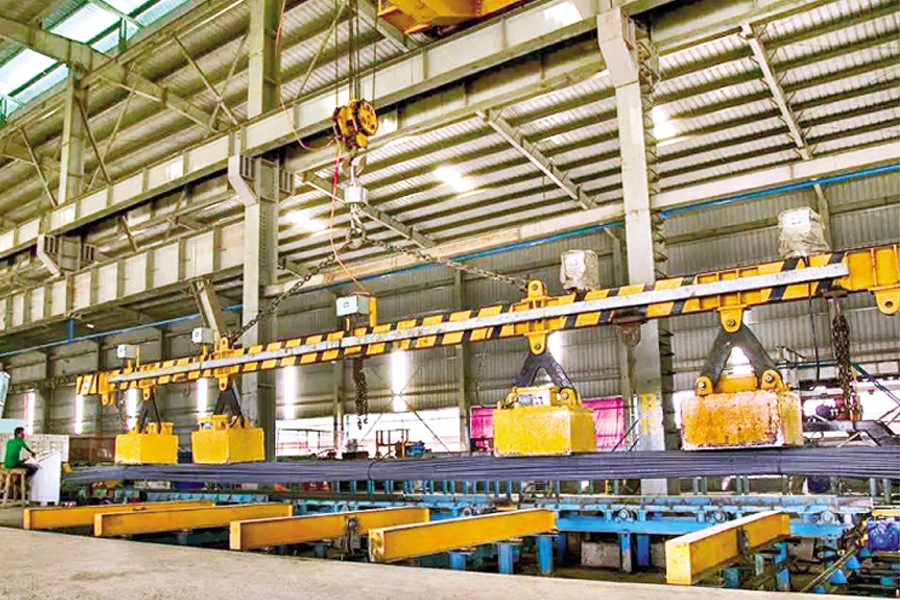
Let us now investigate the technological -process routes that we use in our plants. Around 95 per cent of our country's steel -manufacturing plants are using induction furnaces (IF). I am talking about the hot-rolling plants which produce molten metal and then manufacture rebars, not the cold-rolling mills for corrugated sheets or profile sheets. When the whole world we have seen is focusing on increasing the production through EAFs, we have only two companies who use this means, and the rest all in operation are using IFs. IF always comes with small capacity, thus not efficient in voluminous production with respect to use of land (keeping in mind that our country is a very small one and land is a critical resource for us). Also, it usually needs around 150 units of more power to produce a tonne of molten metal than EAF. On top of that, pollution control in the IF process is very difficult. I guess all readers can relate to this whilst they are travelling through Dhaka-Chattogram highway and experienced heavy smokes on the street whilst exiting Dhaka, near Narayanganj.
We only produce rebar in our hot-roll process and only one plant produces some plates (very low in capacity). We do not have any hot-rolled coil-producing facility in our country, which means all other materials like our profile sheets/corrugated sheets (dheutin), LPG cylinders, shipbuilding plates, electric motors, home appliances, automotive plates or any other steel items we use every day are actually processed from imported hot-rolled coils, mainly from China and India. Now we can relate why our manufacturing capacity in industrial sectors and any other sectors are so much dependent on imports. Because we do not have the basic steel-coil -manufacturing facility in our country, we are dependent on trading rather than manufacturing.
Let us make a simple articulation now. The global average for steel consumption is around 221kg per person while we are sitting at 50kg per person. If we want to see ourselves in a better status in 2030, this number must reach 100 kilograms per person. Also, we have to do it in the most efficient way because we have to rely on imported scraps, as current ship-breaking industries can only provide 15 to 20 per cent of the total demand and imported LNG. We have to switch to EAF-based plants, start planning to use HDRIs by importing from the countries who will produce that, and later plan for establishing such plants. The government is carrying out establishing several coastal-based economic zones and ports, e.g., Mirsarai and Matarbari with adequate utility supplies. Local big players with government support and FDIs should plan for steel-manufacturing plants in these zones. Thus, raw material and LNG imports and supply to necessary power stations and steel plants will be convenient.
The immediate next step is to establish the first hot-rolled-coil -manufacturing plant with EAF process route. Imagine if Walton was able to buy its required coils and plates from the local market and earn from its exports, how much value would have been added. Our country's image will emerge as a manufacturing nation from a user nation. We need to strengthen our power grid to feed at least 18-million-tonne steel -manufacturing facilities with EAF process routes. That is itself a mammoth task, and only the government can pull off such a huge task. So, the policy for supporting such activities is to be thought of from now on.
In 2030, we should aim for a day when we wake up in the morning and see at least 50 per cent of our surrounding steel materials are completely produced in Bangladesh. That day we can truly feel that we are on the growth path with sustainability. We will become makers from users. I wish to be living on that day and will try from my level to support this target as much as possible. I will request the readers to contemplate the same if it seems logical to them as well. Let us drive for a nation where we will be manufacturing maestros.
gmtauseef@gmail.com