

Published :
Updated :
 For all latest news, follow The Financial Express Google News channel.
While introducing himself, the veteran journalist, poet and writer Maruf Kamal Khan says with a touch of Dickensian humility: “Not a famous person, neither a consequential one in terms of popularity; could not get established as a litterateur despite writing some prose and poetry; lone source of earning livelihood has remained writing – particularly journalism. Could not rise to a higher pedestal with regard to formal education; neither could occupy a position of prestige through matrimony, kins, and well-wishers. Could not become a politician despite close linkages with politics, parties, and leaders since student-days. Neither could occupy any position in the domain of politics, party, and power. It was not possible to become a ‘somebody’ despite loitering around in the realm of culture and aesthetics, which included recitation and debate. Overall, continues to be a simple, ordinary, professional citizen”.
However, the experiences that Maruf Kamal Khan gathered while traversing these variegated arenas, and the opportunities he got to observe from a close range the internal and external dynamics of important personalities and events were quite rare for an ordinary citizen. He has now jotted down some of these episodes in the form of anecdotes. But he strove to maintain the objectivity of a journalist while dwelling on these, although there might have been shadows of his own views in some of the accounts and analyses.
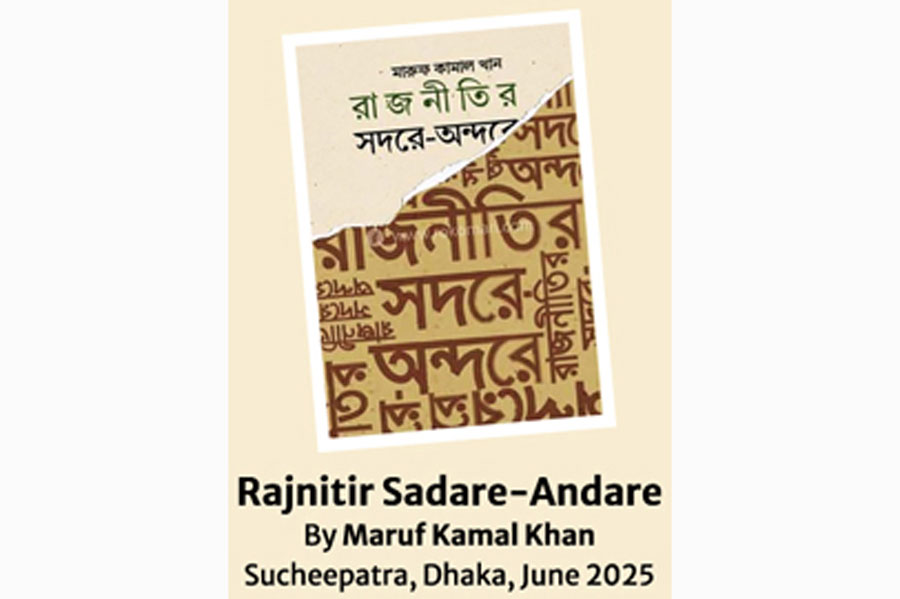
Through this book titled Rajnitir Sadare-Andare of captivating, eye-opening anecdotes, Maruf Kamal has presented for the inquisitive readers fascinating glimpses of the inner and outer workings of Bangladeshi politics, and the strengths and weaknesses of some renowned personalities from the domains of society, politics, culture, and journalism. As the author himself points out in his introduction, although these can be used as raw-materials or ingredients of history, they certainly are not historical accounts. However, the accounts have not been dyed with the colours of imagination. Rather, they are factual and related to real-life events. There has also been a conscious effort by the author to describe events as they happened by upholding objectivity, truthfulness, and unbiased outlook without promoting any political or ideological stance.
The readers will get an idea about the diverse contents of the anecdotes from their colourful titles, some of which are as follows: Tale of a historic statement; Khaleda Zia’s deposition; Taher Thakur’s divine settlement; Mizan Chowdhury’s goal-post; Sheikh Hasina’s Rasputin; General Osmani’s field marshal dog; fragmented and holistic C R Datta; Hannan Shah: Last post for the commander; Patol Bhai: How can I forget what was drawn with pain; Deleting Mujib because of Hasina; Call for unity and BAKSAL’s troika; General Shishu and the theme of Rasputin; News about Shah Aziz; Auranga and Bokul’s Pandora’s Box; Shaheed Zia’s ‘Desh’, Mukul’s ‘Desh’; Lost reminiscences of Firoz Noon; Salam Bhai on neck-biting and other topics; Before and after Ershad’s capture of power; A flash of Bidisha’s memory; Santosh Da loses privacy; Character of Moulana’s son; Quaid was not a Namazi; Sher-e-Bangla said: you are not doing the right thing Shaheed; Two historic resignation letters and the liability of history; After all, it was Faiz Bahi; National anthem, Zia, and the new generation; Elegy for B Chowdhury and uncovering the mysterious curtain; Bomb-hit Mostaq’s mistake; Delwar Bhai: pieces of hidden memory.
The summary of a sample anecdote titled ‘Kar Hashi Key Hashey’ is presented below to offer potential readers a taste of the contents: “Omar Ali Mistry was a famous rickshaw-maker before independence, who used to fabricate the bodies of rickshaws and baby-taxis at a garage owned by a Bihari entrepreneur. But immediately after independence, he not only became the proprietor of that garage, but also became owners of many shops, residences, plots and properties by becoming a frontline leader of the metropolitan branch of Sramik League – a sister organisation of the Awami League. His influence and power became irresistible when he undertook responsibilities for his party like supplying people for public meetings, leading party processions, and attacking the opposition activists on the streets of Dhaka. However, whether due to intra-party quarrel or external squabbles, whatever might have been the reason, Mistry was suddenly murdered one fine evening when he was fired upon by miscreants at his Paltan residence. Naturally, the Dhaka-based newspapers gave coverage to this incidentby attaching due importance.
“The late reporter of Dainik Bangla Zahirul Haque was assigned to write a follow-up story on it. What he reported in Dainik Bangla the following day was quite interesting. When he went to Mistry’s simple and unsophisticated first wife, she lamented: “Just when he saw some happiness after a life of hard work, he left at that very point, leaving behind such huge wealth! ” The brother of his second wife, who was running a shop at the market owned by Mistry at Nababpur said: “I was only preparing to shut my shop in the evening when I was informed by telephone that dula-bhai has been shot”. Residing in another residence of Mistry, the sorrow of his third wife was also visible despite wearing gold jewelleries and expensive sari. She sighed, “Why did Mr Mistry go out on a rickshaw when four of his cars were lying idle at the garage”? Mistry’s fourth wife was a university student whose hands still displayed the colour of henna. While wiping her eyes with a handkerchief, she cried: “What a setback! Now, what will happen to me”? At the fag end of the report, Zahirul Haque divulged: Multi-talented Omar Ali Mistry was also trying his hand at producing films. The title of the film he produced that was ready for release was “Kar Hashi Key Hashey” (Who laughs whose laughter?).”
Apart from internal and external pictures of deshi politics, the themes covered in the book include the rise and fall of people in power, as well as anecdotes from contemporary art, culture, media, and literary scene. The book will undoubtedly enlighten the history-enthusiasts as well as observers of Bangladesh society, politics, and culture, by shedding light on many issues that are still relevant for the countrymen.
Dr Helal Uddin Ahmed is a retired Additional Secretary and former Editor of Bangladesh Quarterly.
hahmed1960@gmail.com