



Bangladesh has evolved into one of the most rapidly expanding economies in South Asia. Over the years, it has transitioned from an agrarian structure to a diversified economy characterised by robust manufacturing, service, and export sectors. At present, Bangladesh's economy and business growth are moving forward with digital transformation. Digital transformation is reshaping not only public‑services and consumer behaviour but also business models, sectoral growth and the economy at large in Bangladesh.
Digital transformation means the integration of modern technologies including Artificial Intelligence (AI), automation, cloud computing, data analytics, and online platforms into all areas of business operations. It refers to adopting technology, about redefining how business management functions and how organisations interact with their customers. Digital transformation marks a revolutionary shift in how businesses leverage technology, fundamentally altering the status quo of traditional operational models.
We are living in the era of the 4th industrial revolution which clarifies the essentiality of technology to survive and adapt with this changing world. World economy, business model and people’s livelihood have dramatically reshaped with the digital transformation by integrating technology into every aspect of life. It has modernised how we work, communicate, shop, and learn enabling remote work, online education, e-commerce, and instant global communication. In order to operate a business more efficiently, businesses now rely on data, automation, and digital tools. Besides business organisations, governments and healthcare systems use technology to improve services and access.
Digital transformation is essential for a business organisation to adapt with the changing market dynamics and evolving customer expectations, making business operation faster, analysing customer demand and feedback and achieving overall business growth. Traditional processes are conventional, paper-based, slower and less effective. Nowadays, companies shift from physical to digital platforms. For example, dresses were stored in a shop and customers bought them physically. But in the modern era, customers can choose from online and social media, and buy it easily via digital payment system. It enables an organisation to enter into a large market as well as enables a customer to choose from million shops easily.
Bangladesh has already entered a digital transformation process with e-governance, e-Sheba, e-commerce platforms (Daraz, Chaladal, Ajkerdeal, Foodpanda), digital payment systems (bKash, Nagad, Rocket), social media marketing (Tiktok, Facebook, Instagram), automation and cloud services (inventory management, accounting software and cloud platforms), start-up and tech innovations (ridesharing, delivery service, online education platform) and data driven decisions to analyse customer behaviour and market trends. That transformation will be increasing in business models over time.
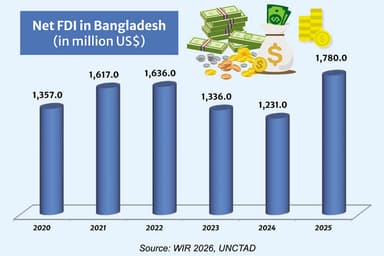
Statistical data from different sources show that there are about 133 million internet users (54.2% of the population), over 192 million active cellular mobile connections, about 47%-56% digital banking transaction, $7-$8 billion e-commerce transaction every year in Bangladesh which has driven the business as well as economy turn into digitalisation. Digital transformation has brought significant changes to Bangladesh’s business model and economy. Through this digital transformation, the ICT sector contributes over 1% to Bangladesh GDP and 2 million youths get employment opportunities, encourage million dollars foreign investment and improve government efficiency which are gradually increasing.
"Digital Bangladesh'', a national vision of the country launched by the government of Bangladesh in 2009 to transform the country into a technology-driven and knowledge-based economy. It emphasizes using digital technology to improve health, business, education and government services. It has also prepared the way for the next step ''Smart Bangladesh-2041" where technology will power every part of life. To accomplish this vision, The ICT Division of Bangladesh has already released a draft version of the 'National Digital Transformation Strategy' on February 16, 2025 with the collaboration of the United Nations Development Program (UNDP). It is a comprehensive plan to integrate digital technologies across government and the economy to improve, create a digital economy, efficiency and enhance public services. This initiative will also address major cybersecurity concerns by 2030.
To embrace digital transformation, business organisations in Bangladesh have taken a variety of initiatives like automation of operation and analytical dashboards, digitisation of financial service and e-KYC onboarding, digital platforms for small and medium enterprises, e-commerce and online business models, developing digital infrastructure and business ecosystem, etc. Besides these initiatives, business organisations should increase the use of their artificial intelligence using capacity to analyse data, use cloud computing and remote work systems, data analytics and business intelligence, own cyber security system, sustainable and green technology to meet customers demand effectively and efficiently.
Although there are some challenges including over-dependency, high technological cost and Cyber security risk, digital transformation will be the unveiling of the future of business. As the world becomes increasingly connected, digital transformation is unveiling the future of business growth in Bangladesh by making enterprises more agile, efficient, customer-focused and innovative. Digital transformation is not just a trend, it is a global movement towards smarter, faster, and more connected business models.
- The writer is a student of North South University. She could be reached by email: faria.munni@northsouth.edu