

Published :
Updated :
 For all latest news, follow The Financial Express Google News channel.
The trend of politics in Bangladesh is quite distinct. It is unique in melody and rhythm. Its nature and mobility also have distinctive features. If its flow is obstructed or if any threat emerges, a deluge of floods result that inundates both the banks. If there is any hindrance to its melody and rhythm, then a dance of annihilation ensues. And when the message is reckless, the ravages of a storm commence.
Everybody can recall this manifestation of Bangladeshi politics during the War of Independence in 1971. Most people of this country had responded to the call for independence by unhesitatingly plunging into a bonfire of sacrifice. They swam through a river of blood in their effort to achieve independence. The national psyche was revamped with a daring resolve. The strength of self-confidence gave rise to sky-high arrogance.
The message of Bangladeshi politics is that of self-reliance – not dependence on others. This message stands out for distinctiveness, not for self-abjection. It advocates keeping one’s head high even in the midst of acute poverty and deprivation. It seeks neighbours as friends, not as masters or guardians. That resolve was once more visible during the revolution of November 7 (in 1975). The characteristic features of Bangladeshi politics had once more become apparent through that test.
The combined slogan of the masses-soldiers-students on November 7 was a clear reflection of that politics. If the slogans of that revolution were analysed, their real significance would become transparent to many.
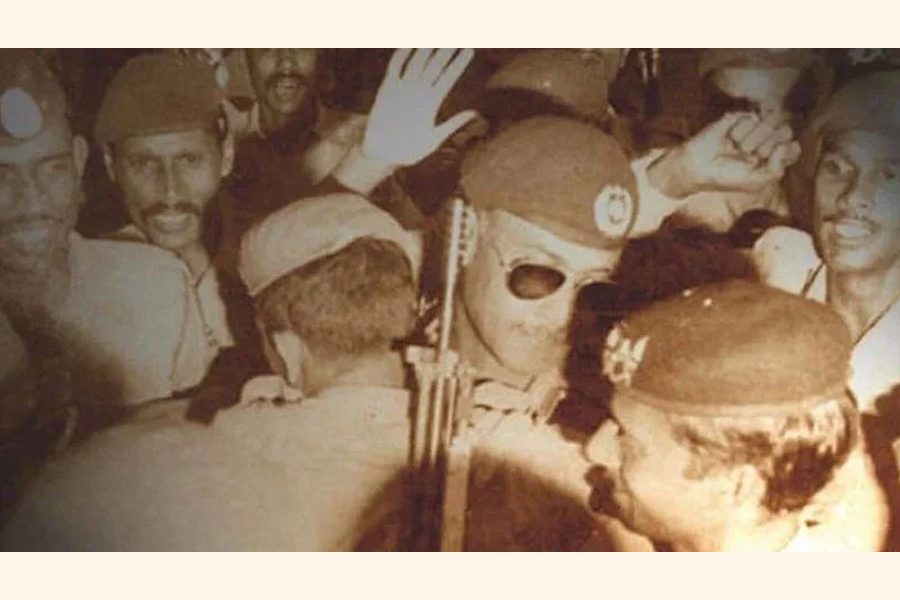
This chapter of November 7 was composed by three illustrious freedom fighters of Bangladesh. The details of ‘who did what’ is available elsewhere. This article has only attempted to clarify their respective contributions to the direction and spontaneous unfolding of politics in Bangladesh. From this context, it can be said that just as General Ziaur Rahman was a distinctive product of this trend, he was also an outstanding architect of that historical episode. The melody and rhythm of Bangladeshi politics had then reverberated with the creative leadership of Zia. The message of Bangladeshi politics found echoes in his voice. The notable features of Bangladeshi politics were visible from his works and deeds.
On November 3 in 1975, freedom fighter Khaled Mosharraf staged a coup-de-tat to topple the cabinet headed by the Awami League leader Khandakar Mostaque Ahmed. He was the one who promulgated Martial Law for the first time in the country’s history. It was he who dissolved the parliament that was elected in 1973. The first Martial Law administration in Bangladesh was established under him. Some people say, Khaled Mosharraf took this measure to restore the image of Sheikh Mujib and rehabilitate his BAKSAL government. It might have been that he was a fan of Mujib. He also had good ties with the Awami League. But if his aim was to restore the image of Sheikh Mujib, then he would have maintained contact with the top leaders of Awami League. Then he would also have taken measures to protect the lives of four national leaders imprisoned in jail, or would have buried them beside the graves of three other national leaders on the High Court premises after failing to save their lives. That proposal was in fact given to him. It was expected that he would be happy when a procession went to Shiekh Mujib’s residence from the Dhaka University campus on November 4. He also could have formed a council of advisers or ministers comprising the Awami League leaders. But he did none of these.
Some people also say that Khaled Mosharraf staged the coup to restore the chain of command in the army. Like other senior officers in the army, he was also dissatisfied with the influence of the Army Majors who had staged the August Coup and who were showing disregard to the hierarchical command structures in the army. But if the main ground for staging this coup by Khaled Mosharraf was dissatisfaction with those Army Majors, then how could he remove the Army Chief General Zia and place him under house arrest? How could he make arrangements for the safe exit from the country of the violators of chain of command, especially when he knew that they were involved with the killings of four national leaders. In fact, he staged the November 3 coup to eliminate the numerous organizations of ordinary soldiers mushrooming in the Army and the Air Force through a pre-emptive strike. That was because, those organisations were formed under the leadership of another distinguished freedom fighter – Colonel Taher – as part of the revolutionary programs of the Gano Bahini (people’s army).
Whatever the ground, the 3rd November coup of Khaled Mosharraf was ultimately branded as a pro-Indian coup by the student community and the people of Bangladesh. The role of the then leaders of Jatiya Samajtantrik Dal (JSD) as well as Colonel Taher in this labelling was crucial. They were apprehensive that the goals for which so many revolutionary organisations of soldiers were established would be lost forever. Even if that coup was not pro-Indo-Russian, the dominance of India and Russia might expand if political uncertainty continued in Bangladesh. As a result, the pro-India Awami League rule might get restored once more. They were also concerned by the procession that went to Sheikh Mujib’s residence from the Dhaka University campus. They were terrified at the prospect of domination by the Russo-Indian cliques as well as the reemergence of BAKSAL.
Due to these apprehensions, leaflets were distributed on behalf of the ‘Biplobi Soinik Sangstha’ (Revolutionary Soldiers’ Association) in different cantonments on November 5. The decisions that were taken at a meeting of the leaders of the Sangstha under the chairmanship of Colonel Taher on November 6 were also expressions of these fears. These decisions were: “The coup-de-tat of the Indian agent Khaled Mosharraf has to be neutralized; Ziaur Rahman has to be freed from captivity; a ‘Revolutionary Soldiers’ Council’ has to be formed to direct the army; arrangements have to be made for implementation of the 12-point demands of the soldiers; all political prisoners have to be freed; a national government has to be formed comprising all the political parties except BAKSAL”.
The revolution of November 7 should be viewed in this backdrop. The resolve for upholding the independence of Bangladesh was articulated at that time by the combined voices of the students-citizens-sepoys. The need for preserving the sovereignty of Bangladesh and for thwarting any attempt to subjugate Bangladesh through conspiracy also found expression then.
If the importance of ‘Revolution and Solidarity Day’ on November 7 is to be comprehended, one should understand in what sense it was revolutionary? What significance did it carry? In the words of Hannah Arendt: The modern concept of revolution is inextricably bound up with the notion that the course of history suddenly begins anew, and an entirely new story, a story never known or told before, is about to unfold (On Revolution, 1966, 21).
It is quite evident that November 7 was a revolutionary event when we look at it from the political, economic, and cultural viewpoints. Bangladesh after November 7 was quite different from Bangladesh before November 7. This distinctiveness has been quite apparent in domestic arena as well as in the international field. It was visible in the domains of politics, economy, and even culture. The mist of pre-7-November BAKSAL rule was cleared in the post-7-November Bangladesh. The political parties upholding multi-party democracy then flourished. The pages of newspapers started to speak out. The Judiciary began to emerge out of the grips of the Executive. By coming out of the Indo-Soviet axis in the international arena, Bangladesh started to traverse the wider realms of global politics. She was able to hold her head high as an independent actor in international politics. She also succeeded in occupying a place of honour in the regional platforms.
Bangladesh could then play a proactive role in forging friendships in South, Southeast and East Asia, the Middle East and North Africa on the basis of sovereign equality. Deep-seated changes were also initiated on the economic front. The corrupt and wasteful economic structure that was in place in the name of socialism was done away with. In place of the narrow and parochial ‘Bangali Nationalism’, the appeal of a liberal and refined ‘Bangladeshi Nationalism’ having a wider expanse and a larger following in society became irresistible. In other words, a fundamental change occurred in Bangladesh’s worldview after 7 November.
The perceptions of the people at that time were not much different than what they are today. Besides, the teachings of 7 November are relevant for those people who want people’s welfare, seek to transform society in the light of existing realities, and wish to resolve the problems faced by the country through upholding national interest. For them, the appeal of 7 November has not diminished a bit.
Source: Bangladesh Quarterly. The writer was a leading intellectual of the country and former Vice Chancellor of Dhaka University
Translation from Bangla to English by Dr Helal Uddin Ahmed – a retired Additional Secretary and former Editor of Bangladesh Quarterly. hahmed1960@gmail.com