

Trump threatens internatio nal order
US withdrawal from key multilateral bodies has long-term implications
Published :
Updated :
 For all latest news, follow The Financial Express Google News channel.
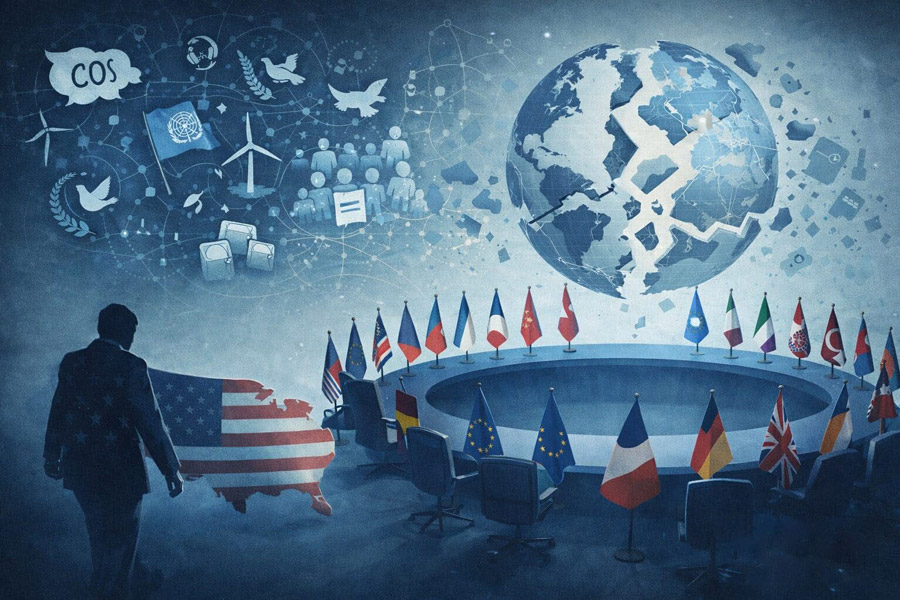
The Trump Administration's sweeping Executive Order issued in the first half of January stipulates the withdrawal of the United States from dozens of United Nations bodies and international organisations. This latest decision by the United States is being viewed as a targeted assault on multilateralism, international law, and global institutions critical to safeguarding human rights, peace, and climate justice. This step is being considered as a US retreat from multilateral institutions that is likely to undermine the rule of law.
The Centre for International Environmental Law has described the Order as representing "a deliberate effort to dismantle the international infrastructure designed to uphold dignity, protect children, improve gender and racial equality, advance sustainable development, preserve the oceans, and confront the climate crisis". It has also been underlined that it "undermines bodies that safeguard the global commons and ensure basic protections for marginalised people and those in vulnerable situations around the world, including refugees, women, children, people of African descent, and many others".
The anxiety created through the Order has led columnist Thalif Deen to wonder whether the US is moving towards the UN's exit pathway?
Organisations from which the United States aims to withdraw-
(a) Non-United Nations Organisations:
(i) 24/7 Carbon-Free Energy Compact; (ii) Colombo Plan Council; (iii) Commission for Environmental Cooperation; (iv) Education Cannot Wait; (v) European Centre of Excellence for Countering Hybrid Threats; (vi) Forum of European National Highway Research Laboratories; (vii) Freedom Online Coalition; (viii) Global Community Engagement and Resilience Fund; (ix) Global Counterterrorism Forum; (x) Global Forum on Cyber Expertise; (xi) Global Forum on Migration and Development; (xii) Inter-American Institute for Global Change Research; (xiii) Intergovernmental Forum on Mining, Minerals, Metals, and Sustainable Development; (xiv) Intergovernmental Panel on Climate Change; (xv) Intergovernmental Science-Policy Platform on Biodiversity and Ecosystem Services; (xvi) International Centre for the Study of the Preservation and Restoration of Cultural Property; (xvii) International Cotton Advisory Committee; (xviii) International Development Law Organisation; (xix) International Energy Forum; (xx) International Federation of Arts Councils and Culture Agencies; (xxi) International Institute for Democracy and Electoral Assistance; (xxii) International Institute for Justice and the Rule of Law; (xxiii) International Lead and Zinc Study Group; (xxiv) International Renewable Energy Agency; (xxv) International Solar Alliance; (xxvi) International Tropical Timber Organisation; (xxvii) International Union for Conservation of Nature; (xxviii) Pan American Institute of Geography and History; (xxix) Partnership for Atlantic Cooperation; (xxx) Regional Cooperation Agreement on Combating Piracy and Armed Robbery against Ships in Asia; (xxxi) Regional Cooperation Council; (xxxii) Renewable Energy Policy Network for the 21st Century; (xxxiii) Science and Technology Center in Ukraine; (xxxiv) Secretariat of the Pacific Regional Environment Programme; and (xxxv) Venice Commission of the Council of Europe.
(b) United Nations (UN) Organisations:
(i) Department of Economic and Social Affairs; (ii) UN Economic and Social Council (ECOSOC) - Economic Commission for Africa; (iii) ECOSOC - Economic Commission for Latin America and the Caribbean; (iv) ECOSOC - Economic and Social Commission for Asia and the Pacific; (v) ECOSOC - Economic and Social Commission for Western Asia; (vi) International Law Commission; (vii) International Residual Mechanism for Criminal Tribunals; (viii) International Trade Centre; (ix) Office of the Special Adviser on Africa; (x) Office of the Special Representative of the Secretary General for Children in Armed Conflict; (xi) Office of the Special Representative of the Secretary-General on Sexual Violence in Conflict; (xii) Office of the Special Representative of the Secretary-General on Violence Against Children; (xiii) Peace building Commission; (xiv) Peace building Fund; (xv) Permanent Forum on People of African Descent; (xvi) UN Alliance of Civilizations; (xvii) UN Collaborative Programme on Reducing Emissions from Deforestation and Forest Degradation in Developing Countries; (xviii) UN Conference on Trade and Development; (xix) UN Democracy Fund; (xx) UN Energy; (xxi) UN Entity for Gender Equality and the Empowerment of Women; (xxii) UN Framework Convention on Climate Change; (xxiii) UN Human Settlements Programme; (xxiv) UN Institute for Training and Research; (xxv) UN Oceans; (xxvi) UN Population Fund; (xxvii) UN Register of Conventional Arms; (xxviii) UN System Chief Executives Board for Coordination; (xxix) UN System Staff College; (xxx) UN Water; and (xxxi) UN University.
Besides these sixty-six, withdrawals also include pullouts from the Human Rights Council, the WHO, UNRWA and UNESCO, while imposing drastic reductions in funding for the remaining UN entities the US has not yet formally exited.
The seriousness of this US decision will have a major impact because historically, the United States has been the largest financial contributor, typically covering around 22 per cent of the UN's regular budget and up to 28 per cent of the peacekeeping budget.
Dr Stephen Zunes, Professor of Politics, University of San Francisco, who has written extensively on issues relating to the United Nations, has observed that even the U.S. Presidents most hostile to the United Nations- like Ronald Reagan and George W. Bush- recognised the importance of the world body in terms of advancing U.S. interests, including understanding the importance of maintaining the UN system as a whole, even while violating certain legal principles in particular cases.
Mandeep S. Tiwana, Secretary General, CIVICUS, a global alliance of civil society organisations, has also commented that the retreat from international institutions by the Trump Administration is an attack on the legacy of President Franklin D. Roosevelt who gave the people of the United States the New Deal and envisioned a bold framework for the establishment of the UN to overcome the horrors of the Second World War. In this regard Tiwana has observed that "many of the impacted international institutions were built through the blood, sweat and tears of Americans. Pulling out of these institutions is an affront to their sacrifices and reverses decades of multilateral cooperation on peace, human rights, climate change and sustainable development."
It may be recalled that the possibility of the United Nations coming under heavy fire was reflected in the critical views expressed by President Trump when he addressed the UN General Assembly last September. Trump remarked, "What is the purpose of the United Nations? It's not even coming close to living up to [its] potential." Dismissing the U.N. as an outdated, ineffective organisation, he boasted, "I ended seven wars, dealt with the leaders of each and every one of these countries, and never a phone call from the United Nations offering to help in finalising the deal."
Meanwhile, in a veiled attack on the United Nations, Secretary of State Marco Rubio has said, "what we term the -- international system -- is now overrun with hundreds of opaque international organisations, many with overlapping mandates, duplicative actions, ineffective outputs, and poor financial and ethical governance. Even those that once performed useful functions have increasingly become inefficient bureaucracies, platforms for politicised activism or instruments contrary to our nation's best interests. Not only do these institutions not deliver results, they obstruct action by those who wish to address these problems. The era of writing blank checks to international bureaucracies is over."
Rebecca Brown, President and CEO of the Centre for International Environmental Law (CIEL) has observed: "At a time when rising seas, record heat, and deadly disasters demand urgent, coordinated action, the US government is choosing to retreat. The decision to defund and withdraw from the UN Framework Convention on Climate Change (UNFCCC) does not absolve the US of its legal obligations to prevent climate change and remedy climate harm, as the world's highest Court made clear last year. This action is simply a continuation of this Administration's efforts to prioritise corporate interests over people and planet, and flout the rule of law. Withdrawing from institutions designed to support global climate action does not change the stark reality of the climate crisis, rebut the irrefutable evidence of its causes, or eliminate the US's clear responsibility for its consequences. Withdrawal only serves to further isolate the US to the detriment of its own population and billions around the world."
One can recall at this point, before concluding, that one of President Trump's first actions after returning to Office in January 2025 was to announce the withdrawal of the US from the Paris Agreement for the second time. This will take effect on January 27, 2026. From this point forward, the US will no longer be legally bound by the agreement's carbon-cutting pledges. By withdrawing from the Paris Agreement to target the UN Framework Convention on Climate Change (UNFCCC) the US Administration aims to exit the entire international framework for climate negotiations.
Notably, the US will however remain a Member of the UN Security Council, the World Food Programme (WFP), and the UN Refugee Agency (UNHCR), which the US Administration has identified as serving essential security or humanitarian functions.
Muhammad Zamir, a former Ambassador is an analyst specialised in foreign affairs, right to information and good governance. muhammadzamir0@gmail.com