

Published :
Updated :
 For all latest news, follow The Financial Express Google News channel.
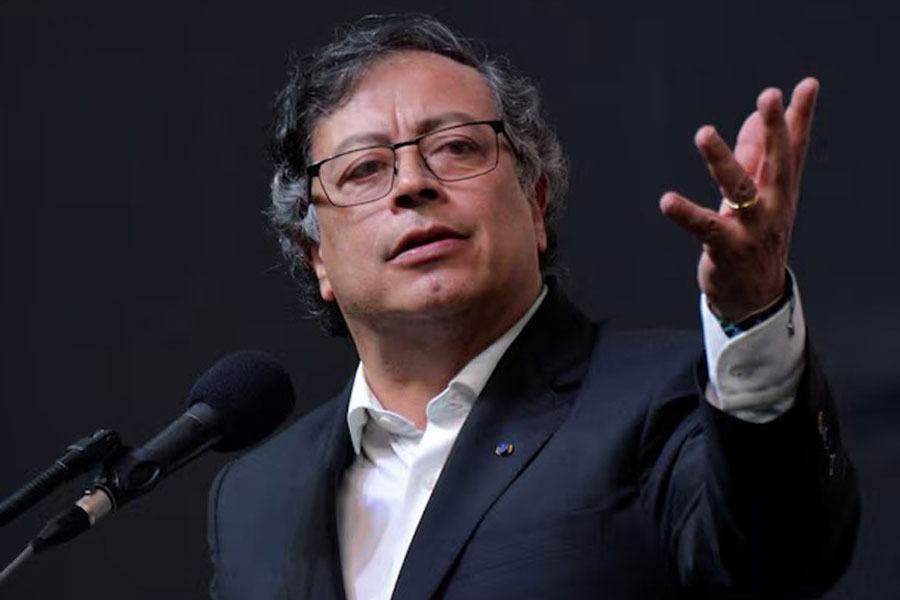
Colombia’s President Gustavo Petro has warned that the country is facing what he has described as a “real threat” of US military action, following recent remarks by US President Donald Trump.
In an interview with the BBC, the Colombian leader said Washington was increasingly treating other countries as part of a US “empire”, adding that such an approach risked leaving the United States isolated globally.
Petro’s comments have come after Trump said a military operation in Colombia “sounds good", according to the BBC.
Petro told the UK-based broadcaster that the United States risked shifting from “dominating the world” to becoming “isolated from the world”.
The Colombian president has also accused agents of US Immigration and Customs Enforcement, known as ICE, of behaving like “Nazi brigades”, the BBC added.
Trump has expanded ICE operations sharply, describing them as part of a crackdown on crime and undocumented immigration.
The BBC reported that it has approached the White House for comment.
Following recent US strikes in Venezuela and the capture of President Nicolás Maduro, Trump said a military operation targeting Colombia “sounds good”.
Trump has also repeatedly told Petro to “watch his ass”, remarks the Colombian president strongly condemned.
Trump and Petro spoke by phone on Wednesday evening. Trump later said he would meet Petro at the White House in the “near future”.
Writing on his Truth Social platform, Trump termed the conversation as a “great honour”, the BBC reported.
A Colombian official said the call reflected a sharp shift in tone from both sides.
Speaking to the BBC on Thursday, Petro, however, suggested relations had not improved significantly.
He said the phone call lasted just under an hour and focused largely on drug trafficking in Colombia, Venezuela and broader developments across Latin America involving the United States, the BBC said.
Petro again criticised US immigration enforcement, repeating his claim that ICE agents were acting like “Nazi brigades.”
Trump has accused Colombia and Venezuela of failing to do enough to curb drug trafficking. The broadcaster noted that the US has carried out more than 30 strikes in recent months on vessels allegedly used for drug trafficking in the Caribbean and Pacific, killing more than 110 people.
In an interview with Fox News aired on Thursday night, Trump said that after targeting drug trafficking at sea, the US would begin striking land targets, adding that drug cartels were “running Mexico”, the BBC said.
Trump has frequently linked immigration to crime and trafficking in the US, using it to justify large-scale enforcement operations. Since returning to the White House, ICE agents have been deployed across US cities, it added.
The US administration has said it deported 605,000 people between Jan 20 and Dec 10, 2025.
It also said 1.9 million immigrants had voluntarily left the country following a public awareness campaign, as per the BBC.
About 65,000 people were being held in ICE detention as of Nov 30, 2025, data cited by the BBC showed.
It also reported that a US immigration agent this week shot dead a 37-year-old US citizen in Minneapolis, triggering protests overnight. Federal officials said the woman attempted to run over agents with her car, while the city’s mayor said the agent acted recklessly and demanded federal agents leave the city.
Petro told the BBC that ICE had reached a point where it was no longer only targeting Latin Americans but was also killing US citizens, calling it an affront.
He warned that such actions could turn the US into an isolated power rather than a global leader, adding that empires were not built through isolation.
Petro said the United States had for decades treated Latin American governments as part of an empire, regardless of international law.
The two leaders have long traded insults and tariff threats online, the BBC noted.
Following US military action in Venezuela, Petro accused Washington of pursuing wars over oil and coal.
He said that if the US had not withdrawn from the Paris Agreement, global relations would have been more democratic and peaceful, according to the British broadcaster.
After Trump’s remarks on Colombia, demonstrations were held across the country in the name of sovereignty and democracy.
Petro told the BBC that Trump’s comments amounted to a “real threat”, citing Colombia’s loss of territory, including Panama, in the 20th century. He said removing the threat depended on continued dialogue.
Asked how Colombia would defend itself in the event of a US attack, Petro said he preferred dialogue.
He added that Colombia’s history showed how it had responded to large armies, relying on its population, mountains and jungles rather than heavy weaponry.
Petro also confirmed to the BBC that he had spoken with Venezuela’s acting president Delcy Rodríguez and invited her to Colombia.
He said Venezuela had long been subject to interference by intelligence agencies, adding that while such agencies were permitted to operate in Colombia to combat drug trafficking, other covert actions were “unacceptable”.
Petro did not directly answer whether he feared similar covert operations against his own government.
Maduro was captured by the US military’s Delta Force with the help of a CIA source inside the Venezuelan government, the BBC noted.
As the world’s largest cocaine producer, Colombia plays a central role in the global drug trade and also holds major reserves of oil, coal and precious minerals.
The US has said it will control Venezuelan oil sales indefinitely as it prepares to ease restrictions on the country’s crude exports.
Speaking aboard Air Force One after the Venezuela operation, Trump described Petro as a “sick man” involved in cocaine production, comments Petro rejected in his BBC interview.
Petro said he had spent two decades fighting drug cartels and that his family had gone into exile as a result.
A former guerrilla, Petro has pursued a “total peace” policy since taking office, prioritising dialogue with armed groups. Critics say cocaine production has reached record levels under his watch.
Petro told the BBC that coca cultivation growth was slowing and described a dual approach of negotiations and military action against groups rejecting peace.
He said talks were ongoing in southern Colombia, where coca cultivation and homicide rates had fallen most sharply, adding that the strategy aimed to reduce violence while recognising the nature of the groups involved.