

Bangladesh leads ZKTOR’s privacy-first platform expansion in South Asia
Published :
Updated :
 For all latest news, follow The Financial Express Google News channel.
Bangladesh is emerging as more than an early market in ZKTOR’s South Asia rollout. It is becoming one of the clearest real-world tests of whether the region is ready for a different model of digital participation.
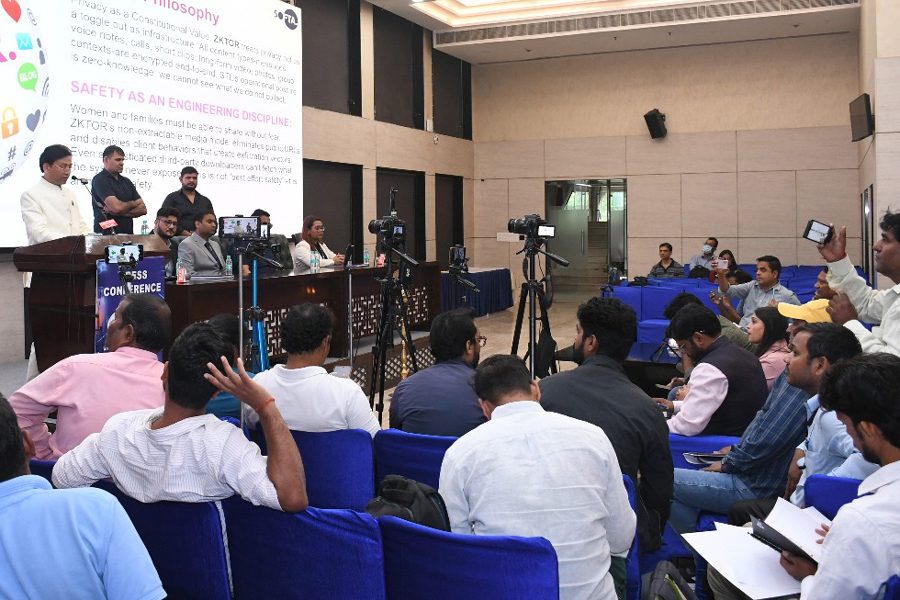
According to the company, the privacy-led Indian social media platform has crossed more than half a million users in just two months across India, Nepal, Sri Lanka and Bangladesh, with youth and women accounting for much of the early base.
The next phase of beta expansion will take the platform into Pakistan, Bhutan and the Maldives. On the surface, this appears to be a straightforward user-growth story. Beneath that lies a much larger wager: that users across South Asia may now be ready for a platform built less around broad exposure, behavioural extraction and algorithmic amplification, and more around trust, data safety, family-safe participation and local economic fit.
That is precisely what makes Bangladesh unusually important for the company, which thinks Bangladesh is a large, young, mobile-first and socially dense market where digital adoption is shaped not only by entertainment and virality, but also by family comfort, community reputation, women’s visibility, small-business credibility and the practical needs of everyday users.
According to the company, unlike older social platforms that scaled by making users more visible, more behaviourally legible and more commercially extractable, it is being positioned around privacy and data safety by design. Its architecture includes zero behaviour tracking, no-URL media logic, bounded platform-side readability, multi-layer encryption and VDL, which reduce extractability, lower misuse risk, strengthen digital dignity and create a more disciplined environment for participation.
The distinction matters even more in the AI era. Privacy, in the older sense, was largely about who could access user information. Data safety is a broader and more consequential question. It asks what remains possible once information, media or behavioural traces enter the system. Images can now be copied, manipulated and redistributed at extraordinary speed. Voice samples can be repurposed. Video clips can be detached from context and recirculated. Personal traces can support deeper forms of inference than earlier digital systems were ever designed to contain. In that setting, the company’s argument is that privacy alone no longer captures the full risk architecture of online participation. Data safety matters just as much. That proposition may resonate particularly strongly in Bangladesh, where digital life increasingly sits at the intersection of aspiration, caution and economic necessity. Users are not simply seeking visibility; they are also calculating exposure. A platform that offers lower extractability and stronger control is therefore not merely promising a cleaner user experience. It is responding to one of the region’s most urgent digital anxieties: how to remain visible without becoming structurally overexposed.
The composition of the early user base makes that thesis more credible. Across South Asia, youth adoption is often the first signal of cultural momentum. Young users test platforms first, form habits first and carry them into wider peer networks, creator communities and local commercial settings. Strong youth uptake therefore signals more than novelty. It suggests relevance, legibility and the possibility of organic diffusion. Women’s adoption may be even more meaningful. Across Bangladesh and neighbouring markets, women already drive substantial layers of tutoring, education support, beauty services, resale activity, home-based retail, neighbourhood commerce and other forms of local enterprise. Yet the digital environment has often expanded women’s visibility faster than it has improved women’s control. That imbalance creates a hidden participation cost. A platform that lowers that cost by making online presence feel safer, more bounded and more manageable can unlock a deeper layer of economic activity. In that sense, strong adoption by women is not merely a trust signal; it is also a market-depth signal. This is where family-safe design begins to acquire clear commercial meaning. In Bangladesh, as elsewhere in South Asia, digital platforms do not spread through isolated individuals alone. They move through homes, shared screens, domestic scrutiny and social context. A platform that feels too extractive, too unpredictable or too socially awkward in those settings may still be used, but it is less likely to become fully legitimised. A platform that feels more controllable, more bounded and more family-safe can gain household legitimacy, and household legitimacy in markets like Bangladesh can become a powerful engine of adoption rather than a secondary branding attribute.
The broader economic implications are substantial. Bangladesh’s digital opportunity is not limited to urban creators or national advertisers. A significant share of its future value sits inside the everyday economy: tutors, service providers, clinics, local retailers, home businesses, district entrepreneurs and informal-to-formal operators. That is why the hyperlocal economy sits so close to the centre of the ZKTOR story. Across South Asia, this remains one of the region’s hidden multi-billion-dollar layers: large in aggregate, fragmented in practice and still under-served by platforms designed primarily for mass attention rather than trusted local conversion. A trust-rich platform could potentially organise that layer more effectively. It could help merchants appear in a more credible digital environment. It could help creators move closer to local commercial function. It could help women-led enterprises become more discoverable without becoming disproportionately exposed. It could also support local jobs and strengthen district and rural economies by creating a setting in which digitally fluent young users act as operators, translators and visibility builders for businesses and services that lack strong digital capability of their own. This logic becomes even clearer when viewed inside the wider Softa ecosystem. Softa appears to be treating the South Asia rollout as systems validation rather than geography alone. If the same platform logic works across India, Nepal, Sri Lanka and Bangladesh, and then extends into Pakistan, Bhutan and the Maldives, the company’s claim to regional repeatability becomes materially stronger. At that point, the story becomes less about market count and more about whether a broader South Asian digital ecosystem thesis is starting to prove itself. Softa’s capital posture adds another layer to that narrative. The company says the ecosystem has been built without venture capital, without government grants and without debt. That no-VC, no-grants, debt-free posture is central to its independence-led identity. Internally, Softa describes the method as closer to an ISRO model: frugal, mission-led, architecture-first and long-horizon. Whether markets ultimately accept that comparison in full is another question, but it does help distinguish the company from the more familiar capital-fuelled, momentum-driven consumer technology playbook. The platform’s founder and chief architect, Sunil Kumar Singh, sharpens that positioning further. His Finland-linked design discipline suggests an engineering outlook shaped by restraint, accountability and proportionality. That also places the company closer to the broader direction of travel reflected in GDPR in Europe and DPDP in India, both of which have pushed rights-conscious design, data minimisation and safer user architecture higher up the policy and governance agenda.
None of this means the outcome is settled. Scale durability, commercial conversion, moderation resilience and ecosystem coordination still have to be proved. But Bangladesh is a serious market in which to test the thesis because it concentrates youth energy, social density, local enterprise, creator ambition and reputational sensitivity in one place. If the platform’s trust-first logic continues to hold there, and then travels successfully through Pakistan, Bhutan and the Maldives, the company’s rise may begin to mean more than an expanding beta footprint. It could come to represent one of the first credible signs that South Asia is moving toward a different digital order, one in which privacy, data safety, family-safe participation, digital dignity, local jobs, rural and district-economy relevance and hyperlocal discovery become central to platform value rather than peripheral features. If that happens, Softa may not simply be remembered as the company behind another rising app. It may instead be seen as the builder of a long-horizon South Asian digital ecosystem with the potential to scale into a billion-dollar enterprise.