


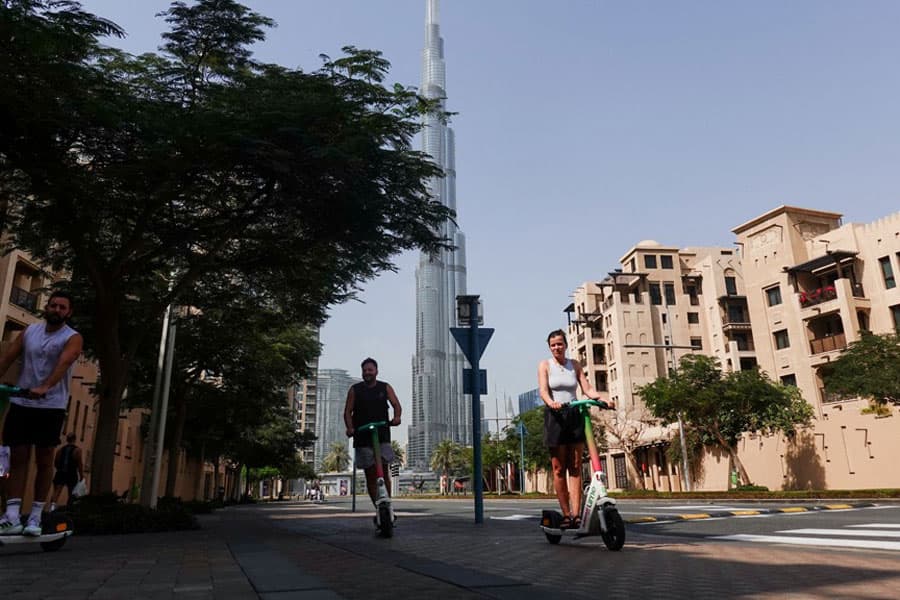
Beyond the physical devastation of debris and casualties, the high-tech display of AI-guided weaponry, and growing fears over the closure of the Strait of Hormuz, it is the shattering of Dubai’s image as a "safe haven" that has captured the most intense focus in Western media.


Some commentators have invoked the imagery of a “mirage” to describe the aftermath of Iran's retaliatory strikes on the Gulf state’s luxury hotels, towers, and airports.
The sentiment was echoed by those who observed that the “Dubai fantasy” marketed by global influencers had effectively vanished in a “puff of missile smoke”.
For decades, the global elite bought into a carefully constructed promise: no matter how volatile the Middle East became, the chaos would stop at Dubai’s borders, Reuters reported.
The city-state marketed itself as a glittering, tax-free sanctuary, a "Truman Show" in the desert that rivalled the financial gravity of London and the efficiency of Singapore, the report explained.
That unspoken contract was torn apart as Iranian retaliatory strikes reached the heart of the emirate, striking the psychological and physical foundations of the world’s most famous safe haven, Reuters said.
A City Branded On Stability
Dubai’s transformation from a fishing port to a global hub was a decades-long project fuelled by non-oil sectors. The brand was primarily built on stability.
As reported by Reuters, the city successfully shifted its economic reliance away from energy. Oil accounts for less than 2 percent of its GDP. In its place, the emirate built a model powered by international confidence, luxury real estate, and high-end tourism.
This "brand Dubai" was so effective that the UAE became the world’s top destination for relocating millionaires, according to international media outlets.
CNBC highlights that the city’s millionaire population doubled over the last decade to 81,000, attracting nearly 10,000 high-net-worth individuals in 2025 alone.
These expatriates provided the "brains, brawn, and investment capital" necessary for the city to function.
Unlike its neighbour Abu Dhabi, which holds the vast majority of the UAE’s oil reserves, Dubai’s survival is intrinsically tied to its reputation for pristine security, the CNBC report said.
The Fall
The aura of invincibility vanished when missiles and drone fragments struck key landmarks.
According to Reuters, the strikes hit Dubai International Airport, Jebel Ali Port, and the iconic Burj Al Arab hotel. Beyond the physical damage, which included fatalities and injuries, the attacks struck the very identity of the city.
An opinion piece in The Guardian notes influencers and hedge fund managers who moved to the desert to escape the "rain" or "London going to the dogs" suddenly found themselves huddled in basements, realising that their tax-free paradise sat just a few hundred miles from Tehran.
The UAE government acted swiftly to manage the narrative.
Reuters reports that the National Emergency, Crisis and Disasters Management Authority insisted the situation was "under control".
In a more aggressive move to protect the city’s image, CNBC noted that Dubai police threatened to arrest social media influencers who shared content contradicting official statements or inciting "social panic".
Despite these reassurances, the financial fallout was immediate.
Stock markets in the UAE were forced to close, and tech outages hit major cloud computing facilities, disrupting banking operations.
According to CNBC, the exodus of the wealthy has already begun, private jet brokers reported a surge in enquiries rivalling the start of the pandemic, with some corporate clients seeking to evacuate thousands of employees.
Reuters cited an unnamed source at a UAE-based mid-sized investment firm who stated that their company had begun preemptively planning layoffs and halted fundraising. Demand for gold bars surged, a jewelry industry source told Reuters.
International private banks, which had been expanding advisory operations in the emirate, may also reassess the scope of their presence, a private banker shared with Reuters. Firms may begin to rethink serving clients locally versus from another location, the banker said.
The Economic Peril
Experts warn that Dubai is uniquely vulnerable to a prolonged conflict.
Jim Krane of Rice University’s Baker Institute told Reuters that while the physical damage might be manageable, the "psychological pain" is acute. Because Dubai’s model relies on foreigners who can move their capital at the click of a button, any lingering doubt about safety could be fatal.
"The city cannot function if everyone with a foreign passport flees," Krane cautioned via CNBC, noting that Dubai is more exposed to the risks of an "expat exodus" than any of its oil-rich neighbours.
If the ultra-wealthy, who manage over $1.2 trillion through the Dubai International Financial Centre, decide that the geopolitical risk premium is too high, they may look for alternative hubs like Bali or Singapore.
The crisis has also forced a grim realisation upon the city’s diverse population.
The Guardian points out that the 300,000 Britons trapped in the Gulf are, in essence, "economic migrants" seeking a better life, much like the army of workers who clean the pools and nanny the children of the elite.
This war has "weaponized interconnectedness", proving that in a globalised economy, no tax haven is truly insulated from distant shocks, the Guardian article noted.
As the conflict continues, the resilience of Dubai’s real estate market, which has seen five years of record growth, is now under scrutiny.
With Fitch Ratings already predicting a market correction, the departure of expatriates could place immense pressure on housing values, CNBC reported.
Dubai now faces its greatest challenge: proving it can remain a global financial capital when its most valuable commodity, security, is no longer guaranteed.