

Published :
Updated :
 For all latest news, follow The Financial Express Google News channel.
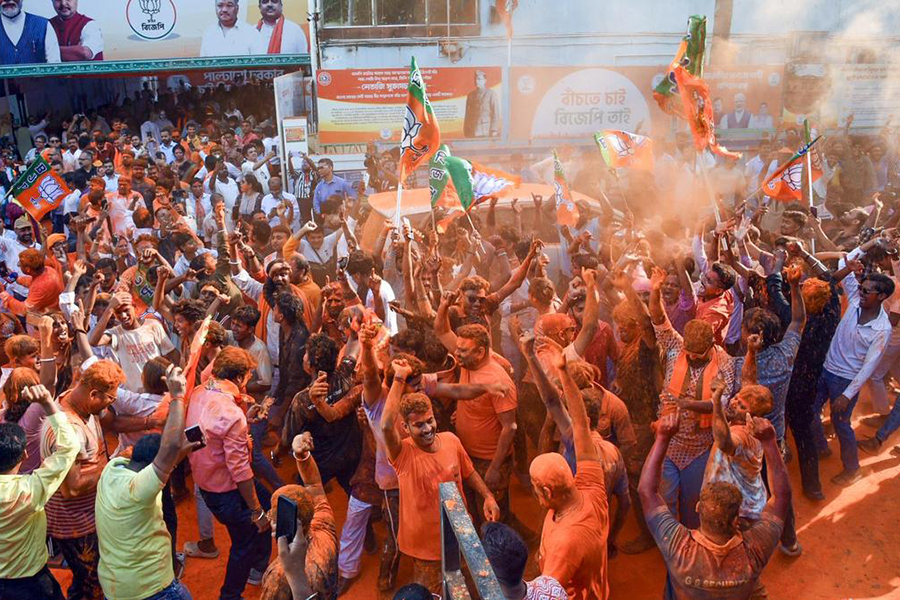
Riding high on an anti-incumbency against the 15-year-old Trinamool Congress government, the Bharatiya Janata Party (BJP) swept the West Bengal Assembly elections with the party set to form the government in the State for the first time, The Hindu reports.
Chief Minister Mamata Banerjee lost the Bhabanipur seat to BJP’s Suvendu Adhikari by 15,105 votes.
Election Commission of India (ECI) data at 12.40 a.m. on Tuesday (May 5, 2026) showed that the BJP had won 206 seats, while the Trinamool bagged 80 seats and was leading in another seat (Rajarhat New Town). The BJP, which registered an all-time high vote percentage of over 45.84 per cent, saw its vote share increase by more than 7 per cent from 38.4 per cent in the 2021 polls. The Trinamool’s vote share dropped by almost 8 per cent from 48.5 per cent in 2021 to 40.8 per cent in this election.
This victory is not only an electoral success for the saffron party but also a significant ideological triumph. For decades, West Bengal was an unfinished project for the BJP, as Syama Prasad Mookerjee, the founder of the Jana Sangha – the predecessor of the BJP – hailed from the State and played a significant part in setting up the tone of Hindutva politics in pre-independent India.
Not only has the BJP been able to retain its strongholds in north Bengal and southwest Bengal, but it has also made significant inroads in erstwhile Trinamool bastions of Kolkata and adjoining districts. In several districts of the State, such as Cooch Behar, Alipurduar, Jalpaiguri, Darjeeling, Kalimpong, Purulia, Paschim Bardhaman, Jhargram, Bankura and Purba Medinipur, the trends indicate that the Trinamool is likely to draw a blank.
The result broke several myths, including secularism being deeply embedded in West Bengal’s society and that the electorate cannot be polarised on religious lines. While the elections saw polarisation of Hindu voters, the Muslim votes, which largely used to go with the Trinamool in the past, were split between candidates of the Left-ISF alliance, Congress, and Humayun Kabir’s Aam Janata Unnayan Party (AJUP), spoiling the Trinamool’s chances. While the elections witnessed a bipolar contest, two seats each went to the Left-ISF alliance, the Congress, and the AJUP.
The elections in West Bengal were held in the backdrop of the Special Intensive Revision (SIR), which saw the deletion of 90 lakh electors. With the BJP winning seats across the State in all regions, which have seen high to low deletions, it is not clear if the deletions favoured any particular party or coalition. The Trinamool’s strategy of building the entire election campaign on the SIR did not work.
For the BJP, Adhikari also won from Nandigram; former State president Dilip Ghosh was leading from Kharagpur Sadar; and in Kolkata’s Rashbehari seat, Swapan Dasgupta beat his Trinamool rival by 20,865 votes.
For the BJP, Adhikari also won from Nandigram; former State president Dilip Ghosh was leading from Kharagpur Sadar; and in Kolkata’s Rashbehari seat, Swapan Dasgupta beat his Trinamool rival by 20,865 votes.
The Trinamool failed to address issues such as the flight of industries, unemployment, and the irregularities in teachers’ recruitment. The welfare schemes of the State’s ruling party lost their shine after the BJP promised to double the cash incentives for women and unemployed youth. The saffron party caught the imagination of the electorate with the promise of jobs, reducing out-migration of workers and ending illegal infiltration from across the border.
With the victory of the BJP in the Assembly polls, West Bengal will see the same party in power at the Centre and State after almost five decades.