


US negotiators have told Ukraine during peace talks in Berlin that it must agree to withdraw its forces from the eastern Donetsk region as part of any deal to end the nearly four-year-old war, an official familiar with the matter said.
The source, speaking on condition of anonymity as Ukrainian and US negotiators concluded a second day of talks in the German capital, said Kyiv had requested further discussions. A second person familiar with the talks said there were still major obstacles to overcome to reach an agreement on the issue of territory.
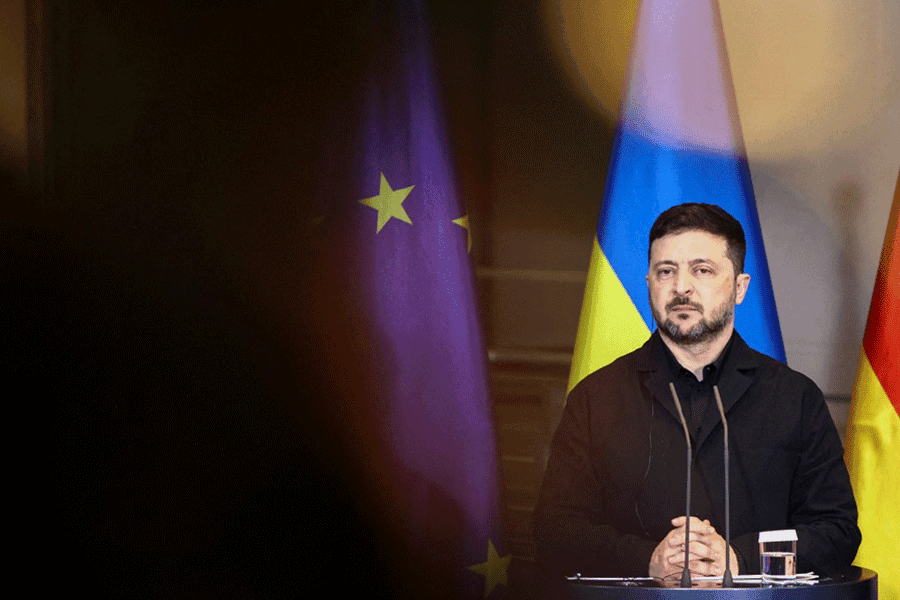
Ukrainian President Volodymyr Zelensky has been holding talks in Berlin with US envoy Steve Witkoff and President Donald Trump's son-in-law Jared Kushner as well as European leaders.
Kyiv is under heavy pressure from Trump to make concessions to Russia to end Europe's deadliest conflict since World War Two, which began with Moscow's 2022 invasion. Ukrainian officials have maintained an upbeat tone in public comments.
"Over the past two days, Ukrainian-US negotiations have been constructive and productive, with real progress achieved," Rustem Umerov, secretary of the National Security and Defence Council, wrote on X after Monday's talks.
"The American team led by Steve Witkoff and Jared Kushner are working extremely constructively to help Ukraine find a way to a peace agreement that lasts."
A US official told reporters later on Monday that, under the deal being discussed in Berlin, Ukraine would receive security guarantees similar to those provided in Article 5 of the NATO treaty, which requires the alliance to come to the defence of any member that comes under attack.
Those guarantees would not be on the table forever, however, US officials cautioned.
One said Russia was open to Ukraine joining the European Union and that Trump wanted to prevent Russia from encroaching further westwards.
TERRITORY, NATO MEMBERSHIP AMONG TOP ISSUES IN TALKS
Ukraine said on Sunday it was willing to drop its ambition to join NATO in exchange for Western security guarantees. But it was not immediately clear how far talks had progressed on that or other vital issues such as the future of Ukrainian territory, and how much the talks in Berlin could persuade Russia to agree to a ceasefire.
Zelensky said in a post on X after Monday's talks that "there is a great deal of work under way on the diplomatic track right now" but did not divulge details.
In Moscow, Kremlin spokesman Dmitry Peskov told reporters that Russia's demand that Ukraine not join NATO was a fundamental question in talks on a possible peace settlement. He said Russia expected an update from the US after the negotiations in Berlin.
Russia claims to have annexed Ukraine's eastern Donbas region comprising Donetsk and Luhansk as well as three other regions including Crimea, something Kyiv and its European allies say is unacceptable. Russian forces do not fully control all the territory that Moscow claims, including about 20 percent of Donetsk.
Zelensky is treading a difficult line between appearing flexible and reasonable to the Trump administration while also not making concessions that the Ukrainian people would reject.
Underscoring the challenge he faces, a poll published on Monday showed three-quarters of Ukrainians reject major concessions in any peace deal.
The poll, by the Kyiv International Institute of Sociology, found that 72 percent of Ukrainians were prepared for a deal that froze the current front line and contained some compromises.
However, 75 percent believed a Russia-friendly plan that included Ukraine ceding more territory or capping the size of its army without receiving clear security guarantees was "completely unacceptable".
"If security guarantees are not unambiguous and binding... Ukrainians will not trust them, and this will affect the general readiness to approve the corresponding peace plan," wrote KIIS executive director Anton Hrushetskyi.
EUROPEAN DIPLOMACY FACES CRUCIAL WEEK
Monday's talks come at the start of a pivotal week for Europe, with an EU summit on Thursday set to decide whether it can underwrite a massive loan to Ukraine with frozen Russian central bank assets.
Europe has come under fire from Washington over its policies on migration, security and regulating big tech. The European Union and national governments have struggled to find a unified response to the US criticism.
EU foreign ministers met in Brussels on Monday to agree new sanctions targeting the Russian shadow fleet of oil tankers.