



Every Eid afternoon tells the same story in households across Dhaka. Several cousins gather in the drawing room, phones in hand, scrolling through feeds whilst sitting shoulder to shoulder. Someone suggests Uno, a card game. A few agree half-heartedly, but within twenty minutes, everyone's back on their screens. The carrom board sits untouched in a different room and they just visit another cafe to take new pictures.
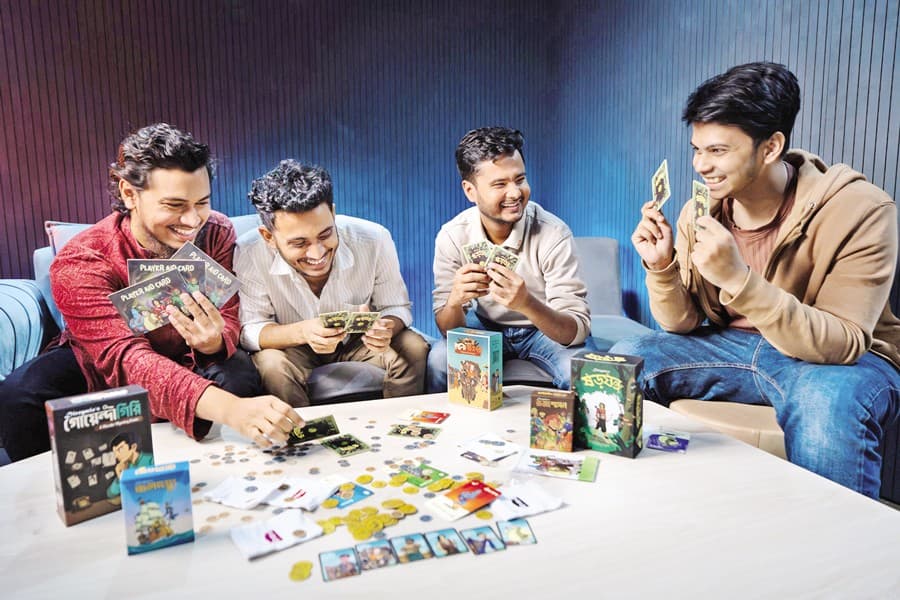
But in living rooms, cafés, and university common rooms across Bangladesh, something is quietly shifting. Groups now deliberately meet at cafés in Dhanmondi or Banani not for coffee but for game nights. Friends gather at someone's flat on Friday evenings with a specific game in mind. University students block out common room tables for hours-long sessions. A new generation is discovering that entertainment doesn't have to mean endless scrolling or imported Western games that don't quite fit local sensibilities. They're finding it in games with strategy, deduction, and stories that feel authentically Bangladeshi.
This cultural moment has given rise to youth ventures like Diceymio, a homegrown board game company that's building Bangladesh's one of its first modern tabletop gaming ecosystem. Founded by a Saim Nafi, a student of BUET and Samin Rayed, a student of IUT, who experienced this same festival-gathering disconnect firsthand, the venture represents an ambitious bet that Bangladeshis are hungry for sophisticated, locally-rooted entertainment.
"At every festival when our cousins gathered, we were physically together but never truly engaged. We'd chat a bit, then everyone drifted back to their phones," Saim Nafi, CEO of Diceymio explains. "We tried classic games like Ludo or Uno, they never created the excitement or connection we wanted."
Their frustration mirrored a broader market gap. Whilst the global board game industry offers richly designed experiences, from social deduction mysteries to intricate strategy battles, these remain largely out of reach for Bangladeshi consumers. High import costs, limited availability, and the absence of localised language and themes create serious barriers. Meanwhile, the domestic market has stagnated around the same classics that have dominated for decades.
A market beyond Ludo and Carrom: The numbers tell a compelling story. The global board game market, valued at roughly US$ 18 to 20 billion in 2024, is projected to surge beyond US$ 40 to 50 billion by 2033. Asia is driving much of this growth, yet Bangladesh remains noticeably underdeveloped in the modern gaming segment. For context, a quality imported strategy game can cost upwards of Tk 3,000 to 8,000 here, putting it out of reach for most families, whilst retail shelves remain dominated by the same handful of titles year after year.
Locally, the market centres on perennial favourites like Ludo, UNO, Chess, and Carrom, which see predictable spikes during major festivals and holidays. But the modern social board game segment, with story-driven, bluffing, deduction, and deep strategy experiences, is virtually non-existent.
"We saw the huge potential of board games to bring people together, especially in Bangladesh where face-to-face entertainment is still limited," Samin Rayed, CFO of Diceymio notes. Their solution was to create games that "feel local in language and culture whilst meeting global standards in design, mechanics, and replayability."
Building a local gaming culture: Diceymio's catalogue reflects this philosophy. Shorojontro (Conspiracy) offers a cerebral strategy battle where players must outsmart opponents through intelligence and precise planning. Goyendagiri pits players as detectives solving crimes using logic, clues, and alibis. Kalobazar (Black Market) brings high-pressure bluffing and negotiation to hidden deals and sudden chaos. Additional titles like Rajjoshashon (Rule the Realm) and Joloddshu (Pirates' Plunder) expand the strategic depth and thematic variety.
The company has deliberately positioned itself to serve diverse needs. Their games accommodate larger groups, crucial for Bangladeshi social gatherings, and offer varying durations from quick 10-minute café sessions to immersive 2.5-hour experiences for weekend evenings. Age ranges span from simple family-friendly options to complex challenges for hardcore strategists.
Perhaps most innovatively, Diceymio has created interconnected characters and narratives that appear across multiple games, fostering emotional attachment and encouraging players to explore the full catalogue. It's a technique borrowed from successful global franchises but executed with distinctly Bangladeshi sensibilities.
The team of 11 hasn't limited their ambitions to product development. They've actively cultivated community through game nights, tournaments, and events, including a notable live Squid Game programme at Notre Dame College.
Tanisha Rahman, a final-year student at Dhaka University, has watched her friend circle transform. "Last winter break, we played Shorojontro at my flat and everyone got so into it that we forgot to check our phones for three hours," she says. "Now my friends actually ask what games we're playing before deciding whether to come over. That never happened with Ludo."
"Since launching Diceymio, our own gatherings have transformed," the founders reflect. "Festivals and special occasions are now filled with laughter, competition, and real connection."
Economic opportunity and global potential: The venture addresses a straightforward value proposition: making sophisticated games more affordable than imports whilst maintaining quality components and gameplay. For a generation of Bangladeshi consumers who want depth beyond traditional options but can't justify premium import prices, it's an appealing middle ground.
Early signals suggest the model is working. Diceymio reports building a dedicated player base and notes that office cultures are improving, cafés and universities are creating livelier social spaces, and families are reconnecting. Perhaps most tellingly, they're receiving interest from abroad, suggesting their products could succeed in international markets.
This global potential isn't accidental. By aligning with worldwide trends towards well-designed tabletop experiences whilst maintaining cultural authenticity, Diceymio has positioned itself to capture both domestic growth and export opportunities. As Asian markets continue expanding faster than Western counterparts, locally-rooted publishers with quality products may find themselves uniquely advantaged.
The broader picture: Diceymio's emergence reflects broader shifts in how Bangladesh's youths consume entertainment. As digital fatigue sets in, there is a growing appetite for tangible, face-to-face experiences. Board games offer something increasingly rare: genuine presence, tactical thinking, and organic conversation.
The question now is whether this represents a genuine cultural shift or merely a niche enthusiasm. Can modern board gaming move beyond early adopters to achieve mainstream penetration? Can one company's success inspire broader industry development?
The answer may depend on whether Diceymio and potential competitors can sustain quality, continue innovating, and build distribution infrastructure that makes these products as accessible as the Ludo and Uno set found in every department store. But for now, in living rooms across Bangladesh, young people are discovering that the most engaging screen might be a game board spread across a table, surrounded by friends who are actually paying attention to each other.
The writer is studying at North South University, Dhaka.
tasnimazer02@gmail.com