


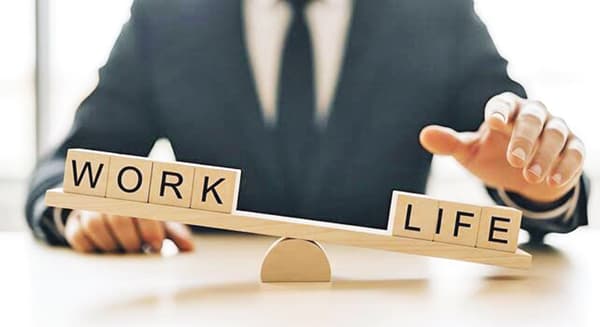
In Bangladesh, in many households, work doesn't end when the work hours are over. The phone rings continuously, messages need to be answered and exhaustion turns into a daily routine. For the vast majority of professionals, this has become normal and hardly anyone questions it. Yet globally, the conversation around work-life balance is growing louder, urging societies to rethink how work and personal life should coexist.


As many countries of the world are adapting to new theories and practices to improve productivity, increase standard of living, create happiness, and deal with mental health, etc., Bangladesh is also trying to do the same. If any organisation wants its employees to be effective and bring out the best output, then they should try to change the typical work-life culture and move on to best practices.
A balanced work schedule doesn't mean you have to divide one's work equally between office and home. Rather, it refers to a sustainable rhythm where professional responsibilities do not come at the cost of physical health, mental wellbeing or personal relationships. It should allow one professional to work productively whilst still being present for their loved ones. In many developed work cultures, professional-personal balance is institutionalised day by day. Fixed working hours, paid parental leave, mental health support and respect for personal time are not seen as privileges but as rights. Employers realise that rest increases productivity, and employees are encouraged to set boundaries without fear of being labelled uncommitted.
The situation in Bangladesh tells a different story though. Long working hours are often seen as a sign of dedication and leaving on time can be misinterpreted as a lack of seriousness. In many sectors, especially private and informal ones, the expectation to remain available beyond office hours is implicit. Economic pressure, job insecurity, and high competition further discourage workers from prioritising balance, even at the cost of personal wellbeing. This imbalance is not only an organisational issue but also rooted in social and cultural realities. For many families, stable income takes precedence over personal comfort, making overwork a necessary compromise. Women suffer more as they face a double burden, balancing professional responsibilities with domestic labour. In this regard, Afra Nawmi, a private service-holder, shared her bitter-sweet experience working in the development field. "I have switched to four organisations, but unfortunately all national NGOs have the same environment. It seems like they have created a syndicate of not letting their staff have their personal life. We are paying you, so you must work 24/7. There must be some strict regulations and monitoring now."
Sumaiya Tasnim, who previously worked at a non-profit organisation, said something graver. "When many of the staff left the organisation, I was burdened with their works. Being a married woman, I had to face gender-biased criticism that I leave early, whereas I used to leave just on time. It was difficult surviving in an organisation who claimed to uphold women's rights but failed to practise it. So, I had to leave it without even securing another job." Adnan Mohammad, working in the corporate sector, shared, "Whilst applying for a leave I was asked the reason. I had clearly mentioned - casual leave. Also, questioning such invades personal privacy. I found this very inappropriate and complained anonymously at my organisation. Though I see no change. Ha-ha." The consequences of this reality are visible. Burnout, chronic stress, declining job satisfaction, and strained family relationships are becoming a common thing, but the irony is that excessive work often leads to reduced productivity, creating a cycle where longer hours produce diminishing returns.
Mr Bashir currently serves as the head of HR at a multinational company. "As an organisation operating in a competitive and resource-constrained environment, our policies are designed primarily to protect institutional sustainability, meet deadlines, and ensure stakeholder commitments. At times, this requires flexibility and extended availability from employees to maintain performance and service continuity. We understand that it often costs more from the staff end. Trust me, our intention is not to disregard work-life balance, but to prioritise stability and collective success in a challenging economic context." But the picture is not entirely bleak. Positive changes are slowly emerging. Young professionals are more vocal about mental health and personal boundaries. The post-pandemic rise of remote work has challenged traditional notions of productivity. Start-ups and some forward-thinking organisations are experimenting with flexible schedules and employee-centred policies.
Public discourse around wellbeing —once rare, is now gaining space. Mazed Nasim, who is currently working in a financial institution, said, "My working hours are from 10 to 6, similar to most office-goers. Even though the job can be demanding, the atmosphere in our department is quite pleasant. During breaks, casual conversations about local and international issues, along with some light jokes, help us unwind and reduce stress. Here, everyone values work-life balance. We make a conscious effort to complete our tasks on time and leave the office within working hours." Mashfiq Ahsan, working at a development bank, shared: "Maintaining a balanced workload and planning tasks a week ahead helped him achieve harmony between professional and personal life. I had the autonomy to make micro-decisions, especially in communication, and felt supported by the organisation in my overall growth." Healthy work culture in Bangladesh may not yet reflect global ideals, but it is no longer an invisible issue. Meaningful change does not require immediate perfection; it requires gradual mindset shifts from equating overwork with loyalty to valuing sustainable productivity.
As awareness grows, so does the possibility of a work culture where success is measured not only by output, but by the quality of life it allows.
sajidahmed734@gmail.com