


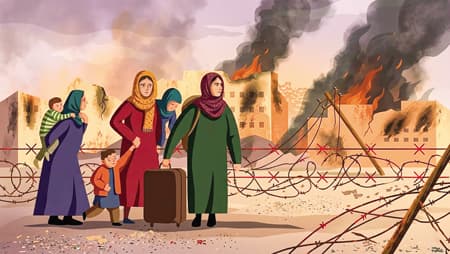
Traditionally, war has been quantified in terms of obvious destruction: loss of territories, cities reduced to rubble, and soldiers killed in combat. Governments count victories and defeats through statistics and shifting borders. However, the underlying effects of contemporary war are most frequently immeasurable. Twenty-first-century conflicts are not merely military actions. They are psychological, economic, and generational occurrences with a far-reaching impact that extends well beyond the battlefield to the aspirations, worries, and opportunities of millions of young people worldwide, including those who are nowhere near the front lines.


Young people today are the most globally connected generation in human history. A missile strike in Israel, a drone attack in the Middle East, or rising tensions in the Red Sea are placed almost immediately on smartphones through livestreams, social media posts, and constant news briefings. Psychologists have come to term this vicarious trauma: the condition in which exposure to violence through the media causes individuals to develop anxiety and psychological stress even when they are not directly involved in a conflict. For young people especially, the emotional weight of watching violence unfold in real time, helplessly, on a screen, is a burden that previous generations simply did not carry in the same way. War in a digitally connected environment is no longer confined to a physical arena. It spreads through screens and networks, shaping the perceptions, emotions, and mental health of young people across different continents.
The scale of this exposure is significant. According to estimates from international humanitarian organisations, approximately 142 million children today reside in active conflict zones, and millions more require mental health support due to violence, displacement, and instability. Even those far removed from direct conflicts are not emotionally insulated. Young people increasingly report feelings of anxiety, helplessness, and what some researchers describe as a pervasive sense of global fragility.
Contemporary wars rarely remain on the battlefield. They generate economic shockwaves that ripple across global markets and supply chains. Bangladesh is particularly vulnerable to such disruptions as a trade-dependent economy closely
integrated with international markets. The Russia-Ukraine war serves as a clear example. When the conflict disrupted agricultural production and trade routes, international prices of wheat, fuel, and fertilisers rose sharply. Bangladesh, which imports significant quantities of wheat and fuel, witnessed increased food prices and inflation, placing an additional burden on ordinary households.
For young people in Bangladesh, these macroeconomic shifts translate into everyday realities. Rising costs of living mean that families are forced to spend more on basic commodities such as food, transport, and energy. This, in turn, reduces resources available for education and career development. Students find it harder to afford tuition fees or to pursue higher education abroad. Graduates entering the job market during periods of economic uncertainty face reduced employment prospects as companies adopt more cautious investment strategies.
The ready-made garment industry illustrates directly how global instability affects the employment opportunities of young Bangladeshis. The sector contributes approximately 80 per cent of the country's export revenue and employs millions of people. Its success depends on consistent demand from global markets. When consumer spending in Western countries declines due to conflicts or economic slowdowns, clothing orders fall. Factories respond by slowing production, delaying expansion plans, and deferring new hires. For young people entering the workforce, this can mean a scarcity of internships and entry-level positions at precisely the moment they need them most.
International tensions also interfere with global shipping routes. Heightened instability surrounding the Red Sea and surrounding maritime areas has pushed freight costs upward and caused significant delays across international supply chains. Bangladesh relies heavily on maritime transport to import raw materials and export finished garments. These disruptions can affect factory output and employment security, with young workers and new entrants to the labour market often bearing the greatest risk.
Migration represents another significant link between international conflict and the lives of young Bangladeshis. Millions of Bangladeshis work abroad, and the remittances they send home constitute a substantial share of national income. For many families, overseas employment represents a pathway to economic stability.
However, geopolitical instability and economic recessions in destination countries can reduce demand for foreign labour, narrowing this avenue for young people considering working abroad.
Education is also affected, sometimes in less visible ways. For Bangladeshi students who aspire to pursue higher education internationally, global instability can mean delayed visas, increased costs, and limited funding opportunities.
The contemporary world is not a collection of separate national economies; it is an interconnected network. A conflict in Eastern Europe affects grain prices in South Asia. Instability in the Middle East has consequences for fuel costs and shipping lanes in the Indian Ocean. These global processes inevitably shape the domestic economic conditions of countries that are deeply integrated into international trade and labour networks.
Recognising this interconnectedness is the first step towards meaningful preparation. Young people need to understand the world not merely through the lens of local circumstances but as participants in a global system that is, at present, under considerable strain. This demands not only awareness but active and deliberate preparation.
Financial literacy is one of the most practical forms of resilience young people can cultivate. Understanding how inflation, currency fluctuations, and trade disruptions affect everyday life equips individuals to make more informed decisions about savings, education, and career planning. Alongside this, digital media literacy is increasingly essential. Young people who can critically evaluate the information they consume, distinguish credible reporting from misinformation, and resist the emotional manipulation of propaganda are far better placed to maintain sound judgement in turbulent times.
Vocational and academic flexibility also matter greatly.
Wars eventually end. Ceasefires are declared, reconstruction begins, and the physical destruction of conflict is slowly repaired. However, the less visible effects of war are sometimes long-lasting, persisting well after the fighting has ceased. The enduring consequences of contemporary conflict may not always manifest in fallen cities or redrawn borders. They emerge instead in disrupted economic circumstances, psychological burdens, and diminished prospects. In that sense, the generation that must navigate and absorb the aftermath of today's wars faces perhaps the most consequential battlefield of all.
imifan563@gmail.com