

Published :
Updated :
 For all latest news, follow The Financial Express Google News channel.
Bangladesh's blue-economy-sector financing continues to crumble, reflecting an inconsistent flow of credit and a lack of bankable projects in the country's vast marine and coastal areas.
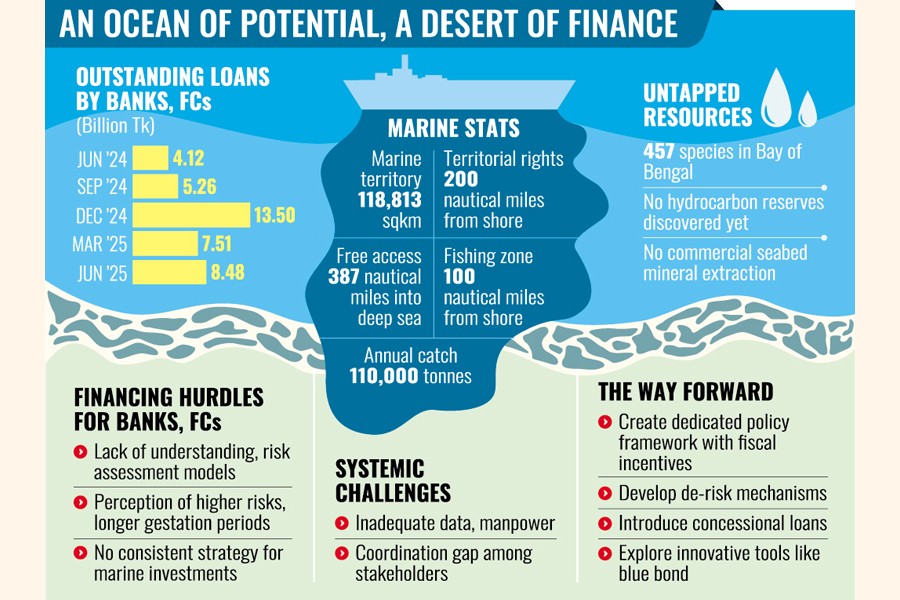
According to the latest data from the Bangladesh Bank, the total outstanding loans in the blue-economy-financing category under green finance stood at Tk 8.48 billion till June 2025, up from Tk 7.51 billion in March.
The figure was well below the Tk 13.50 billion recorded in December 2024, suggesting a notable contraction in the first half of this year.
The lending trend shows considerable volatility over the past year - outstanding financing was Tk 4.12 billion in June 2024 and rose sharply to Tk 13.50 billion by December, before slipping again in early 2025.
Sector analysts say the fluctuations indicate that banks have yet to adopt a consistent strategy for marine-based investments, despite the government's push to tap into the country's ocean resources.
After settling maritime boundaries, Bangladesh is unlocking immense potential in its 118,813 sq km of sea area.
The blue economy strategy focuses on sustainable resource harnessing across sectors like energy, fisheries, and marine transport.
Financing needs are significant, with efforts underway to explore innovative mechanisms like blue bonds to fund this major economic transition.
Insiders say despite having a vast ocean territory, most of Bangladesh's marine resources remain untapped due to inadequate data and manpower, lack of coordination among stakeholders, and low levels of investment.
The country is currently engaged in fishing with conventional trawlers only in shallow offshore areas, with annual output amounting to around 110,000 tonnes of sea fish.
It is yet to discover any hydrocarbon reserves in offshore areas, although neighbouring India and Myanmar have long been producing natural gas from their offshore blocks.
The commercial extraction of valuable seabed minerals also remains a distant goal.
Bangladesh has territorial rights up to 200 nautical miles from the shore as an exclusive economic zone in the Bay of Bengal.
In addition, it has free access to around 387 nautical miles into the deep sea, following the demarcation of the maritime boundary by the International Court of Arbitration.
However, Bangladeshi trawlers currently fish only up to 100 nautical miles from the shore, leaving vast marine areas unexploited.
According to a recent Department of Fisheries and Livestock report, 24 survey cruises have identified 457 species in the Bay of Bengal, including 373 species of fish, 21 species of sharks and rays, 24 species of shrimps, 21 species of crabs, three species of lobsters, one species of mantis, four species of octopus, five species of squids, and five species of cuttlefish.
Bangladesh Bank officials, speaking on condition of anonymity, have told The Financial Express that major investors have yet to show interest in the blue economy, resulting in limited financing despite the sector's vast potential.
They also note that no proposals related to blue economy projects have been submitted under a central bank's major refinance scheme so far.
Besides, they describe the current level of outstanding financing as insignificant compared to the enormous potential of the sector.
Dr Masrur Reaz, chairman of Policy Exchange Bangladesh, observes that blue economy financing in Bangladesh is still in its formative stage, primarily due to the limited understanding of the sector among financial institutions.
"Blue economy financing is still at a nascent stage. Banks are cautious because they lack adequate knowledge and risk assessment models for marine sectors, such as fisheries, shipping, and coastal tourism," he says.
He notes that while the government has identified the blue economy as a key driver of future growth, the financial ecosystem remains underprepared to support it.
"Unless there is a dedicated policy framework with fiscal incentives and capacity development, the growth will remain uneven."
He emphasises the need for the Bangladesh Bank and the finance ministry to work closely with sectoral ministries like fisheries, shipping, and energy to develop a structured roadmap for blue financing.
"Building technical capacity within banks and creating de-risking mechanisms, such as credit guarantees or blended finance tools, will be crucial to attract private investment in this frontier area," Dr Reaz says.
Industry insiders point out that banks often prioritise green or renewable energy projects over blue economy ventures, as the latter typically involve longer gestation periods and higher perceived risks.
"The pipeline of viable blue projects is still thin," says a senior official of a leading private commercial bank.
"Without technical support and concessional credit lines, lenders find it difficult to finance activities in the blue economy."
Experts stress the need for capacity building among financial institutions and better coordination between the finance and fisheries ministries to mainstream blue financing.
Khondkar Morshed Millat, a faculty member at the Bangladesh Institute of Bank Management (BIBM) and a former director of the Sustainable Finance Department at the Bangladesh Bank, says blue economy financing should encompass a broad range of marine-linked sectors, such as shipbuilding, marine fisheries, and coastal development, while also supporting sustainable management of marine resources.
"Blue financing should cover shipyards, marine fishing, and seashore-based enterprises, and contribute to maintaining ecological balance in the sea," he says.
He observes that Bangladesh is yet to fully explore and utilise the potential of blue financing.
"There is also significant scope for introducing blue bonds, but a structured framework is still missing as the Bangladesh Securities and Exchange Commission (BSEC) has yet to take a leading role in this regard," he adds.
Millat, also a sustainable finance and sustainability specialist, says, "Leading passionate banks and finance companies (FCs) in their sustainable finance strategy and sustainability plan till 2050 should include blue financing products/projects/initiatives.
"They should be in a comfort zone to contribute as expected from them, with support from the central bank."
In this context, the Association of Bankers, Bangladesh (ABB), on behalf of the banking community, should approach the Bangladesh Bank with the rationale to open the door of its low-cost funding for getting the banks and finance companies to better contribute to the blue economy, he adds.
Mosleh Uddin Ahmed, managing director of Shahjalal Islami Bank, says a dedicated policy framework led by the Ministry of Finance is essential to advance blue economy financing in Bangladesh.
He notes that his bank has so far financed only 15 fishing trawlers, a figure he describes as "insignificant", given the sector's vast potential.
"There is still a gap in understanding and a lack of awareness about blue financing among both lenders and entrepreneurs," he says.
A concessional loan facility could help accelerate the growth of blue economy financing, he adds.
sajibur@gmail.com