

Published :
Updated :
 For all latest news, follow The Financial Express Google News channel.
Improved Chinese technologies coupled with recent energy supply disruption have given an impetus to Bangladesh's electric bike sector, with manufacturers offering durable batteries at competitive prices.
The sector insiders say the electric two-wheeler is undergoing rapid expansion, driven by affordability, convenience, and shifting consumer sentiment amid volatility in global energy markets.
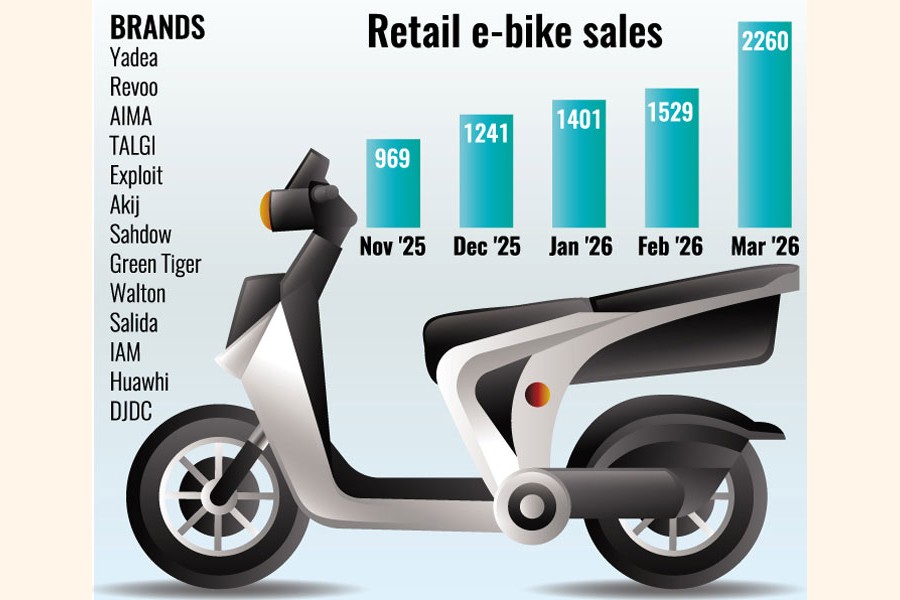
The sector is currently dominated by Chinese brands such as Yadea and Revoo, while domestic companies including Walton, Akij Group, Green Tiger, and RFL Group's RYDO are stepping up efforts to capture the market share and establish their own niches.
So far, around thirty importers have entered the market with approximately 30,000 units through both CBU (Completely Built Unit) and CKD (Completely Knocked Down) channels.
With improved battery technologies, now EV bikes can offer 200 KM range based on the battery capacity.
Imports from China alone are estimated at around Tk 3.0 billion annually, underscoring Beijing's growing footprint in Bangladesh's emerging electric mobility ecosystem.
However, there is currently no full-scale local manufacturing, as there is no dedicated manufacturing policy in place.
Industry stakeholders say absence of a clear policy framework continues to discourage deeper domestic value addition and long-term investment in this sector.
Once the niche market was moving only with 700 units monthly, now the sales of e-bikes have reached 2260 units in March 2026, according to available data.
Driven by prolonged fuel supply disruptions, long queues at petrol pumps, and imposition of a 2.0-liter rationing limit following Middle East conflicts, consumers are now switching over from traditional combustion engines to such electric bikes.
Mohammad Abu Hanif, Chief Business Officer of Runner Automobiles PLC, said the company recorded an 80 per cent growth in electric motorcycle sales in March alone.
He said last year Runner Automobiles PLC marked a significant shift toward sustainable mobility by officially introducing a range of electric scooters from Yadea, the world's top-selling Chinese EV brand.
"We are witnessing strong growth in the electric segment," he told The Financial Express, adding that many consumers are becoming increasingly frustrated with long queues at petrol pumps and uncertainty surrounding fuel supply.
According to him, ongoing geopolitical tensions and the volatile global energy markets have reshaped consumer behaviour.
"Buyers are now more conscious about fuel dependency. Electric bikes are being viewed as a reliable and practical alternative," he said.
He added that if the global conflict prolongs and fuel market volatility continues, demand for electric motorcycles could see a sustained growth.
However, he cautioned that supply chain costs and import-related expenses would remain key determinants of price stability in the sector.
Echoing similar views, Mahmudur Rahman, Chief Operating Officer (Electric Mobility) at RFL Group, said the company has experienced a significant spike in demand in recent months.
"In some cases, we have seen 200 to 300 per cent of sales growth," he said, attributing such a surge primarily to cost considerations.
He also explained that the annual operating cost of a traditional petrol-powered motorcycle can reach around Tk 50,000, while an electric bike typically costs about Tk 4,000 a year in electricity expenses.
"The cost difference is substantial. Consumers are calculating their long-term savings and making their decisions accordingly," he said.
Following the growing demand for e-bike, the company is considering expanding production capacity. Currently, RFL Group has the capacity to manufacture around 5,000 units per month.
Policy analysts see the trend as a broader shift in urban mobility patterns.
Dr Masrur Reaz, Chairman of Policy Exchange Bangladesh (PEB), said the recent rise in the demand for electric bikes reflects a rational economic response to price volatility and structural vulnerabilities in fuel imports.
"Electric two-wheelers offer lower lifecycle costs and reduce exposure to imported fuel shocks. From a macroeconomic perspective, this shift has both consumer and foreign exchange implications," he said.
While the growth momentum is encouraging, sustained expansion of the sector would require supportive policies, including charging infrastructure development, regulatory clarity, and fiscal incentives, He observed.
"Absence of coordinated policy support, prevailing supply-side constraints and infrastructure gaps could slow down the sector's future growth, despite having strong demand for e-bike," he added.
Stakeholders, however, point out that challenges still remain. Import duties, currency fluctuations, battery technology costs, and limited charging infrastructure continue to affect competitiveness.
Despite these constraints, market players believe that as urban consumers prioritise cost efficiency, convenience, and energy security, the electric two-wheeler segment is likely to maintain its upward trajectory.
Shanat Datta, Chief Financial Officer of Runner Automobiles PLC, said the company entered the electric motorcycle business around two years ago and has already seen encouraging market response.
"We entered the electric motorcycle industry about two years ago, and the market is currently dominated by five major brands," he said.
He further said: "Several importers are active in this sector due to the absence of a government policy on electric motorcycles.
sajibur@gmail.com