


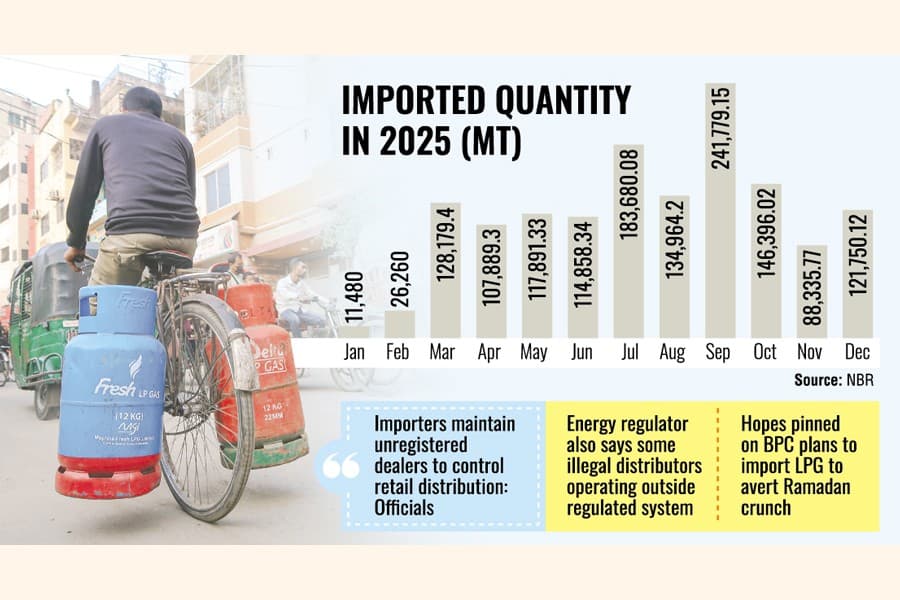
Despite import of liquefied petroleum gas (LPG) more than the consumption requirement for the July-December period of 2025, consumers are experiencing a severe supply crunch of the fuel, raising questions about market transparency and regulatory oversight.


However, the monthly imports have been highly uneven, which could also be one of the reasons for the ongoing crisis.
During the period under review, LPG imports reached an average of 152,818 MT per month, with September recording the highest inflow and November the lowest. Despite import of LPG in sufficient volume, consumers across the country have been facing an "artificial" shortage, with retail prices spiraling out of control.
Data from the National Board of Revenue (NBR) shows that total imports for the 2025 calendar year stood at over 1.42 million MT, averaging about 118,622 MT per month.
A major concern highlighted by market insiders is the narrowing of the import base. Although 58 companies have received licenses to operate, only seven to eight companies are currently active in importing the fuel, creating a monopolised business environment.
NBR data showed that in December 2025, only seven companies were responsible for importing 121,750.12 MT of LPG. The December import was a low in November, where eight companies imported a mere 88,335.77 MT.
While December saw a significant month-on-month jump in volume, the concentration of market power in the hands of a few has left the supply chain vulnerable to manipulation.
Despite the monthly average import of 152,818 MT during the last half of the year -- which exceeds the country's average monthly demand of 125,000 MT -- the market remains in chaos. Sector insiders and energy officials suggest the crisis is not due to a lack of product.
With only a handful of active importers, the ability to control supply and dictate retail terms has increased.
Supplies were reportedly restricted during the peak of the winter crisis to drive up prices.
In many districts, LPG cylinders were unavailable even at nearly double the government-fixed rates.
The demand for LPG in recent months has surged as natural gas supplies dwindle. Currently, the country's annual demand stands at 1.5 million tonnes. However, the infrastructure and active participation of licensed firms have not kept pace with this growth.
With demand projected to reach 2.5 million tonnes by 2030, a 60 per cent rise within the next five years, analysts warn that the current "monopolised" structure poses a threat to energy security.
Testimonies from city residents highlight the severity of the price hike.
Mahbubur Rahman of Mohammadpur reported a purchase price of Tk 2,000 last week following supply difficulties.
In the Hatirjheel area, Papri opted for an electric induction oven after retailers demanded Tk 2,500 for a standard 12-kg LPG cylinder -- nearly double the government-fixed rate.
Abul Kalam, a retail LPG distributor at Mirbagh in Dhaka's Hatirjheel area, says he has been unable to sell LPG cylinders despite receiving regular phone calls from customers as a supply crisis persists.
"The fact that only seven companies are importing while 58 hold licenses indicates a significant barrier to entry or a structural failure," a market analyst told The Financial Express. "Until more licensed players become active, the risk of artificial shortages and price hikes will persist."
Professor M Shamsul Alam, Energy Adviser of the Consumers Association of Bangladesh (CAB), alleges that a market oligopoly has emerged under the LPG Operators Association of Bangladesh (LOAB).
He attributes this to government's "failure" to enforce existing regulatory laws, noting that the market is now dominated by only five to six major operators.
Professor Alam vents deep grievance over the inflated retail prices, labelling the act of charging more than the government-fixed rate as a "criminal offence".
He has criticised regulators for their inaction, stating that a lack of penalties and enforcement has allowed the crisis to persist at the expense of frustrated consumers.
Mohammed Amirul Haque, Managing Director of Delta LPG Limited and president of the LPG Operators Association of Bangladesh (LOAB), notes that supply disruptions from the Middle East continue to impact the market.
However, he expresses optimism that the situation would stabilise before Ramadan.
Haque also highlights that the Bangladesh Petroleum Corporation (BPC) plans to import LPG, a move expected to significantly alleviate the current crisis.
The BERC Chairman Jalal Ahmed acknowledges disruptions to global LPG supply chain, particularly in the Middle East, as major buyers such as India and China have aggressively increased their purchases.
Ahmed, however, did not rule out an artificial shortage on the domestic market, alleging that some illegal distributors operating outside the regulated system could be responsible.
He added that only half of LOAB members have submitted their distributor lists despite repeated requests.
sajibur@gmail.com